Written by Outrank. Published by Mallary Labs LLC.
Published .
Understanding Sentiment Analysis for SaaS Teams
Your auto-reply just thanked a furious customer for their wonderful feedback. The comment said the app crashed during checkout again, and your bot replied with a cheerful message about how glad it was to hear they were enjoying the experience. Screenshots travel faster than apologies. That failure usually is not a copywriting problem. It's a sentiment problem, and understanding sentiment analysis starts with recognizing that a positive or negative label is a decision input, not a description of how someone feels.
Table of Contents
- What Sentiment Analysis Is and Why It Matters for Social Platforms
- Lexicon, Machine Learning, and Deep Learning Approaches
- Aspect-Based and Fine-Grained Sentiment
- Evaluation Metrics and Why Benchmarks Mislead
- Common Pitfalls, Sarcasm, Domain Shift, and Multilinguality
- Data Collection and Labeling for Production Sentiment
- Deployment and API Integration Patterns for Social Platforms
- A 30-60-90 Day Plan for Sentiment in Your SaaS Stack
What Sentiment Analysis Is and Why It Matters for Social Platforms
You're moderating comments after a pricing change. One user writes, "Love paying more for the same outage." Another writes, "New dashboard is fast, billing page is still confusing." A simple keyword counter sees "love" and "fast" and marks both as wins. Your automation then thanks the first user and ignores the billing complaint in the second.
Sentiment analysis is the computational task of classifying what's expressed in text. Most systems predict polarity (positive, negative, or neutral), whether text is subjective or factual, how intense the opinion is, and sometimes which feature or aspect the opinion targets. That's different from emotion detection, which tries to name states like anger or joy, and it's narrower than generic text classification, which might sort messages by topic regardless of opinion.
The Operational Question Comes First
Before you pick a model, define what each label triggers. Does negative mean escalate to support, suppress an auto-reply, or just log for a weekly report? Does neutral mean safe to answer with a template, or does it mean the system couldn't tell? If you can't map a class to an action, the label won't help your team, no matter how accurate it looks in a demo.
Practical rule: Design the action table before the model. Sentiment without a routing decision is decoration.
This is why task definition matters so much. The SemEval-2013 Task 2 benchmark on Twitter and SMS sentiment drew 38 teams and used F1-score, yet the best constrained system reached 88.93% F1 on subjectivity and polarity while the best message-level polarity result was only 69.02% F1. Detecting that a message contains an opinion is easier than deciding which opinion it contains. Headline numbers hide that gap.
The concept map below shows how the definition connects to brand communication and day to day platform work.
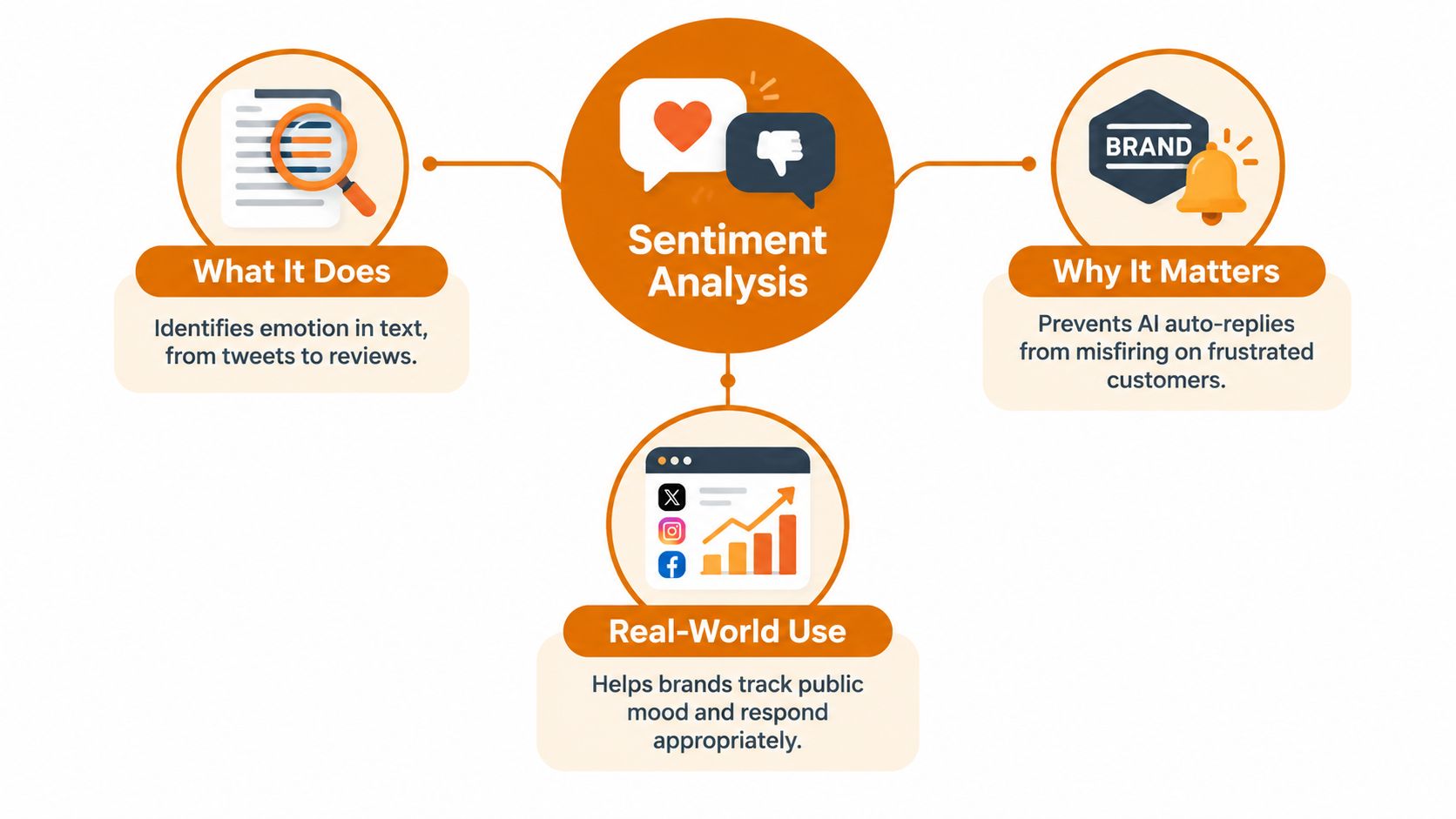
For social platforms, sentiment sits between ingestion and action. It helps you answer, escalate, queue for human review, or stay silent. Treat it as a calibrated signal with uncertainty attached, and it becomes useful. Treat it as a direct reading of customer emotion, and you'll automate confident mistakes at scale.
Lexicon, Machine Learning, and Deep Learning Approaches
Start with the oldest tool because it's still the fastest to ship. Lexicon and rule based systems keep a list of words scored for sentiment, then apply rules for context. VADER is the classic social media example. It pairs a validated lexicon with rules for capitalization, punctuation, degree modifiers, contrastive conjunctions, and negation, so "GREAT!!!" scores stronger than "great" and "not great" flips direction.
That design performed remarkably well on short text. In its evaluation, VADER reached 0.96 F1 on tweets compared with 0.84 for individual human raters, outperforming eleven benchmark approaches including LIWC, ANEW, SentiWordNet, Naive Bayes, maximum entropy, and SVM models. You can also inspect why it scored a message a certain way, which helps when a support lead asks why a comment was escalated.
Three Families, Different Trade Offs
Classical machine learning learns from labeled examples instead of a fixed word list. Teams typically turn text into TF-IDF or n-gram features and train a classifier such as Naive Bayes or an SVM. You'll get better fit to your own vocabulary than a generic lexicon provides, but you now own labeling, retraining, and drift. A model trained on product reviews often stumbles on TikTok slang.
Deep learning and transformer fine tunes read word order and surrounding context, so they handle negation and mixed phrasing better. They need more labeled data, more compute, and more careful monitoring, and their decisions are harder to explain. For teams weighing these trade offs in a regional product context, NLP insights for Australian startups offers a useful practitioner perspective on matching method to resources.
| Approach | Data Needs | Latency | Explainability | Best Fit |
|---|---|---|---|---|
| Lexicon and rules | No training labels | Very low | High, word level reasons | High volume triage |
| Classical ML | Moderate labeled sample | Low | Medium, feature weights | Stable, narrow domains |
| Transformer fine tune | Larger labeled sample | Higher | Lower, needs tooling | Ambiguous, contextual text |
Most production systems don't pick one winner. They run a two tier design, with a lexicon pass handling obvious cases quickly and a contextual model reviewing ambiguous, sarcastic, or high impact messages. That pattern respects both your latency budget and your error budget.
Aspect-Based and Fine-Grained Sentiment
"Food was excellent, service was terrible" breaks single label sentiment. So does "Love the new editor, hate the new price." If your system returns one score for the whole comment, product and support teams can't tell what to fix, what to promote, or who should reply.
The illustration below traces the move from one label for a whole document toward labels attached to specific targets.
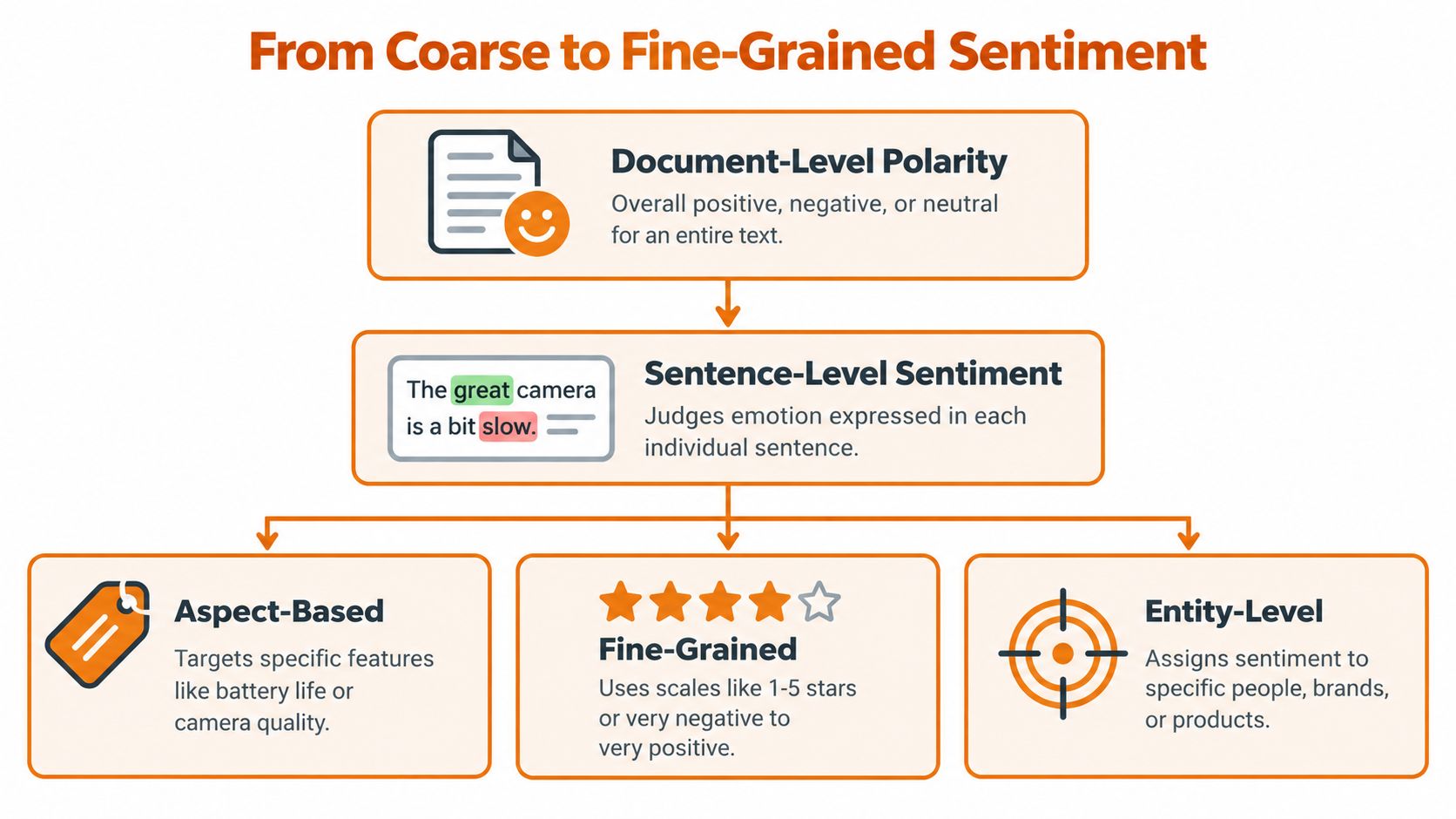
Aspect based sentiment analysis, often shortened to ABSA, extracts a structured opinion instead of a lone tag. A useful record contains the entity being discussed, the aspect of that entity, the words expressing the opinion, and the polarity toward that aspect. "Billing page is confusing" becomes entity equals your app, aspect equals billing, expression equals confusing, polarity equals negative.
Why Structure Beats a Single Score
That structure became a formal research task in SemEval-2015 Task 12 on aspect based sentiment for laptops and restaurants, where annotation produced 5,761 opinion tuples and more than 15,000 individual label assignments, with 10 teams on the laptop track and 12 teams on the restaurant track. The effort required to build that dataset tells you something important. Each extra field adds a place where the system can be wrong, from missing the aspect to attaching praise to the wrong target.
Fine grained sentiment adds intensity. Instead of three classes, you might use negative, somewhat negative, neutral, somewhat positive, and positive. That scale helps you separate mild annoyance from escalation risk, although annotators disagree more often on neighboring categories. Don't adopt five classes because they look precise. Adopt them only if your routing treats somewhat negative differently from negative.
The short walkthrough below shows how granular labels change what a team can do with the same comment.
Decide your reporting dimensions before deployment. Lock down aspects, languages, channels, and time windows early, because changing the schema later breaks trend lines. Granular sentiment is what turns a dashboard percentage into a bug report, a pricing signal, or a support queue your team can act on.
Evaluation Metrics and Why Benchmarks Mislead
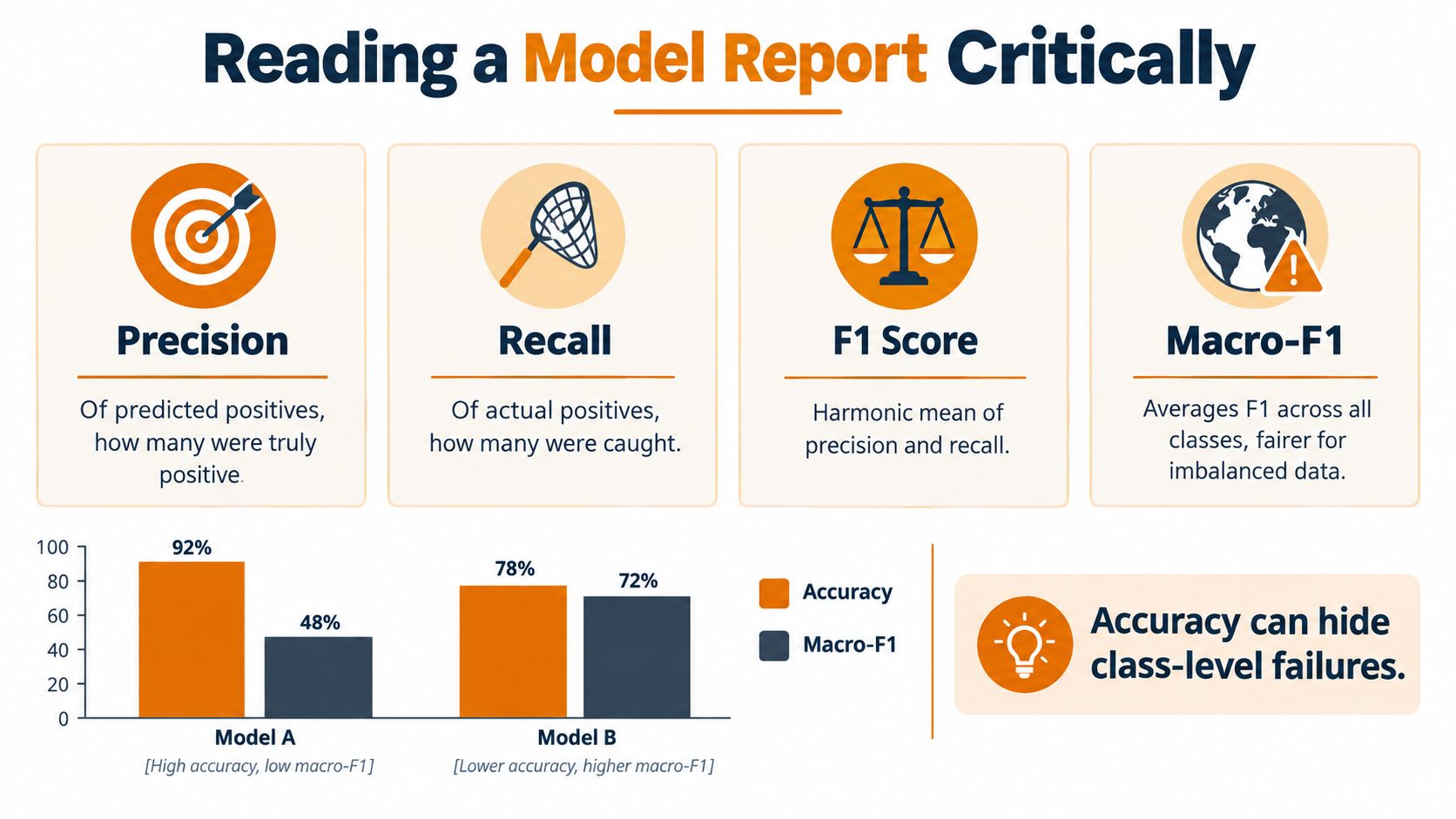
A vendor tells you their model is highly accurate. Your first question should be, accurate at what, on whose data? Accuracy counts every correct prediction equally, so a model can score well by nailing the majority class and missing most complaints. On social comments, where neutral chatter often outnumbers angry replies, that's exactly the failure you can't afford.
Read three numbers instead. Precision asks, of the messages labeled negative, how many were negative. Recall asks, of all negative messages, how many did you catch. F1-score balances the two, and macro-F1 averages F1 across classes so a rare but important class can't hide behind a common one.
The cards below give you a quick reference for reading a model report without falling for a single aggregate number.
Benchmarks Test a Different Language
The Stanford Sentiment Treebank of movie review sentences contains 11,855 sentences and roughly 215,154 labeled phrases across five ordered categories. Its phrase level labels are excellent for testing whether a model understands how "not" or "barely" changes meaning. They don't tell you how that model handles "great, another outage," "lol sure," or a reply that's only an emoji.
So evaluate on your own traffic. Use a time split sample, meaning you train on older comments and test on newer ones, because tomorrow's slang is the true test. Report results by slice, including emojis, hashtags, short replies, and code switching between languages. If you use confidence scores to route work, check calibration too, so a high confidence prediction is right more often than a low confidence one. Teams comparing reporting options, including LinkedIn analytics tools, should apply the same skepticism to any sentiment feature bundled inside.
A published benchmark score is evidence a model learned that benchmark. It is not a deployment guarantee for your comments.
When you connect sentiment to reporting through something like a social media analytics API, insist on class level metrics from production like data. The only defensible number is one computed on messages your system will see next week.
Common Pitfalls, Sarcasm, Domain Shift, and Multilinguality
Switching to a bigger model feels like the obvious fix. It isn't, at least not by itself. The hardest sentiment errors are not vocabulary problems. They're pragmatic problems, where meaning depends on intent, shared context, an attached image, or the previous message in a thread.
The scene below captures the user side of that mismatch, where a system reads the words correctly and the intent completely wrong.

Sarcasm is the clearest case. "Perfect, the export failed again" uses a positive word to deliver a complaint. A 2025 benchmark of large language models on sarcasm detection found current large language models still underperform supervised language model baselines, although GPT-4 and Gemini 2.0 performed comparatively better. Scale helps with fluency. It doesn't automatically supply the missing context that makes sarcasm readable.
When Words Are Not the Whole Message
- Emoji and hashtag reversal: A thumbs up or a laughing emoji can soften criticism or sharpen it, depending on the thread.
- Negation and contrast: "Not bad, but not worth renewing" contains praise and a churn signal in one breath.
- Images and memes: A screenshot of an error dialog can carry the sentiment while the caption stays neutral.
- Domain shift: "Sick," "dead," and "killed it" flip meaning between gaming, health, and support contexts.
Multilingual traffic adds a quieter risk. Models may assign systematically different positive sentiment scores across languages and dialects because emotion is expressed differently across cultures, a pattern described in the same 2025 review noted above. A single global percentage can therefore look stable while one market is being misread every day.
Design for uncertainty instead of forcing a label. Let the system abstain below a confidence threshold, request more thread context, or route the message to a person. A withheld auto reply costs you a few minutes. A cheerful reply to a crisis signal costs you trust you have to earn back publicly.
Data Collection and Labeling for Production Sentiment
Your model will learn your labeling habits, including the sloppy ones. That's why production sentiment starts with production like data, meaning real comments, replies, direct messages where you have permission, and reviews from the channels you'll automate. Borrowed datasets can warm up a prototype, but they can't validate a system that has to read your users.
Sample with intent. Pull recent traffic across channels, languages, and post types, and keep newer messages aside for validation so you're testing on language the model hasn't memorized. Oversample rare but costly cases, such as complaints, safety signals, and short ambiguous replies, because random sampling buries them under routine praise and questions.
A Labeling Checklist That Survives Contact With Reality
- Define the schema first: Capture polarity, aspect, language, channel, and annotator confidence, not just one tag.
- Use more than one annotator: Send disagreements to adjudication and write down the ruling so future labels stay consistent.
- Keep the hard cases: Sarcasm, code switching, and emoji only replies belong in training data, labeled as ambiguous when that's the honest answer.
- Log corrections: Every time a moderator overrides a prediction, store the original score beside the corrected label.
If you're deciding what kinds of human judgments to collect, you can browse human feedback data types to compare annotation formats before committing your team to a schema. That choice matters because relabeling a large set later is slow and expensive.
Watch for imbalance in who gets represented. If your labeled set skews toward one dialect, one platform, or calm weekday traffic, performance will drop for everyone else. Feeding this stream from a social media listening API helps you keep collection continuous rather than treating it as a one time project. Refresh the set on a schedule, retire stale examples, and treat corrected predictions as your most valuable new labels.
Deployment and API Integration Patterns for Social Platforms
Follow one comment through a working system. Collect comments through an API that supports your account and platform. Use comment webhooks where available. For YouTube, poll the commentThreads.list and comments.list endpoints. Its push notifications cover video uploads and video title or description changes. Your service stores the raw text, language, platform, and thread context, then runs a pre flight sentiment check before anything else is allowed to act on that message.
The fast pass comes first. A lexicon or lightweight model handles clear cut praise and obvious complaints with low latency. Anything ambiguous, low confidence, or tied to a sensitive topic moves to a contextual model, and the riskiest slice goes to a human in the loop queue. Only after that decision does an auto reply generator draft a response, using the sentiment result as a guardrail rather than a prompt suggestion.
Plumbing Details That Prevent Public Mistakes
Make sentiment a first class field in your publish and reply payload, alongside confidence, aspect, language, and model version. If it's buried in a log line, downstream automation can't enforce rules like "never auto reply to low confidence negative comments." Use durable job queues and idempotency keys so a retried webhook doesn't escalate the same complaint twice or post duplicate replies.
Dashboards need the same discipline. Because many sentiment models remain language specific and perform inconsistently across languages and dialects, and training data bias can distort results in domains such as public health, politics, and misinformation detection, a single cross platform score can conceal underperformance for low resource languages and informal speech. Roll results up by channel, language, and aspect instead.
Routing principle: Automate the confident middle. Escalate the uncertain edge.
A unified social media comments API keeps that pattern consistent across platforms, whether requests arrive through REST, an MCP agent interface, a CLI, or a no code workflow. Keep the model behind your own interface, and you can swap vendors without rewriting every automation rule that depends on the score.
A 30-60-90 Day Plan for Sentiment in Your SaaS Stack
You don't need a research program to start. You need a sequence that matches automation risk to evidence.
Days 1 to 30, instrument one channel. Ship a lexicon baseline in shadow mode, meaning it scores comments without triggering replies. Define your label schema, build a small validation set from recent traffic, and log confidence, language, and platform on every prediction.
Days 31 to 60, add judgment. Introduce a contextual model for ambiguous cases, set confidence thresholds, and turn on abstention for anything uncertain. Route high impact negative comments to human review and start feeding moderator corrections back into your labeled set.
Days 61 to 90, widen carefully. Expand to more channels and languages, add aspect level reporting, and consider emoji, hashtag, and image context for informal posts. Promote sentiment from a reporting metric to an automation guardrail only where your sliced metrics justify it.
Watch for red flags throughout. A single cross platform score, accuracy only reporting, and the absence of a human escalation path all mean the system isn't trustworthy enough for customer facing automation yet. Shrink the automated slice until the evidence improves, rather than widening it to hit a launch date.
If you're ready to put sentiment guardrails in front of real publishing and replies, Mallary.ai gives your team one API and dashboard for posting, engagement, and analytics across major social platforms, with webhooks, durable queues, and near real time auto replies built in. Start with one channel, score comments before your automation answers them, and scale to every platform without rebuilding the integration each time.
Try it with Mallary
STOP!
Want ChatGPT or Claude to post on social media for you?
Connect your social accounts one time. Then tell your AI what to write. It can make your posts, share them, and reply on social sites that allow replies. You do not need to write code.
Pick your AI





Connect once. Ask in plain English. Mallary does the work.


