Written by Outrank. Published by Mallary Labs LLC.
Published .
Social Media Listening API: A Developer's Practical Guide
You've wired a keyword search into a prototype, watched posts arrive, and shown a convincing demo. Then the first production alert never fires. A token expired, a platform changed what the endpoint can return, or a request limit held up collection long enough to leave a gap.
That failure doesn't mean your query was wrong. It means a social media listening API is infrastructure: it has to collect, track what it could and couldn't access, and deliver results even when platforms behave differently. A useful design starts with three jobs: ingestion, normalization, and delivery.
Table of Contents
- Why Listening Is an Infrastructure Problem
- What a Social Media Listening API Actually Does
- Core Capabilities You Should Expect
- Authentication and Rate Limit Handling
- Choosing Polling, Streaming, or Webhooks
- The Coverage Contract Most Guides Ignore
- Integration Best Practices for Production
- Use Cases and How to Evaluate a Provider
Why Listening Is an Infrastructure Problem
A prototype often makes one request, receives posts, and treats the result as a dependable picture of the conversation. Production is less tidy. One platform may return recent posts through a search endpoint; another may require a different permission or limit how quickly you can ask. If a scheduled job retries too aggressively after hitting a quota, it can delay other tenants' work rather than recover cleanly.
Twitter's early API history shows why programmatic access became central to listening. Twitter launched in July 2006 and released its first public API about two months later, allowing developers to retrieve and publish posts through standardized HTTP methods. By 2010, about 75% of Twitter traffic was attributed to third-party applications, illustrating how much activity already depended on software beyond the consumer website (history of the Twitter API). Listening systems rely on the same basic idea: software can collect, route, and analyze public conversations in ways manual browsing can't.
Design for failure, not just the happy path
Access rules can change, tokens can expire, and schemas can shift. A pipeline that assumes every request succeeds will eventually confuse a collection failure with a genuine absence of mentions. That's a serious product bug. A customer may read “no posts found” as a signal about their brand when the system couldn't reach the data.
The old model of an open public feed also didn't last. Twitter's move toward authenticated access and tighter limits made developers handle OAuth, quotas, pagination, and retries instead of treating listening as a simple keyword search (account of Twitter's developer-relations history). Today, each platform still brings its own rules, so a multi-platform service needs platform-specific adapters and a stable layer above them.
Think of the system as a coverage contract. It should tell the application what it collected, where the data came from, and when access was incomplete. Ingestion fetches or receives records. Normalization gives those records a consistent shape without erasing their source-specific details. Delivery makes them useful to downstream services, dashboards, or alerts.
Practical rule: Treat “no matching posts” and “couldn't access posts” as different outcomes.
What a Social Media Listening API Actually Does
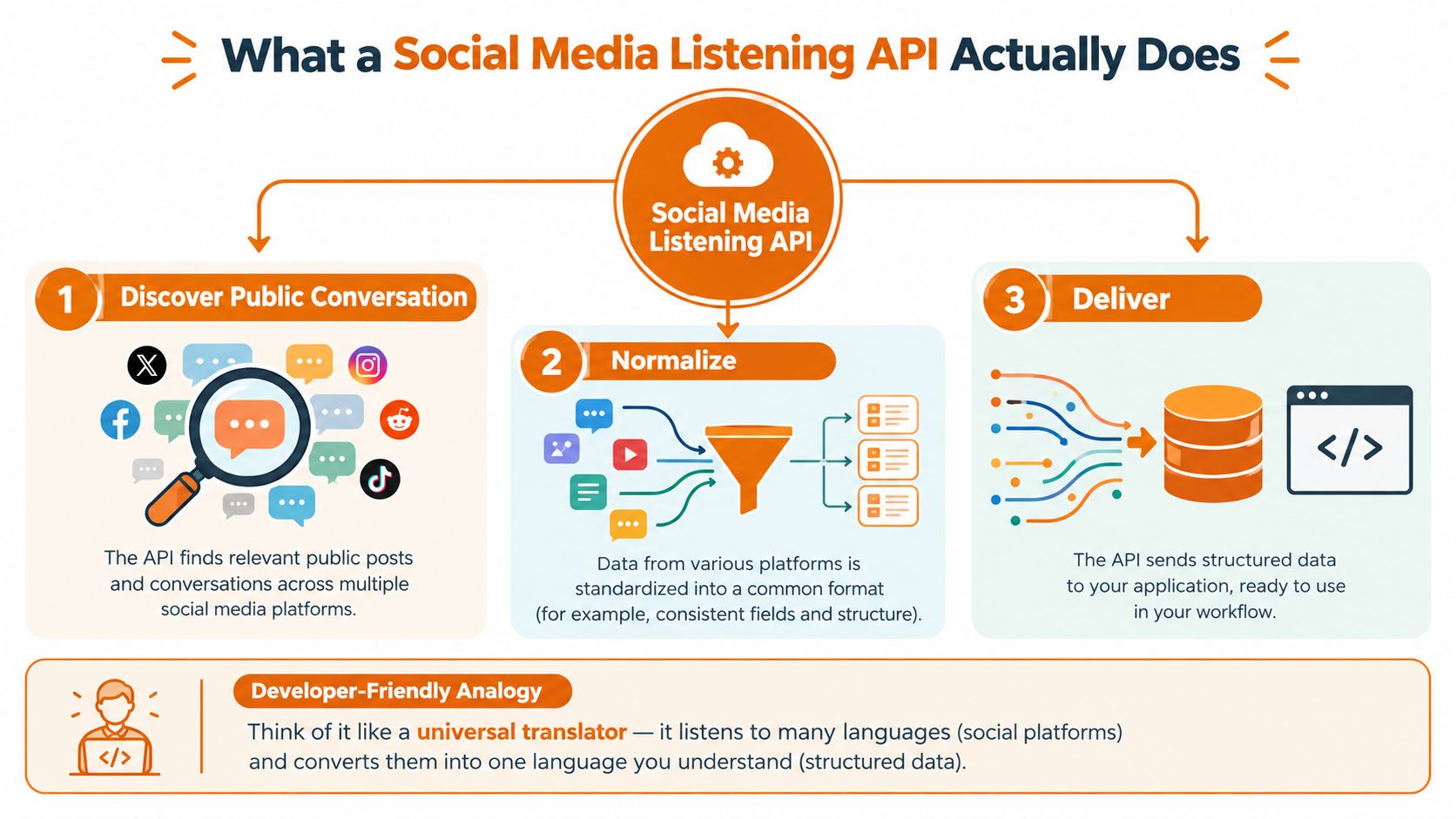
A social media listening API works a bit like a universal translator at a busy help desk. It gathers messages from different places, translates their different formats into a common language, and routes the results to the team that needs them. The analogy has a limit: the API can standardize structure, but it can't make every platform expose the same content.
Discover public conversation
The first job is discovery. Your application asks a source for posts matching a keyword, account, topic, or other supported filter. A search-style request might find recent public posts about a product launch; a streaming connection may deliver matching posts as they become available. A webhook reverses the direction: the provider sends an event to your endpoint when something relevant happens, if that platform or provider supports webhooks for the use case.
These patterns aren't interchangeable. A search request asks for available matching data at a point in time. A stream keeps a connection open for ongoing updates. A webhook delivers events to your service without requiring it to repeatedly ask whether anything new happened.
Normalize without hiding differences
The second job is normalization. One platform might call an item a post, another a comment, and another a video with a caption. Your application can represent these as common fields such as text, author, timestamp, permalink, and platform, while retaining the original platform identifiers and source metadata.
That common shape saves every downstream feature from having to understand every platform's response format. It also helps avoid a common mistake: assuming that fields with similar names mean the same thing across networks. Sentiment, reactions, and audience information may be calculated or exposed differently, so normalization should make differences visible rather than flatten them.
Deliver in a usable form
The final job is delivery. A service can write records to a queue, call an application webhook, update a dashboard, or store data for later analysis. For example, a SaaS product might route a matching complaint to a support workflow while preserving the source post's link and collection details.
Sentiment labels need care: a sarcastic post and a sincere complaint can use similar words but mean different things. For a thoughtful discussion of why judgments about tone can split, see a guide to fan sentiment debates. In your own pipeline, treat automated labels as enrichment, not as a substitute for the underlying post and its provenance.
Core Capabilities You Should Expect
A useful provider should help you answer three questions: Can I find the conversation I care about? Can I trust what came back? Can my application consume it reliably? A long endpoint list won't answer those questions on its own.
Start with discovery. Keyword and topic queries are the obvious baseline, but production use often needs filters for author, platform, date, or content type. Historical backfill matters too, but its reach is platform-dependent. Before promising a dashboard that can reconstruct a campaign from the beginning, verify what each source makes available.
Separate ingestion essentials from enrichment
The foundation is a dependable way to retrieve or receive records, plus enough identity and source information to distinguish one post from another. Search supports scheduled collection and targeted backfills. Streaming or webhook delivery can support faster reactions where those modes are available. Deduplication helps when overlapping queries or sources return the same record more than once.
Analytics such as sentiment, topic labels, or summaries can be useful, but they're enhancements, not substitutes for good ingestion. If a provider attaches a sentiment label, preserve the original content and record which system produced the label. That makes it possible to revisit the interpretation when your product's needs or classification method changes.
An export path is another practical test. Your team may want to send records to a warehouse, internal dashboard, or review workflow. Don't assume that a polished dashboard means your application can access the underlying data in a form that fits your product.
Use a checklist before you commit
Ask a potential provider:
- Query controls: Can you filter by the terms, authors, sources, and dates your use case requires?
- Delivery options: Does it support the collection pattern your product needs, and what happens when delivery is interrupted?
- Record identity: Can you deduplicate records and trace them to their original platform?
- Enrichment boundaries: Are classifications clearly separated from the source content?
- Exports and retention: Can you retrieve the data your downstream systems need, within the provider's access and retention rules?
A marketing dashboard, an agency report, and an AI agent may all need listening data, but they won't consume it in the same way. For a related look at how programmatic performance data differs from raw conversation collection, see the guide to social media analytics APIs. Score the provider against your actual product workflow, not the feature names on a comparison page.
Authentication and Rate Limit Handling
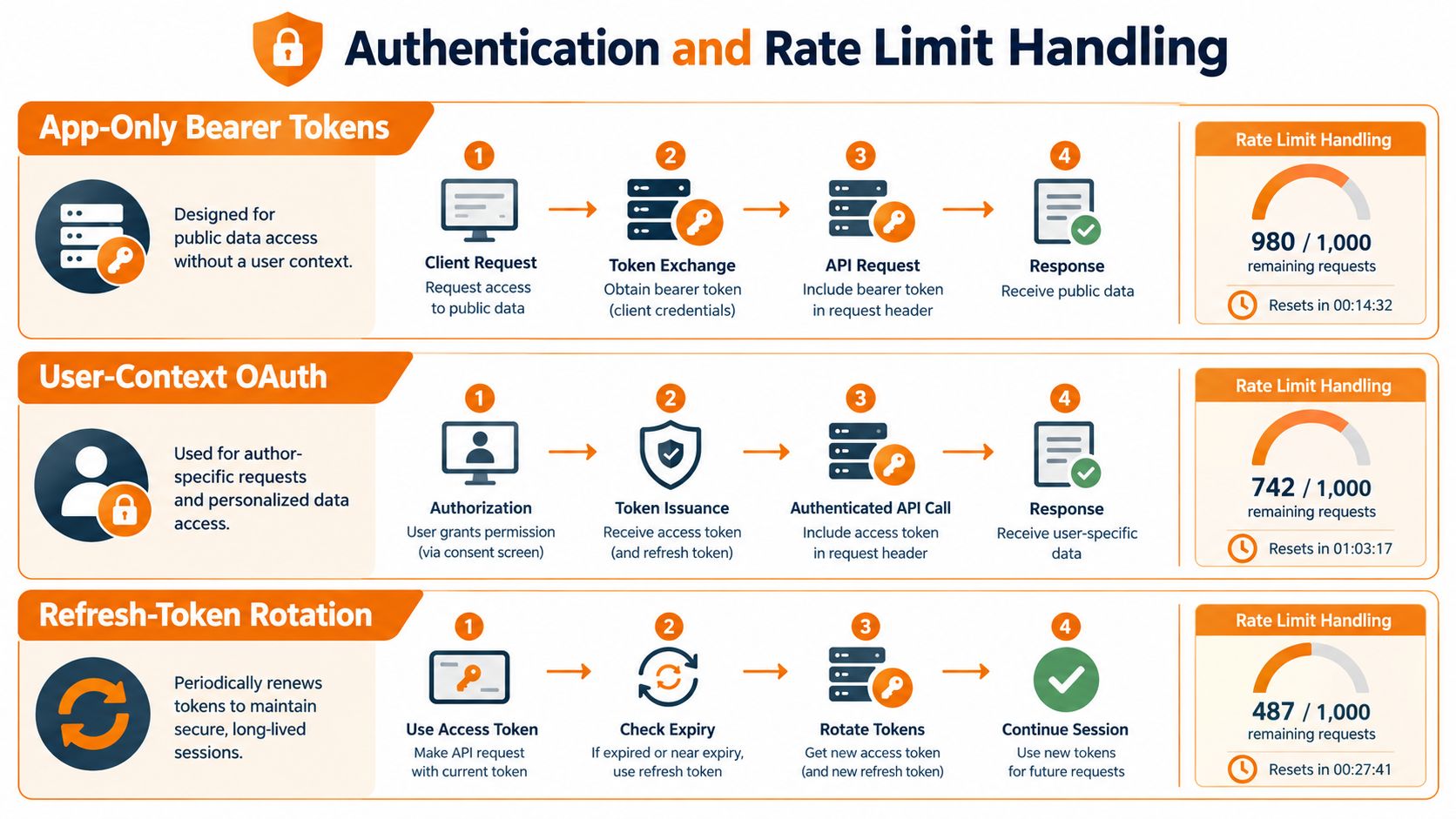
Authentication determines what a request can access; rate limits determine how often you can make it. Keep those concerns separate in your design. A public-data request might use an app-level bearer token, while a request tied to a user's connected account may need user-context OAuth. Long-running integrations also need a secure token-refresh path where the platform provides one.
Never assume every platform offers the same authentication modes or grants the same visibility. Store tokens securely, track their expiry or refresh state when applicable, and make authorization failures visible to the job that owns the request. A token refresh should be an explicit lifecycle operation, not a last-minute patch after a customer reports missing data.
Treat quotas as shared resources
X's official API documents endpoint-specific limits that can vary by authentication mode and time window. Responses can include x-rate-limit-limit, x-rate-limit-remaining, and x-rate-limit-reset; exceeding the allowance can return HTTP 429 (X API rate-limit documentation). A 429 isn't a signal to retry immediately. It's a signal to stop spending that endpoint's available capacity until the reset time.
For example, an internal response record could keep the relevant values alongside the job state:
{
  "status": "throttled",
  "http_status": 429,
  "rate_limit_remaining": 0,
  "rate_limit_reset": "provider-supplied timestamp",
  "retry_at": "calculated from reset time"
}
The timestamp values here are placeholders, not a claim about a particular response. In a real pipeline, read the provider's actual headers and retain them for troubleshooting.
Isolate tenants and schedule retries
Maintain quota state by platform and endpoint, not as one global request counter. If one tenant suddenly runs a large backfill, a shared queue can let that workload consume capacity needed for urgent alerts. Reserve room for high-priority jobs, then delay throttled work until the documented reset time. Exponential backoff can help with transient errors, but a blind retry loop on a 429 only adds pressure to queues.
A normalized ingestion layer can translate provider-specific failures into stable internal states such as queued, throttled, retrying, and completed. Keep the original error code and headers internally so operators can see what happened. For an additional practical overview of retry and quota design, consult the guide to API rate limits.
Choosing Polling, Streaming, or Webhooks
Choose a delivery pattern by asking how quickly the product needs to react and how much operational work your team can own. Polling is straightforward: ask for new matches on a schedule, record what you've seen, and ask again later. It's often a good fit for a recurring report, but frequent polls consume quota and create a delay between collection runs.
Streaming keeps a connection open for ongoing updates. That can suit a live mention monitor, but your service must handle disconnections, reconnects, and buffering. If the consumer is temporarily unavailable, the pipeline needs somewhere durable to hold incoming events rather than relying on a live connection to act as storage.
Webhooks let a provider send events to an endpoint you operate. They work well for event-driven actions, such as routing a relevant mention into a support queue, but only when the provider offers the needed event and your endpoint stays healthy. Validate incoming requests and queue accepted events quickly so a slow downstream system doesn't hold up delivery.
| Pattern | Latency | Quota Cost | Best Fit |
|---|---|---|---|
| Polling | Depends on the schedule | Repeated requests use capacity | Scheduled reports and periodic checks |
| Streaming | Near real time while connected | Depends on the stream model and platform rules | Live monitoring and fast alerts |
| Webhooks | Event-driven when available | Avoids repeated checks, but provider terms still apply | Automated workflows and notifications |
You can combine patterns. Poll for a baseline or a report, then use streaming or webhooks for time-sensitive events where supported. Keep recovery logic either way: a connection can drop, a webhook can fail, and a scheduled job can be delayed.
If a missed minute changes the response, favor an event-driven path and build recovery around it. If the product only needs a trend summary, polling is usually easier to operate.
The Coverage Contract Most Guides Ignore
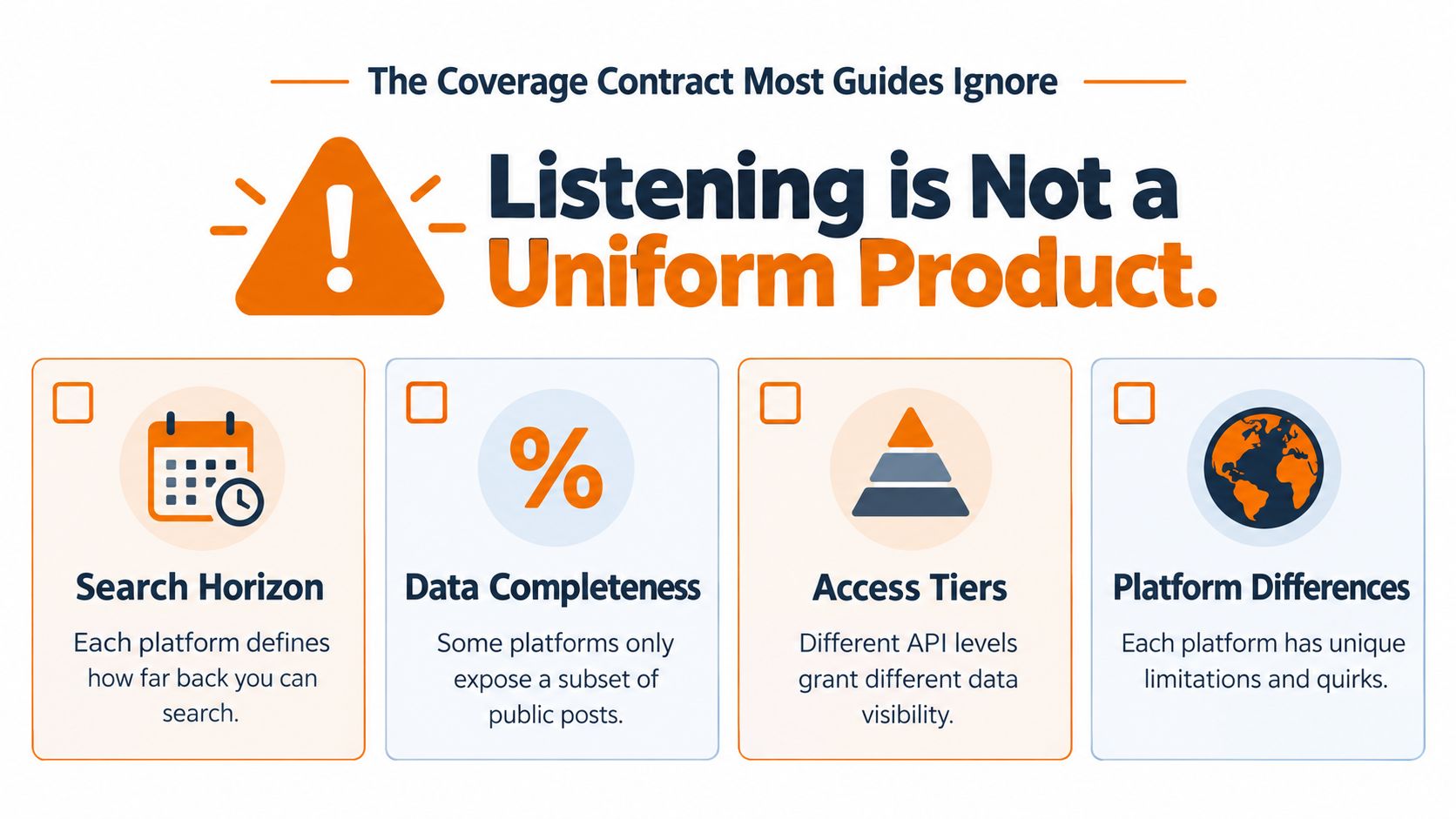
A social media listening API can't promise that every public conversation is visible. Platforms differ in search history, permissions, accessible fields, and how removed content is handled. A system that presents all returned records as a complete view can make a partial sample look like a definitive measurement.
The legal and access conditions matter too. The GDPR constrains the use of personal data and calls for a lawful basis and appropriate safeguards. Meta's Content Library and Content Library API are specialized research-access mechanisms for qualifying users, covering publicly accessible Facebook, Instagram, and Threads content rather than providing a universal feed (research on restrictions and platform-specific access). More broadly, a George Washington University Institute for Data, Democracy & Politics report describes opaque sourcing among commercial monitoring tools and notes that sustained direct platform access can be rare and inconsistent (report on commercial social-media-monitoring tools.
Make the limits part of the data
Attach provenance to each record, including the platform, endpoint, collection time, authorization scope, and visibility state. Where relevant, track deletion or takedown status as well. This lets a customer distinguish a record's original content from the conditions under which the system collected it.
Your API response should also distinguish between “no matching content” and “content unavailable because access was restricted.” A third state, not observable, is useful when a platform or permission model prevents the system from answering the question at all. Without these distinctions, an AI agent may treat missing data as evidence that a brand has no mentions or that sentiment has shifted.
Write the contract in plain language
Tell users what sources are included, what historical range is available, which permissions are required, and what happens to deleted content. Document language limitations and platform-specific sampling where they apply. Don't compress those differences into one “global sentiment” figure unless your product also explains how the underlying coverage varies.
This is a better basis for trust than a broad claim of completeness. The strongest listening system doesn't pretend uncertainty is a bug it can hide. It gives downstream applications enough context to make careful decisions.
Integration Best Practices for Production
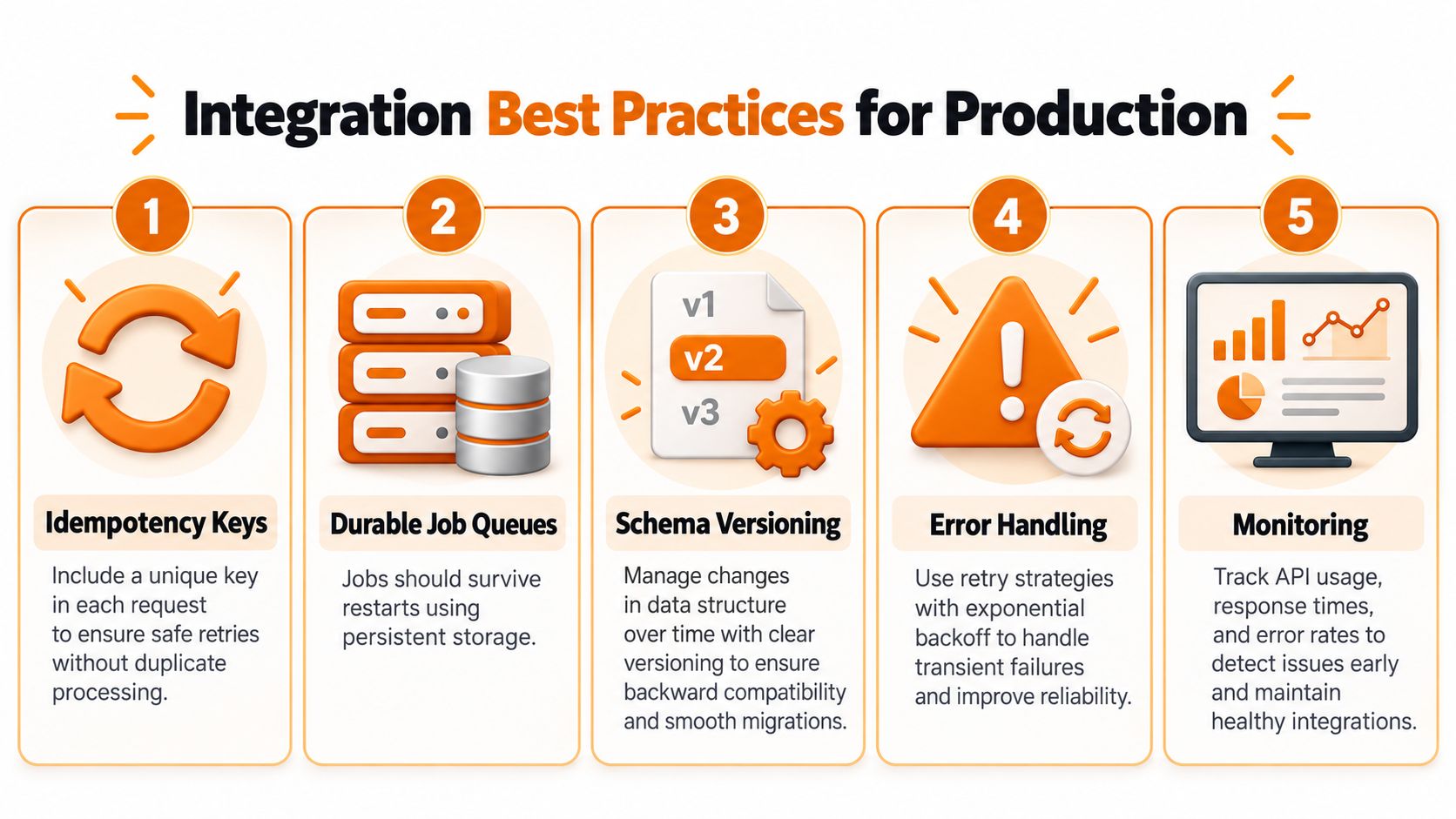
A resilient listening pipeline needs to survive duplicate events, worker restarts, schema changes, and platform access changes. These are ordinary conditions, not edge cases. Design each job so it can be retried without causing duplicate side effects, and so a service restart doesn't erase work that was waiting in memory.
Start with idempotency. Give each collected event a stable identity, and make downstream writes safe to repeat. If the same post arrives through overlapping queries, your application should update or ignore the existing record rather than create a second mention. Keep a durable queue between collection and processing so a temporary database or analytics outage doesn't discard incoming work.
Make change visible and recoverable
Platforms can add fields, change schemas, or withdraw access. Version the normalized schema and preserve raw provider fields where your retention rules allow. That gives consumers a stable contract while letting your team inspect unfamiliar data without forcing every downstream service to change at once.
Use explicit job states for retryable failures, permanent permission errors, and throttling. Apply backoff to transient failures, but don't retry authorization failures indefinitely. If an endpoint disappears, mark that source as unavailable, notify operators, and degrade the affected feature instead of returning empty results.
Before launch, run preflight checks against the permissions, queries, and destinations your workflow needs. Verify webhook signatures when the provider supplies them, normalize timestamps to a consistent timezone, and monitor queue age alongside API errors. Duplicate detection should use stable platform identifiers when available, not text alone, because different posts can contain identical wording.
A practical production checklist looks like this:
- Safe retries: Use stable event identities and make writes idempotent.
- Durable work: Store queued jobs so workers can resume after a restart.
- Versioned data: Keep a stable normalized schema and track changes.
- Honest errors: Separate throttling, permissions, unavailable sources, and empty results.
- Operational visibility: Monitor failures, queue delays, and source-level coverage.
Use Cases and How to Evaluate a Provider
Marketing teams use listening for brand and crisis monitoring; SaaS products can build mention feeds and audience dashboards; AI agents need structured conversation context; agencies need workflows that keep client data distinct. Compare providers on their coverage contract, record provenance, quota model, white-label options, and reliance on documented platform access. For a broader view of tools used to monitor reputation, see Carlos Alba Media's top reputation tools, then check whether each option's data access matches your use case. If your product also needs trend discovery, the guide to Twitter trending APIs can help clarify that adjacent requirement.
Mallary.ai combines social publishing, engagement, and analytics behind a developer-oriented API, with a Comments API that can support listening to comments and replies from supported platforms. If you're building a product that needs these capabilities alongside social workflows, visit Mallary.ai to assess whether its API, MCP interface, or CLI fits your integration.
Try it with Mallary
STOP!
Want ChatGPT or Claude to post on social media for you?
Connect your social accounts one time. Then tell your AI what to write. It can make your posts, share them, and reply on social sites that allow replies. You do not need to write code.
Pick your AI





Connect once. Ask in plain English. Mallary does the work.


