Written by Outrank. Published by Mallary Labs LLC.
Published .
White Label Service Explained: Model, Benefits and Risks
Your customers want social scheduling inside your project-management app. Your team can build the workflow, but maintaining platform integrations, refreshing credentials, and investigating failed posts would pull engineers away from the product you sell. A white label service looks like the shortcut, provided customers never have to leave your interface or deal with another vendor.
The important buying decision isn't whose logo appears. It's which responsibilities you transfer, which you retain, and whether you can leave without disrupting customers.
Table of Contents
- What a White Label Service Means in Practice
- How a White Label Service Works Behind the Brand
- Benefits for SaaS Products and Agencies
- Technical and Security Checks Before You Embed
- Who Owns Each Risk When Something Breaks
- Pricing Models and Go-to-Market Costs
- Mallary.ai as a White-Label Social Publishing Example
- Test the Exit Before You Sign
What a White Label Service Means in Practice
Say your project-management SaaS adds a publishing calendar. Customers draft posts alongside campaign tasks, connect their social accounts, and schedule content under your brand. Another company operates the publishing infrastructure, but your customers buy the feature from you.
That's a white label service: a provider builds a standardized capability and sells it to multiple businesses that present it under their own brands.
Think of a commercial kitchen supplying the same base sauce to several restaurants. Each restaurant serves it under its own menu name, chooses the presentation, and handles the diner's complaint if something's wrong. The kitchen produces the sauce; the restaurant owns the dining experience.

What you're actually buying
The arrangement combines several things:
- The capability: Publishing, analytics, automation, or another operational function.
- The customer relationship: You package the offer, charge customers, and manage their expectations.
- The brand surface: Your interface, domain, emails, and product language, within the scope the agreement permits.
Private label is different. A private-label product is generally developed exclusively for a particular retailer; a white-label offering usually shares its underlying product across buyers, with configurable branding.
For software teams, shared infrastructure avoids duplicating every integration and maintenance task. Your developers can concentrate on campaign approvals, project context, or industry-specific workflows instead of rebuilding the publishing engine.
Fit test: If buyers need the same underlying capability with different branding and configuration, white labeling can work. If every buyer needs a separate implementation, you're purchasing custom development under a different name.
Don't confuse a shared engine with identical customer experiences. You can differentiate the workflow around the service without requiring the provider to maintain a separate product for you.
How a White Label Service Works Behind the Brand
A workable architecture separates presentation, integration, and execution. If those boundaries are unclear, your team can end up maintaining the backend behavior it thought it had outsourced.
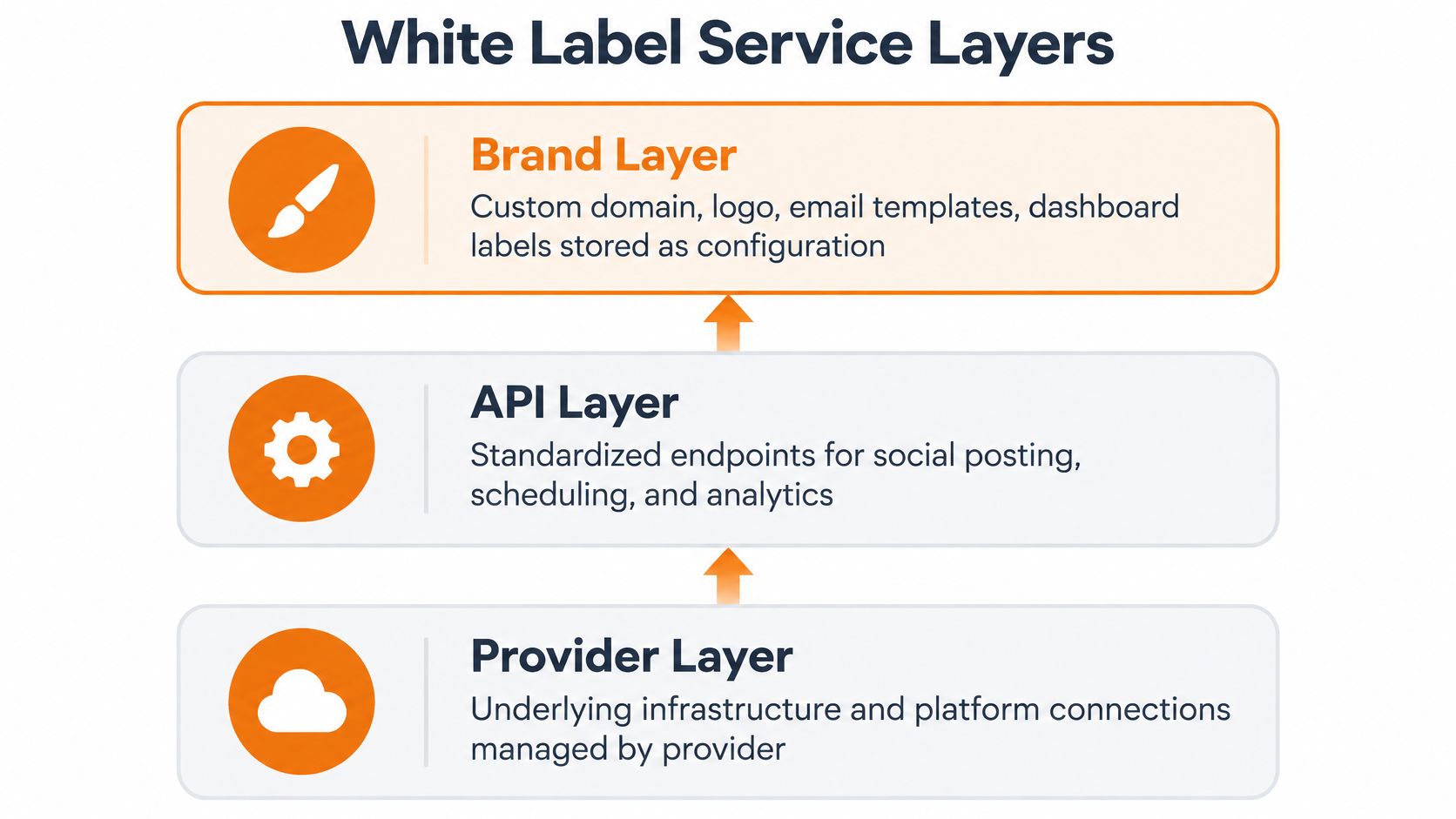
The layers and their boundaries
The brand layer contains custom domains, logos, email templates, and dashboard labels. Store these as configuration, not reseller-specific code branches. Otherwise, every product update becomes a compatibility project.
The API layer exposes stable resources such as profiles, connected accounts, posts, media, and webhooks. Your application should work with those resources rather than reproduce each platform's internal vocabulary.
The provider layer operates OAuth flows, rate-limit handling, token refresh, retries, durable queues, and platform adapters. Digital distribution offers a useful parallel: Interspace Music's white-label distribution explainer describes how APIs let a branded service create releases and retrieve reports while the upstream provider manages specialized delivery.
The architecture should keep these responsibilities distinct.
Follow a publish request
A production-ready request should move through a predictable lifecycle:
- Accept the request. Your app sends the content with an idempotency key and correlation ID.
- Validate the payload. The provider checks media and text against each destination's rules.
- Persist the work. An accepted job enters a durable queue rather than relying on an open browser session.
- Execute safely. A worker refreshes credentials when needed and retries transient failures with backoff.
- Report the outcome. A signed webhook tells your app what succeeded, what failed, and what action the customer must take.
Accepted isn't the same as published. Your interface needs separate states for queued, processing, successful, and failed work. Preserve the correlation ID so support staff can trace the same operation across requests, jobs, and callbacks.
Our dashboard lets users create a separate profile for each business and connect its social accounts. Each profile holds one account per social platform. For embedding, multi-tenant SaaS architecture is the relevant design foundation, not merely a profile selector.
The API is a contract boundary. Normalize upstream failures into documented error classes, while retaining diagnostic details for authorized operators. Adapter fixes should reach resellers without requiring application changes unless the public contract itself changes.
Benefits for SaaS Products and Agencies
White labeling makes sense when the purchased capability supports your differentiation rather than becoming the differentiation itself. A publishing engine might be essential to your campaign product without being the part customers choose you for.
For SaaS product teams
- Ship the surrounding workflow sooner. Buying integrations removes implementation work, but delivery still depends on the provider's reliability and coverage.
- Keep roadmap effort on your domain. Engineers can build campaign context or industry-specific automation instead of maintaining platform adapters. That advantage shrinks if every useful change requires paid customization.
- Present a native experience. Customers stay in your product, although branding control doesn't give you control over external platform rules.
One engineering team can support a shared capability across tenants. That's useful only if your application and the provider agree on authorization, account ownership, and failure handling.
For agencies
A hypothetical agency managing a dozen client brands across several platforms needs a consistent publishing routine, not a collection of disconnected logins. Separate client profiles help operators select the right accounts, prepare campaigns, and investigate exceptions without mixing brands.
An agency can also add a service without hiring specialists for every underlying platform. For a different service category, Ever Outbound Inc.’s resource on how to resell done-for-you lead generation is useful when considering an outsourced delivery model. The same buying discipline applies: establish who performs the work and who answers to the client.
Predictable subscriptions can simplify budgeting, but usage fees and support work can erase the apparent saving.
Buy the repeatable infrastructure. Keep control of the workflow customers pay you to understand.
Before choosing, list the features customers would miss most. Determine whether each is included, configurable, or custom work. Then estimate the engineering effort to build and maintain the integrations yourself, and compare its cost with subscription, implementation, and operating costs over the same period.
Technical and Security Checks Before You Embed
Start with tenant isolation, not the branding demo. A polished interface doesn't prove that customer data remains separated when someone changes a resource identifier or replays an old webhook.
EJN Labs' multi-tenant SaaS penetration-testing guidance explicitly covers cross-tenant access through applications, APIs, exports, background jobs, database controls, and custom-domain sessions. Your acceptance tests should cover those paths too.
Establish the isolation boundary
Bind every request, job, export, webhook, and database operation to an authenticated, immutable tenant ID. Enforce authorization at the data and API layers using row-level security or an equivalent policy.
Create adversarial tenant-A and tenant-B tests. Attempt to retrieve another tenant's media, replay its callback, alter a scheduled job, and export its records. Run these tests before major releases, including releases that appear to change only branding.
Use signed user-and-tenant tokens, deny-by-default authorization, and separate encryption contexts where feasible. Custom-domain cookies and sessions must remain isolated independently of the visible logo.
Technical checks, what to verify and red flags
| Check | What to verify | Red flag |
|---|---|---|
| Tenant isolation | Tenant ID bound to every request, job, export and webhook | Test data from tenant A appears in tenant B |
| Branding isolation | Custom domains cannot share cookies or sessions across tenants | Sessions or logos leak between brands |
| Credential handling | OAuth tokens scoped per profile and refreshed automatically | Customers must re-authorize accounts often |
| Retries and idempotency | Idempotency key accepted on publish requests | Duplicate posts after timeouts |
| Error model | Platform errors mapped to documented error classes | Raw vendor error messages reach end users |
| Media validation | Preflight checks for file type, length, shape and text | Rule violations appear only after publish |
| Webhooks | Documented delivery guarantees and retry behavior | No signature check or no retry policy |
| Audit logs | Tenant, actor, operation and resource IDs recorded | Logs cannot show who changed what |
Repeated authorization requests deserve investigation, although revoked permissions can legitimately require customers to reconnect. Likewise, an idempotency key needs documented scope and retention behavior, not just an accepted header.
Our preflight checks cover file type, file count, video length, image shape, text length, and other platform media rules, with a clear message when something's wrong. Exercise those checks with deliberately invalid content, including individual rows in bulk uploads.
We're a Meta Verified Tech Provider and use official APIs rather than scraping. That addresses the integration method; it doesn't replace authorization testing or your own social media security practices.
Before signing, obtain documentation for token expiration, retry backoff, webhook guarantees, media-validation outcomes, and deletion propagation. Ask for sample audit records too. If support can't reconstruct who changed a resource, incident response will rely on guesswork.
Who Owns Each Risk When Something Breaks
Outsourcing execution doesn't outsource accountability. Customers see your product, pay your invoice, and contact your support team when a scheduled campaign fails. White labeling can increase your perceived responsibility even as it reduces engineering work.
Sprintlaw's white-label SaaS agreement guidance identifies data roles, security duties, incident cooperation, permissions, and termination handling as matters to make explicit. Treat the following split as a negotiation starting point, not a statement that every vendor accepts these duties.
Responsibility split by risk scenario
| Scenario | Provider usually handles | Reseller usually handles | Write into the contract |
|---|---|---|---|
| OAuth token compromise | Revoking and rotating platform tokens | Notifying affected clients | Incident cooperation and notice windows |
| Platform takedown or policy violation | Platform-level enforcement coordination and appeals | Client content decisions | Who pauses which posts and how fast |
| Privacy or data-subject request | Deletion and export from infrastructure | Answering the end user | Response timelines and data-role definitions |
| Data breach | Forensic logs and root-cause report | Regulatory and customer notice | Notification duties and cost sharing |
| End-user support | Platform status and API errors | First-line and billing questions | Support hours and escalation path |
| Account discontinuation | Final export and deletion confirmation | Customer migration | Post-termination export and deletion |
The external platform controls enforcement decisions. Neither your reseller agreement nor the provider's support process can guarantee reinstatement after a takedown.
For a compromised credential, specify who can immediately suspend work, who revokes access, and who preserves logs. Waiting for commercial approval before stopping a queue is a poor incident procedure.
Turn obligations into operating instructions
Confirm the legal counterparty. For our service, that company is Mallary Labs LLC. The agreement, order form, security commitments, and escalation contacts should identify the parties consistently.
Request explicit service-level terms:
- Availability: The uptime commitment and measurement method.
- Incident response: Severity definitions, response times, and escalation ownership.
- Remedies: Service-credit calculations and exclusions.
- Planned work: Maintenance windows and change-notice periods.
- Cooperation: Access to evidence, customer communications, and incident reports.
Contractual allocation isn't the same as regulatory responsibility. Assigning a task or liability to a provider doesn't automatically remove obligations you owe end users. Have counsel review the data roles and notice duties for the markets you serve.
Keep customer communication, consent management, and first-line ownership assigned internally. A contract can require the provider's assistance, but your team still needs someone authorized to make decisions during an incident.
Pricing Models and Go-to-Market Costs
Start with the margin equation:
Resale revenue minus provider cost minus onboarding and support labor equals contribution before tax and overhead.
Market size won't tell you whether your offer works. Market.us valued the global digital marketing outsourcing market at $17.1 billion in 2025, as cited by Vendasta's white-label services guide, but your economics depend on account density, usage, and support demand.
Calculate the cost of serving a brand
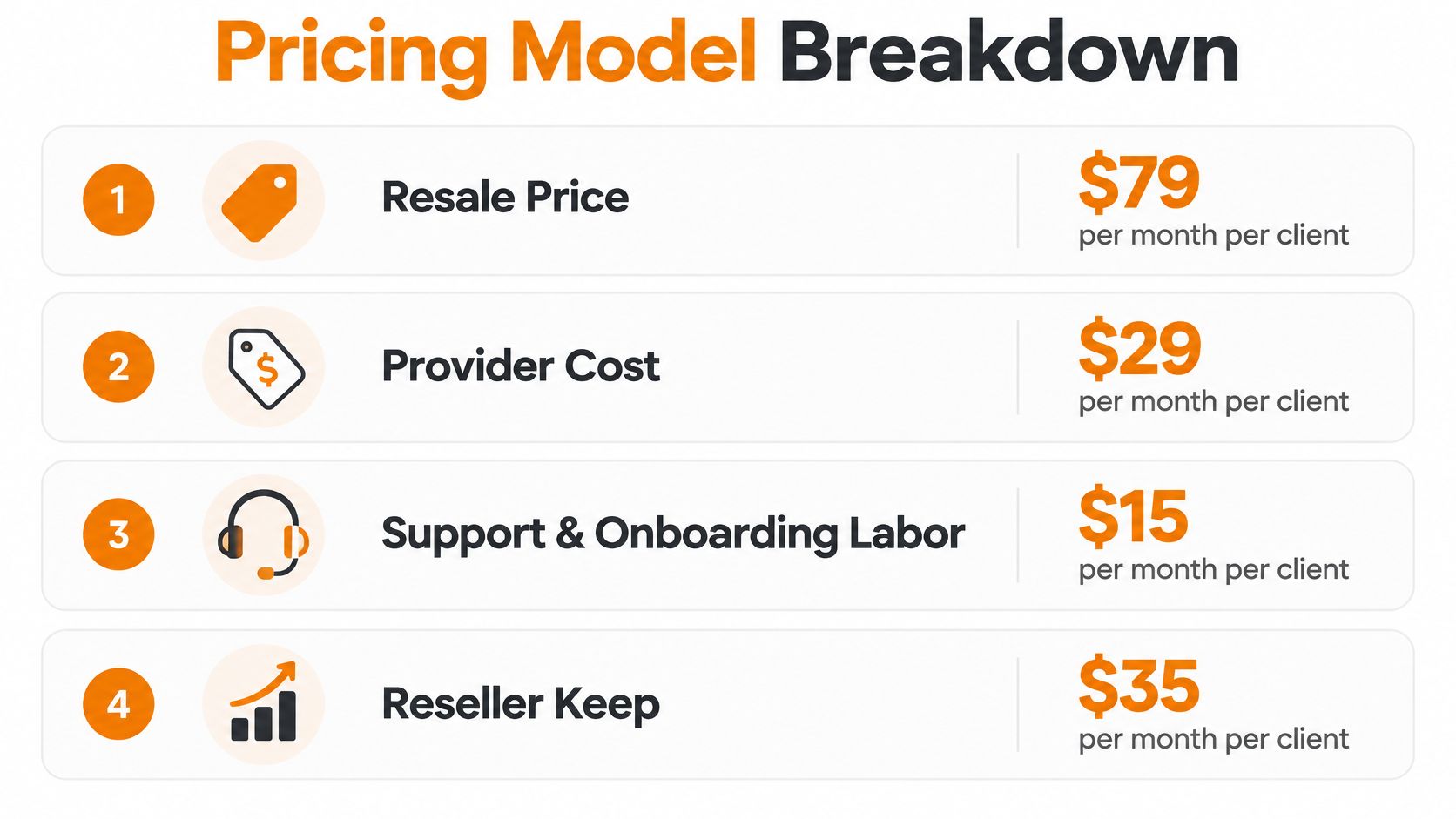
Consider a hypothetical offer charging $79 per client per month. Two clients share our Standard plan, listed at $29 for 5 social accounts, and each connects two accounts. Assuming the arrangement is commercially permitted, allocated provider cost is $14.50 per client.
Suppose monthly support takes an hour at a hypothetical internal cost of $40 per hour. Recurring contribution is $24.50 per client, before tax, overhead, and metered usage. If onboarding also takes two hours, that adds $80 per client upfront; recover it through setup pricing or include it in your payback calculation.
The visual below illustrates a different allocation of costs, not the worked example above.
Pricing models compared for white label buyers
| Pricing model | How it is billed | Suits | Watch for |
|---|---|---|---|
| Flat platform plan | Fixed monthly fee with account or seat limits | Steady, predictable client load | Account caps shared across profiles |
| Per-account pricing | Fee rises with each connected account | Small client counts | Costs climb across many brands |
| Usage-based metering | Billed per action or credit | Bursty or low-volume use | Metered services added to the base plan |
| Revenue share | Provider takes a cut of each resold fee | Launches where upfront fees are waived | Margin ceiling and dependency |
| Setup plus monthly | Integration fee plus recurring fee | Custom branding at larger scale | Non-refundable setup and minimum terms |
Our Starter plan is $15 monthly in USD before tax, with X usage billed separately. Business is $95 monthly, with X and other metered services charged separately.
A post or reply to X containing links costs $0.20. X credits are passed on at cost with no markup, so include that activity in your client pricing rather than treating all publishing as covered by the subscription.
Budget explicitly for tax, trial credits, support escalations, migration work, and minimum contract terms. Test margins against an active client, not just a quiet account that barely uses the service.
Mallary.ai as a White-Label Social Publishing Example
Say your SaaS already has campaign tasks, content drafts, and customer permissions. You want to add publishing without making customers operate another dashboard. Our social media posting API provides a possible infrastructure layer, integrating 10 platforms behind a unified publishing interface.
The implementation work belongs alongside your existing application workflow.
Embed the operation, not an assumption
Your application maps a customer to a profile, lets authorized users connect accounts, and submits publishing requests. Your own interface displays scheduled work and outcomes. The provider handles the underlying publishing operation while your team defines how it fits the product.
Our paid plans include REST API, MCP, CLI, webhooks, uploads, analytics, comments, and replies. Automation builders can connect workflows through n8n, Zapier, and Make rather than building every interaction into a custom interface.
Scheduling, multiple first comments at publish time, supported comments under posts, and AI auto-replies can extend that workflow. Don't assume every engagement feature works identically on every destination; define the supported behavior in your product before exposing a universal control.
The accompanying video provides another way to examine the product.
Match the commercial offer to the architecture
We aren't sold as a full white-label service. Profiles and a dashboard are included, but we're also not a full agency approval and client-reporting suite. An agency needing branded performance reports and client sign-off must account for those requirements separately.
Before committing your roadmap, resolve these questions:
- Commercial permission: Does the agreement permit your intended embedded or resale offer?
- Branding scope: Which interfaces, authorization screens, notifications, and domains can you control?
- Reporting coverage: Which customer-facing reports must your team or another tool supply?
A technically embeddable API isn't, by itself, a complete white-label commercial arrangement. Confirm both before promising the feature to customers.
Test the Exit Before You Sign
A fully branded product can still leave you dependent on its provider. Customer records, post history, media, analytics, automation rules, OAuth connections, and webhook mappings may each require a different migration approach.
TOS Lawyer's white-label reseller agreement guidance flags export, retention, deletion, migration, and surviving obligations as recurring risks. Treat exitability as an acceptance criterion, not a document to read after cancellation.
Set up a realistic test profile
For our service, pick a plan, start the 14-day free trial, connect social accounts, and create a separate profile for each brand or client. The plan's account limit is shared across all those profiles.
X publishing and comments require paid credits during the trial. Include representative activity in your test budget, and use non-sensitive test content so you can exercise deletion without affecting a live campaign.
Run the portability test
- Export the working records. Confirm formats for posts, media, profiles, and analytics. Open the files and check identifiers, timestamps, status fields, and relationships.
- Check API coverage. Verify that every resource needed to rebuild your operation is retrievable. A dashboard download isn't enough if migration requires repeatable extraction.
- Revoke a test credential. Confirm that the account disconnects cleanly and queued work stops appropriately. Establish which connections will require fresh customer authorization after migration.
- Request deletion confirmation. Ask how deletion covers primary storage and backups. Distinguish immediate removal from documented backup expiration.
- Establish backup ownership. Confirm who controls backups, whether you can obtain a copy, and what usable format you receive. Don't assume an infrastructure snapshot is a customer export.
- Document sunset handling. Obtain written notice periods for discontinued integrations and services, plus the scope and cost of migration assistance.
Check the exported records against the live profile rather than accepting an empty sample file. Attempt to reconstruct a draft, its media attachments, and its destination mapping in a separate test environment.
Go or no-go: Sign only when every portability check passes against a live test profile, with evidence your team can retain.
A missing export field may be fixable. An undocumented promise to help later isn't an exit plan. Assign an internal owner to record the results and resolve failures before commercial approval.
Mallary.ai offers managed social publishing and engagement through a dashboard, REST API, MCP, and CLI. Visit Mallary.ai to test your publishing workflow, then confirm commercial permissions, branding scope, and portability before building an embedded offer around it.
Try it with Mallary
STOP!
Want ChatGPT or Claude to post on social media for you?
Connect your social accounts one time. Then tell your AI what to write. It can make your posts, share them, and reply on social sites that allow replies. You do not need to write code.
Pick your AI





Connect once. Ask in plain English. Mallary does the work.


