Written by Outrank. Published by Mallary Labs LLC.
Published .
What Is Role Based Security
Role-based security is a model where permissions are attached to job roles and users inherit those permissions through role membership, so a Workspace Editor role might grant publish rights across a tenant without anyone editing that person's account by hand. You're probably meeting it because your SaaS product has outgrown a simple admin flag. One customer wants interns to draft but not publish, another wants an agency to schedule posts but never see billing, and your API tokens suddenly need the same boundaries as your dashboard.
That mismatch is where teams get confused. They add role names to a database, check them in a few controllers, and assume authorization is done. In production, roles touch tokens, scopes, sessions, tenant boundaries, and audit logs, and each of those artifacts can grant more access than the role label suggests.
Table of Contents
- A Clear Definition of Role-Based Security
- How Role-Based Access Control Actually Works
- RBAC Compared to ABAC, ACLs, and Permission Lists
- Role-Based Security in Real SaaS Systems
- Why Role-Based Security Is Not the Same as Least Privilege
- Best Practices for Designing and Operating RBAC
- Choosing and Evolving Your Authorization Strategy
- Frequently Asked Questions About Role-Based Security
A Clear Definition of Role-Based Security
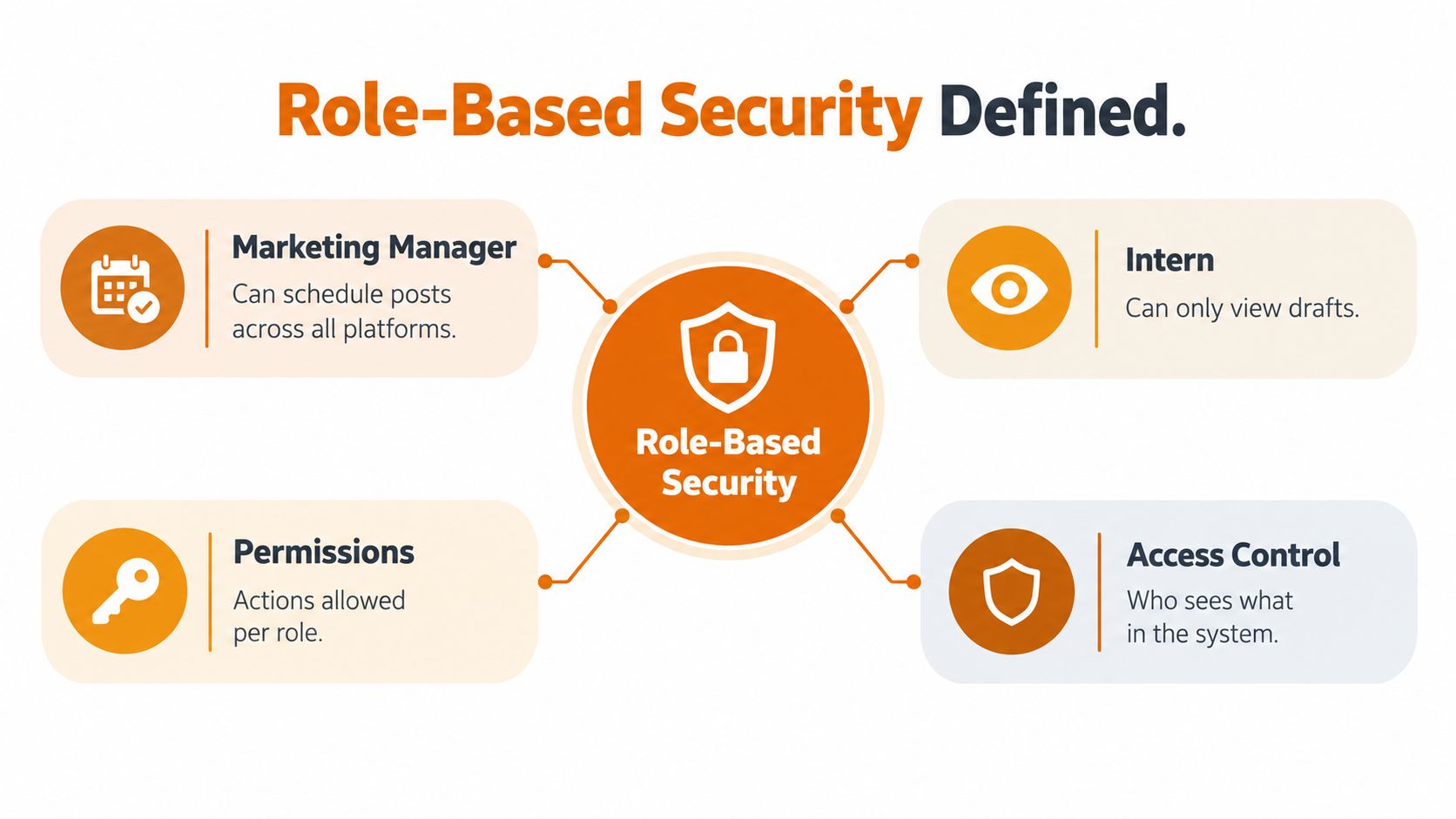
Your marketing manager can schedule posts across every connected platform. An intern on the same team can only view drafts. Nobody configured those two people one permission at a time, and that's the point.
What is role based security in practice? It's an authorization model where administrators attach permissions to roles, assign users to roles, and let users get their effective access through that membership. A role represents a job function, such as Analyst or Campaign Manager. A permission names an allowed operation on a protected object, such as reading a report or publishing a post.
The Four Parts Worth Naming
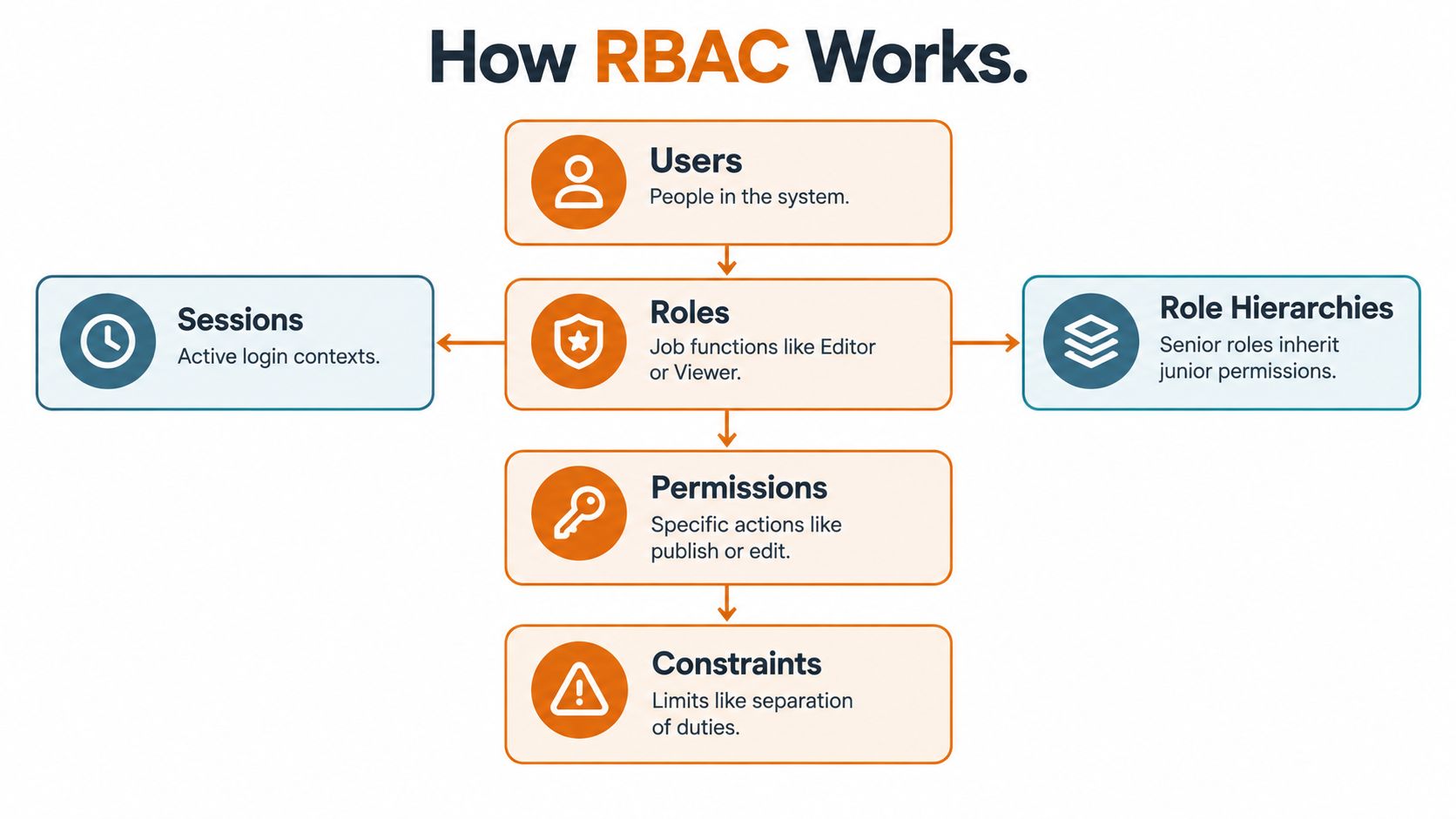
NIST describes four core components, users, roles, permissions, and sessions, in its NIST role-based access control FAQ. A session is the active subset of roles a user invokes while using the system, not every role they've ever been assigned. That distinction matters when someone belongs to several workspaces but is only acting in one of them right now.
Think of a role like a labeled key ring rather than a single key. You don't cut a new key for each employee. You define the ring once, hand it to people doing that job, and change the ring when the job changes.
Change the role once and every member's access updates with it. That's the operational payoff, and it's also why a bad role definition spreads fast.
Because policy is centralized, a team can reuse the same role logic across applications, tenants, and API clients instead of rebuilding permission checks for each surface. Mobile products face the same assignment problem on smaller screens, and this practical guide for mobile teams from Capgo shows how access management decisions carry over when your users aren't sitting in a web dashboard.
The abstraction is the whole idea. People change teams, projects, and employers constantly. Job functions change more slowly, so anchoring permissions to functions gives you a policy you can maintain.
How Role-Based Access Control Actually Works
Start with a publishing platform and separate the moving parts. A user is a person, or sometimes a service account or agent acting as a principal. A role is a named job function like Author, Editor, or Viewer. A permission is a specific operation, written in code as something like draft.read or post.publish.
Administrators connect those pieces in two steps. First they assign permissions to roles, so Author gets draft.read and draft.write. Then they assign users to roles, so a new hire becomes an Author and inherits both permissions without anyone touching the permission table.
Hierarchies, Sessions, and a Request in Flight
A role hierarchy lets a senior role inherit from a subordinate one. Editor might inherit everything Author can do, then add post.publish. You define the baseline once and layer the extra capability on top, instead of copying permission lists between roles and watching them drift apart.
Now follow a request. Your Editor logs in and opens one client's workspace, which starts a session that activates only the roles relevant to that workspace. Her token or server-side session carries claims for that context. When she calls POST /posts/publish, your authorization layer checks whether any active role includes post.publish for that tenant, then allows or denies the call.
That session step is where many implementations get sloppy. If you load every role a user holds into one always-on token, a person who's an admin in a test workspace may carry that power into a client workspace where she's only a Viewer. Activating a subset per session keeps each context separate.
Constraints That Make It Policy, Not Naming
Constraints limit how roles can be assigned or activated. The most common is separation of duty, which prevents conflicting responsibilities from sitting with one person. The person who creates a payment shouldn't be the person who approves it, even if both roles exist in your system.
- Static separation: A user can't be assigned to both conflicting roles at all.
- Dynamic separation: A user can hold both roles but can't activate them in the same session.
- Cardinality limits: Only a set number of users can hold a sensitive role like Billing Admin.
With those pieces in place, you can describe the system precisely. People get roles, roles carry permissions, sessions activate a slice of those roles, hierarchies reuse definitions, and constraints block dangerous combinations.
RBAC Compared to ABAC, ACLs, and Permission Lists
New teams often mix up four models that solve different problems. Picking the wrong one usually doesn't break anything on day one. It breaks during your first audit or your fiftieth customer.
Attribute-based access control (ABAC) evaluates policies at runtime using attributes of the user, resource, and environment. A rule might say a document is readable only by its owning department, during business hours, from a managed device. That's expressive, and it's harder to predict, because you can't answer who can see this file without evaluating the policy against live attributes.
Access control lists (ACLs) attach a list of allowed users or groups directly to each resource. They work well for one-off sharing, like a single document shared with three people. They get painful when you need to answer the reverse question, everything this departing employee can reach, because that information is scattered across every resource.
Permission lists assign permissions directly to users in a flat table. They're simple to build and miserable to maintain, since every onboarding, promotion, and transfer becomes manual row editing.
Authorization Models at a Glance
| Model | Defines Access By | Best Fit | Audit Complexity |
|---|---|---|---|
| RBAC | Job function | Stable teams and SaaS workspaces | Low, roles are enumerable |
| ABAC | User, resource, and context attributes | Context-sensitive resources | High, policies need evaluation |
| ACL | Per-resource user list | Ad hoc sharing of single items | High at scale, lists are scattered |
| Permission list | Direct user-to-permission rows | Tiny internal tools | Grows quickly with headcount |
For a multi-tenant SaaS product with stable job functions, RBAC is the right default. It's easier to reason about, cheaper to operate, and an auditor can read your role definitions and membership lists without running a policy engine. If you're wiring this into delegated access flows, it helps to understand how OAuth grants and scopes carry authorization between systems before you decide where role checks belong.
Graduate toward ABAC when context starts deciding access. Time windows, geography, document sensitivity labels, and device posture are attributes, not job functions. When those rules outnumber your roles, layer ABAC on top rather than inventing roles like Editor-EU-Business-Hours.
Role-Based Security in Real SaaS Systems
The model stops being abstract the moment you issue an API token. When a developer creates a token with scopes like posts:write and analytics:read, they're minting a portable slice of a role. The token doesn't know about job titles. Your authorization server translated a role into scopes the token can carry, and each API endpoint checks for the scope it needs.
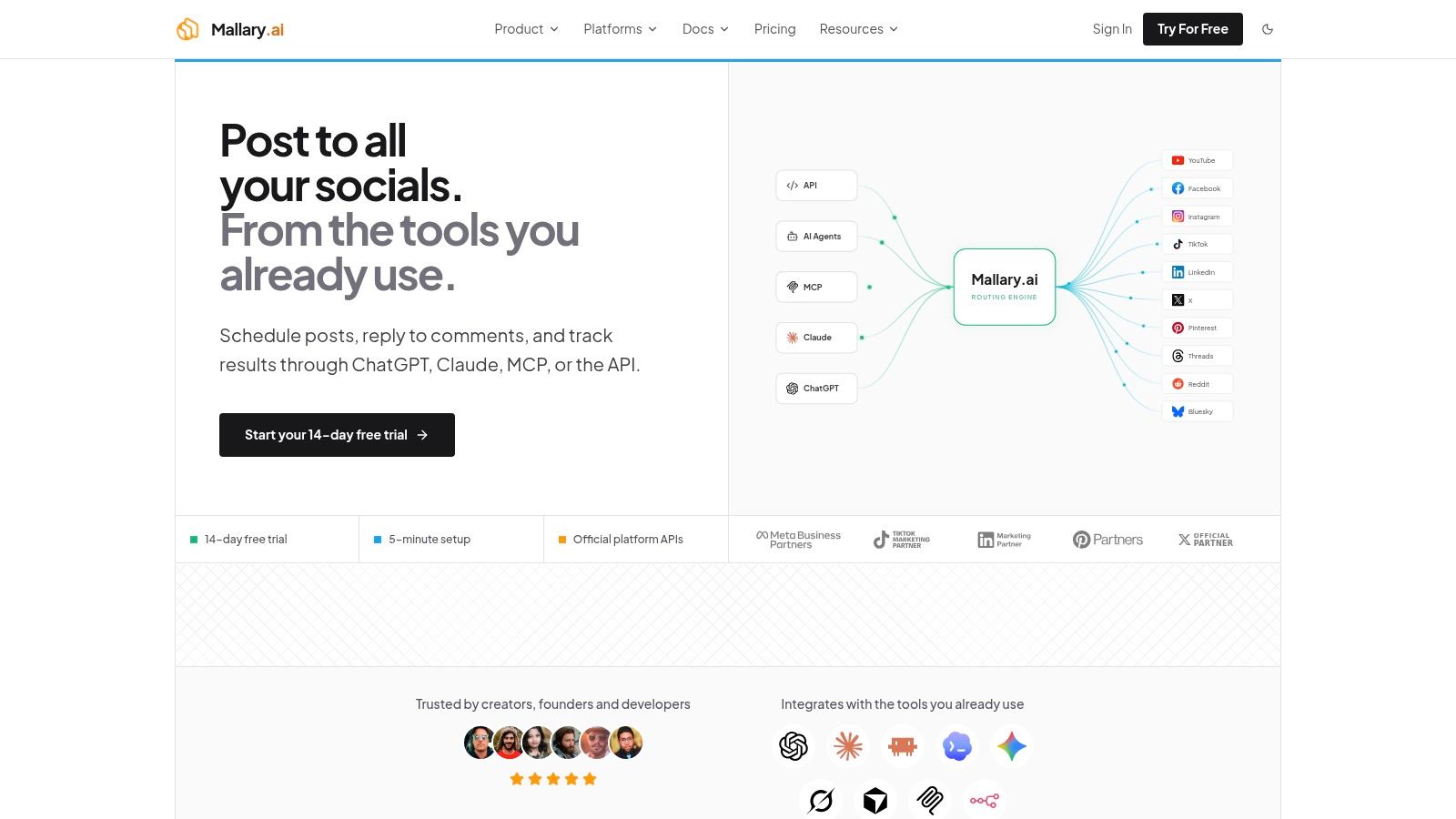
Here's how that surface looks in a working dashboard, where roles and connected accounts sit side by side.
Tokens, Claims, and Tenant Mapping
In a JWT-based system, roles often travel as claims inside the token, sometimes as raw role names and sometimes pre-expanded into permissions. Expanding them at issuance makes endpoint checks fast and simple. The trade-off is staleness, since a revoked role keeps working until the token expires, so short token lifetimes and server-side checks for sensitive actions are common pairings.
Multi-tenancy adds the mapping problem. A user isn't an Editor, she's an Editor in Workspace A and a Viewer in Workspace B. Your role assignment therefore needs a scope column, usually a tenant or workspace ID, and every check must include it. The patterns behind that isolation are covered in this breakdown of multi-tenant SaaS architecture and tenant boundaries, and role mapping is where those boundaries become enforceable rather than aspirational.
Consider a unified social publishing platform such as Mallary.ai, which lets teams publish to many social networks through one API and dashboard. A single integration might hold platform-level roles like Publisher or Engager, while each customer workspace underneath it has its own members, managers, and viewers. Your authorization layer has to resolve both layers on every call, or a Publisher credential for one client could publish to another.
The short walkthrough below shows the kind of dashboard workflow those checks sit behind.
Agents make this concrete. An MCP agent that schedules posts should hold a scoped token tied to a publishing role in one workspace, never a person's credentials. If the agent is compromised or misbehaves, you revoke that token and its role. The human's account, and every other workspace, stays untouched.
Once you see scopes as role fragments and claims as role transport, you can read almost any modern API's documentation and spot its authorization model within a few pages.
Why Role-Based Security Is Not the Same as Least Privilege
Teams love claiming they use RBAC, therefore they follow least privilege. That logic doesn't hold. RBAC is a mechanism for organizing permissions. Least privilege is a claim about whether those permissions match what a person needs, and role labels can conceal access that's far broader than the job requires.
Access drifts in quiet ways. A contractor finishes a project but her account stays active. Someone gets promoted and keeps his old team's roles alongside the new ones. An incident at 2 a.m. produces a broad fallback role that nobody removes afterward. A temporary elevation for a migration never gets its expiry date.
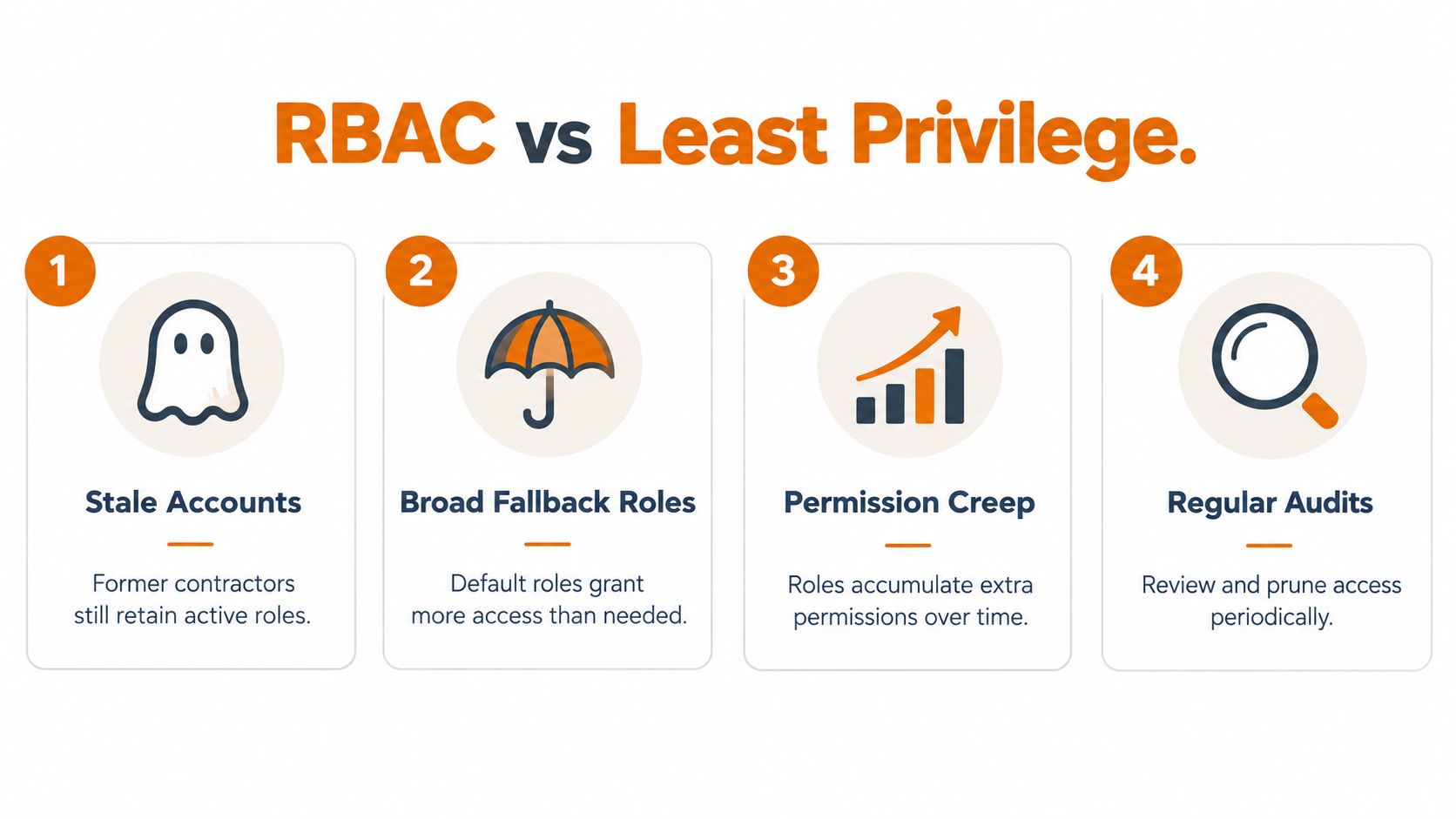
This isn't hypothetical. Identity research analyzing millions of identities and billions of entitlements found that 38% of identity-provider user accounts were dormant yet still active, while the average worker held 96,000 entitlements, as reported in Veza's State of Identity Access analysis. Those organizations presumably had role models too. The roles were tidy on paper while effective access sprawled underneath.
Measure Effective Access, Not Assigned Roles
The fix is to measure what people can do and what they use. Four signals tell you most of the story:
- Permission usage: Which granted permissions has this role exercised recently, and which sit untouched?
- Ownership: Who is accountable for this role's definition and membership?
- Expiry: Does every exceptional grant carry an end date that the system enforces?
- Separation-of-duty checks: Do any users hold combinations your constraints were meant to prevent?
Practical rule: If you can't show when a permission was last used and who approved it, you don't have least privilege. You have a naming convention.
Cleanup has a real trade-off, because aggressive revocation breaks production work and teaches people to demand broad roles as insurance. Staged revocation, time-bound exceptions, and auditable break-glass access get you to least privilege without the outage. Periodic access reviews where managers rubber-stamp a spreadsheet do not.
Best Practices for Designing and Operating RBAC
Good role design starts from job functions, not from your current employees or your org chart's quirks. Interview the work itself. If three people do the same tasks, that's one role, even if their titles differ. Document each role's purpose in one sentence inside your policy files, so a future engineer knows why billing.refund sits where it does.
Watch for role explosion, where every exception spawns a new role until you have hundreds nobody can audit. When a requested role differs from an existing one by a single permission, question whether the base role is wrong instead. Fewer, well-understood roles beat a perfect taxonomy nobody trusts.
Assignment Hygiene and Testing
Give every role a named owner who approves membership changes and answers for them in reviews. Use just-in-time elevation for sensitive work, so an engineer requests production access for a defined window instead of holding it permanently. For high-impact grants, the pattern described in these dual approval security practices from CEFCore, where a second approver confirms elevation, keeps one compromised admin account from minting new admins.
Test authorization like you test business logic:
- Negative-path tests: Assert that a Viewer calling
post.publishgets denied, not just that an Editor gets allowed. - Role-swap tests: Change a user's role mid-session and confirm the new boundaries apply.
- Tenant isolation tests: Verify that a token scoped to Workspace A can't read or write Workspace B resources, even with a guessed ID.
Run those checks in CI against your policy files. A pull request that widens a role should be as visible as one that changes billing code, and pairing that discipline with the broader habits in these social media security best practices for connected accounts keeps role design connected to the accounts your tokens can reach.
Audit Trails and Break-Glass Access
Log every grant, revoke, and role definition change in an append-only trail with the actor, the approver, and the reason. Surface separation-of-duty violations as alerts, not as rows in a quarterly report. Keep a break-glass account for emergencies, sealed behind strong authentication, heavily logged, and reviewed after every use.
Finally, revoke in stages. Move a suspect permission to a warn-only mode, watch who complains and why, then remove it. You'll reach least privilege without training your team to hoard access.
Choosing and Evolving Your Authorization Strategy
Start where the work is stable. Define core roles from job functions, keep the count small, and write down what each role is for. That gives you an authorization layer your whole team can hold in their heads during an incident.
Next, map those roles onto the artifacts you ship. Decide which API scopes each role produces, which token claims carry them, and how tenant scope attaches to every assignment. If a role can't be expressed cleanly as scopes, it's probably two roles wearing one name.
Layer contextual rules only where context genuinely decides access. Sensitivity labels, time windows, and geography belong in attribute-based policies that sit on top of your role checks, not in an ever-branching role tree. Instrument permission usage, dormant accounts, and exception expiry from the first release, because retrofitting those signals after an audit finding is slower and more political.
Role-based security is a starting point, not a destination. The goal isn't a flawless role hierarchy on launch day. It's a system where you can prove, months later, that each role still grants only what its members need, and adjust it when the evidence says otherwise.
Frequently Asked Questions About Role-Based Security
Are API Token Scopes the Same Thing as Roles
No. A role is a named bundle tied to a job function, while a scope is a single capability a token carries. Your authorization server usually derives scopes from a role at issuance, so the token gets a portable slice of the role without exposing your internal role names.
How Does RBAC Work Across Tenants
Each role assignment carries a tenant or workspace identifier, and every authorization check includes it. A user can be an Editor in one workspace and a Viewer in another, and a token scoped to the first can't act on the second.
What Is Role Explosion
It's what happens when every exception becomes a new role until nobody can audit the list. Defuse it by merging roles that differ trivially, pushing contextual rules into attributes, and requiring an owner and purpose statement for each role.
How Does RBAC Support Compliance Audits
Auditors for frameworks like SOC 2 and ISO 27001 want enumerable evidence: role definitions, membership lists, approval records, and revocation logs. RBAC produces exactly those artifacts, provided you log grants and review them.
If you're embedding social publishing into your own product, Mallary.ai gives you one API for publishing, engagement, and analytics across major platforms, with workspace-based access patterns you can map your roles onto instead of building platform integrations yourself. Visit Mallary.ai to see how scoped, role-aware publishing works in practice and start building with it.
Try it with Mallary
STOP!
Want ChatGPT or Claude to post on social media for you?
Connect your social accounts one time. Then tell your AI what to write. It can make your posts, share them, and reply on social sites that allow replies. You do not need to write code.
Pick your AI





Connect once. Ask in plain English. Mallary does the work.


