
Written by Outrank. Published by Mallary Labs LLC.
Published .
White Label Social Media Content for SaaS
You've probably seen this failure pattern: the calendar looks polished, the client sees your logo, and then a scheduled post publishes twice after a timeout. Another post fails because its media format doesn't fit the destination. A third reaches the audience without meaningful alt text, while nobody can prove who approved the claim in the caption.
That's the reality of white-label social media content. The visible interface is the easy part. The difficult work lives underneath, in tenant isolation, OAuth lifecycle management, idempotent jobs, platform-specific derivatives, accessibility metadata, and approval records. A branded dashboard only becomes a reliable product when the infrastructure behaves like one.
Table of Contents
- The Business Case for Embedded Social Infrastructure
- Architecting the Backend for Multi-Tenant Publishing
- Preflight Validation and Accessibility Metadata
- Automating Engagement with AI Auto-Replies
- Navigating FTC Compliance and Chain of Custody
- Designing Controlled Testing and Performance Baselines
The Business Case for Embedded Social Infrastructure
Social distribution is no longer a single-channel problem. DataReportal's 2025 global social media research counted 5.24 billion active social media user identities, representing 63.9% of the global population, with a 4.1% increase over the previous 12 months. The same research found that 97.3% of connected adults used at least one social network or messaging platform monthly, and internet users used an average of 6.83 social platforms per month.
Those figures change the product requirement. A SaaS application that supports one network gives customers only a narrow slice of their normal distribution environment. Agencies, creator platforms, and software-enabled service providers need a way to coordinate publishing, scheduling, engagement, and reporting across several destinations without forcing customers into an unrelated vendor dashboard.
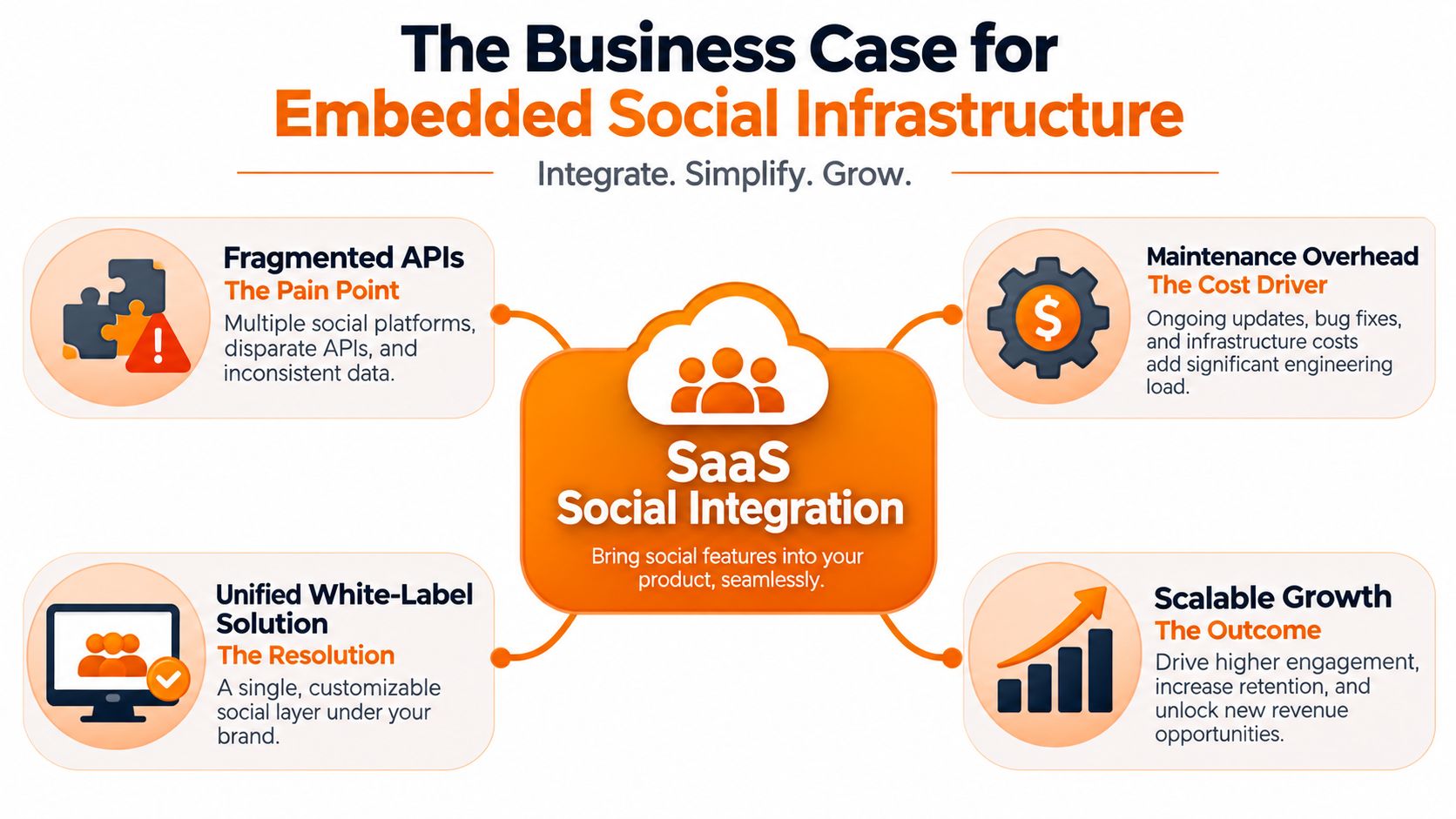
Rebranding a dashboard versus embedding infrastructure
A traditional white-label product gives you a configured surface. You change the logo, colors, and perhaps the sign-in page, while the vendor owns the workflow underneath. That can be useful when your customers have standard needs and you need to launch quickly.
An embedded social layer is different. Your product owns the customer journey, data model, permissions, billing relationship, and user experience. The underlying service handles platform-specific operations, while your application decides how campaigns are created, approved, scheduled, and measured.
That distinction matters because social APIs don't fail uniformly. One destination may accept a media object while another requires a derivative. One account may need a refreshed token while another has been disconnected. A headless integration can expose a clean campaign object to your application and absorb those differences behind a stable contract.
Practical rule: Treat the social provider as infrastructure, not as the customer experience.
Why resale models keep appearing
The commercial model is already familiar to agencies. A 2026 Vendasta report on white-label marketing tools cited an Agency Insights Report survey of more than 400 North American agencies, where 66% said they already resold white-label marketing tools. That result isn't a universal market share, but it is a concrete adoption benchmark for a substantial agency cohort.
Resale works because the agency contributes the relationship, positioning, editorial judgment, and service layer. The infrastructure provider contributes the difficult technical system. In social media, the packaged service may include content calendars, approvals, publishing, analytics, and account management, all presented under the agency's name.
Product teams can apply the same logic inside SaaS. Instead of building every network integration independently, they embed social capabilities as part of a broader workflow. Teams comparing adjacent marketing categories, including those looking to compare music marketing tools for 2026, should evaluate whether a platform offers a branded interface only or a genuine API layer that can support their own product.
For a clear distinction between presentation and delivery, see Mallary's explanation of white-labeling. The central decision is simple: if customers need your product to remain the place where work happens, a logo swap won't be enough. You need infrastructure that lets the social system disappear behind your brand without disappearing from your operational controls.
Architecting the Backend for Multi-Tenant Publishing
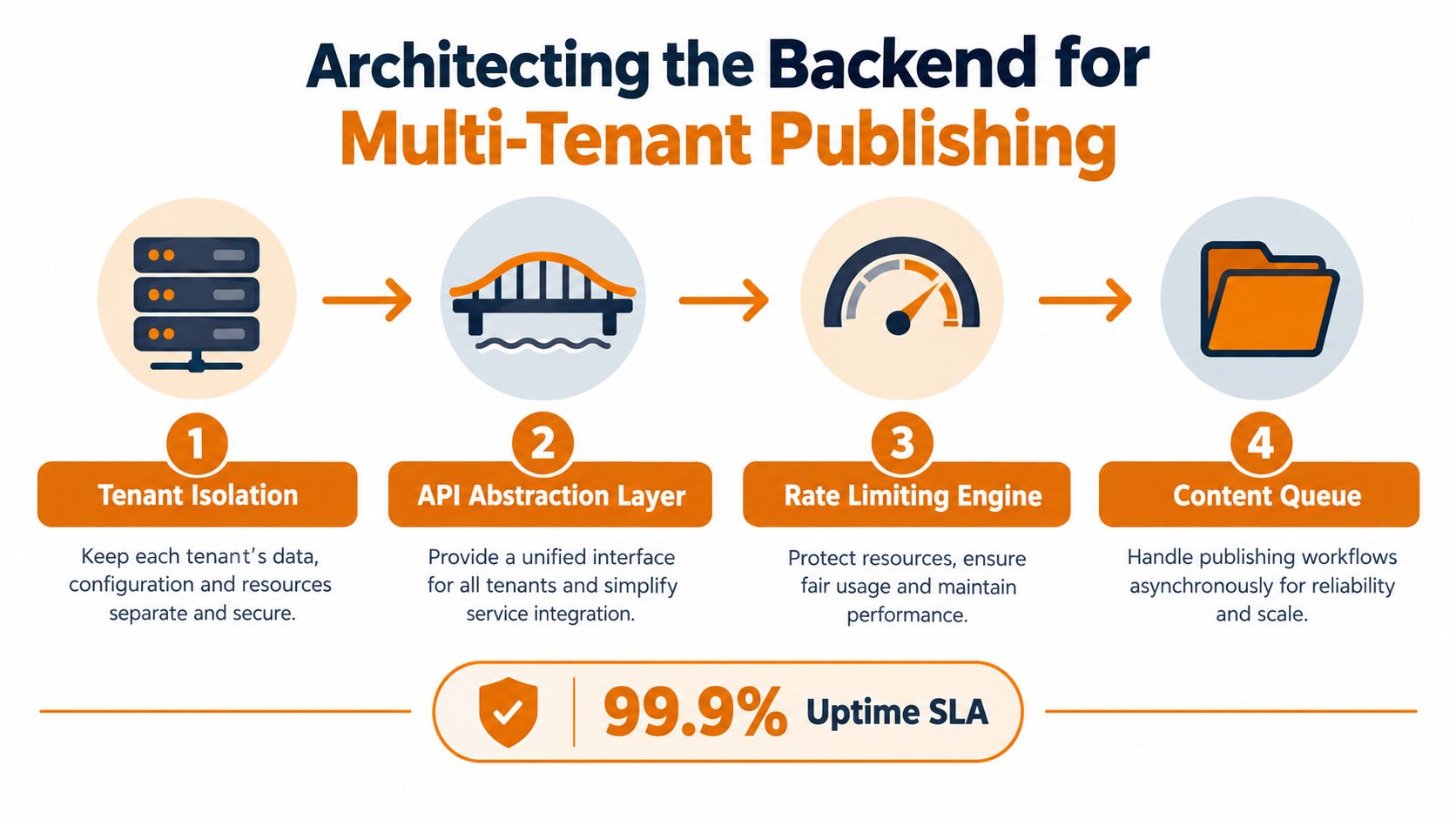
A multi-tenant publisher has two responsibilities that are easy to confuse. It must provide a consistent application contract, and it must preserve the isolation of every customer's credentials, assets, jobs, and reporting data. A shared queue with weak tenant boundaries can turn an isolated platform error into a cross-customer incident.
Start with a tenant-aware data model. Every connected account, asset, campaign, approval, delivery attempt, webhook, and metric record should carry a tenant identifier. Don't rely on a user interface filter for isolation. Enforce it in database queries, service authorization, object storage paths, cache keys, logs, and background workers.
Keep credentials and jobs tenant-safe
OAuth tokens shouldn't travel through ordinary application payloads or appear in logs. Store encrypted credentials separately from campaign content, record their expiry and scopes, and let a credential service handle refreshes. Workers should receive a narrowly scoped account reference, retrieve the credential only when needed, and redact provider responses before writing diagnostic logs.
A durable publishing job needs more than a timestamp. Store the campaign version, destination account, scheduled time, current state, provider request identifier, attempt count, and last error. That record lets operators distinguish a pending job from a failed job, and it gives your system enough information to resume safely.
A network timeout creates the classic duplicate-post problem. Your server may not know whether the provider accepted the request. If a worker retries the entire request, the customer can receive two posts. Use an idempotency key derived from the tenant, campaign version, destination account, and delivery operation. Persist the key before sending, and make repeated attempts resolve to the same delivery record.
Design retries around failure classes
Not every error deserves a retry. A temporary network failure, provider timeout, or rate-limit response may be recoverable. An invalid media format, revoked permission, or rejected policy claim usually needs a state change and human attention.
A useful worker flow looks like this:
- Lock the delivery record so two workers can't process it simultaneously.
- Validate credentials and payload state before making the provider request.
- Send with the idempotency key and record the provider response.
- Classify the result as successful, retryable, or terminal.
- Schedule a bounded retry with backoff for recoverable failures.
- Emit a tenant-scoped event so the customer's application can update its UI.
Rate limiting belongs in a shared policy layer, but the queue must still understand destination and account scope. One tenant publishing aggressively shouldn't consume capacity reserved for another. Per-provider and per-account budgets, combined with jittered backoff, are safer than a single global throttle.
A practical reference for the data boundaries, worker responsibilities, and account mapping involved in this design is Mallary's multi-tenant SaaS architecture guide. The implementation details will vary, but the invariants shouldn't: no cross-tenant reads, no duplicate delivery after uncertain outcomes, and no retry loop that hides a permanent content error.
Preflight Validation and Accessibility Metadata
A unified campaign payload is not a universal post. It should be the canonical source from which the system creates destination-specific versions.
Store the campaign's core asset, caption, CTA, rights metadata, target audience, locale, and approval state together. Keep the campaign identifier stable while generating derivatives for each destination. That lets reporting connect every published variant to the same campaign without pretending that every network received identical content.
Validate media before the queue
A preflight layer should run before a delivery job becomes publishable. It checks media type, dimensions, item count, caption behavior, required fields, account permissions, and destination-specific rules. For example, the supplied Instagram API documentation states that carousels support 2 to 10 items, while Stories support a single image or video and don't support captions. Those constraints belong in validation logic, not in a support article discovered after a failed publish.
| Platform | Media Constraint | Accessibility Requirement |
|---|---|---|
| Instagram feed | Carousel item count and media combinations must be validated before submission | Review alt text for informative images and ensure captions preserve the intended context |
| Instagram Stories | Use a single image or video, with no caption field | Add readable on-screen text, captions or subtitles for video, and a meaningful description in the originating content model |
| Video destinations | Validate duration, encoding, thumbnail, and subtitle derivatives per destination | Store captions or transcripts as structured metadata and review automated text for accuracy |
| Text and link posts | Adapt copy, links, previews, and calls to action to the destination's supported fields | Use descriptive link text, readable formatting, and hashtags that don't obscure meaning |
The table describes engineering controls rather than a promise that one accessibility field behaves identically everywhere. Preserve the original accessibility meaning when you crop, localize, resize, or convert an asset.
Accessibility is a data problem
A blank alt-text field can look compliant while describing nothing. Research summarized in the supplied evidence examined more than 1,000 social posts and reported that, among 349 image posts, 115 lacked alternative text and 209 contained inaccurate AI-generated alternative text. The finding is a warning against treating generated metadata as automatically correct.
Keep accessibility fields beside the canonical asset, then validate every derivative. The model should distinguish decorative imagery from informative imagery, require descriptions that reflect the post's call to action, and route uncertain output to human review. Validate subtitles, transcripts, contrast, readable text size, descriptive links, and hashtag formatting as part of the same preflight process.
A useful implementation separates three states: generated, reviewed, and approved. A derivative shouldn't inherit “approved” merely because the canonical asset was approved if cropping or localization changed the information conveyed.
Teams hiring engineers for this kind of work may find LatHire's resource for hiring Latin American developers useful when expanding backend capacity. For the validation design itself, Mallary's preflight checklist provides a practical way to turn platform rules and accessibility checks into explicit release gates.
Automating Engagement with AI Auto-Replies
Publishing creates a conversation queue. A customer asks about pricing, a prospect replies to a campaign, and another user makes a complaint that needs a person. If the white-label product handles only outbound scheduling, the customer still has to manage the most visible part of the interaction elsewhere.

An AI reply worker should begin with tenant context, not with a generic prompt. Load the client's approved voice, product facts, CTA rules, prohibited-claims library, escalation policy, and locale. Retrieve only the information belonging to that tenant, and record the policy version used to generate each response.
The system should classify inbound messages before drafting. A simple routing model can separate routine questions, purchase intent, support issues, abuse, regulated topics, and messages that require a human. Routine questions can receive a constrained answer. The other categories should create a review task or send a safe acknowledgement without making unsupported claims.
Guardrails must be operational
Prompt instructions alone aren't enough. Store approved answers and factual source material in a tenant-scoped knowledge layer. Limit the model's ability to invent prices, guarantees, availability, medical outcomes, legal conclusions, or product capabilities. Run output checks for banned phrases, unsupported claims, personal data, and links outside the approved domain.
The reply record should include:
- Tenant and account scope: Identify the brand, connected account, and conversation.
- Message version: Preserve the inbound text, context window, and generated draft.
- Policy state: Record the applicable voice, disclosure, and prohibited-claims rules.
- Approval path: Distinguish auto-published, human-approved, edited, and blocked responses.
- Delivery result: Store the provider response and any follow-up failure.
Safety boundary: An auto-reply should be easy to stop, easy to audit, and easy to hand off to a person.
Near real-time behavior also needs backpressure. Webhooks may arrive out of order, duplicate events may appear, and a user may send several messages before the first reply completes. Deduplicate inbound events, serialize replies per conversation when needed, and cancel stale drafts when a newer message changes the context.
For teams evaluating the category, this overview of AI social media management offers useful context on the difference between content generation and ongoing engagement. A white-label implementation should expose the distinction in its controls. Each client needs separate reply policies, credentials, approval thresholds, and audit records.
Navigating FTC Compliance and Chain of Custody
White-labeling doesn't remove accountability. It can make accountability harder to locate if the supplier, agency, client, and approval record live in separate systems.
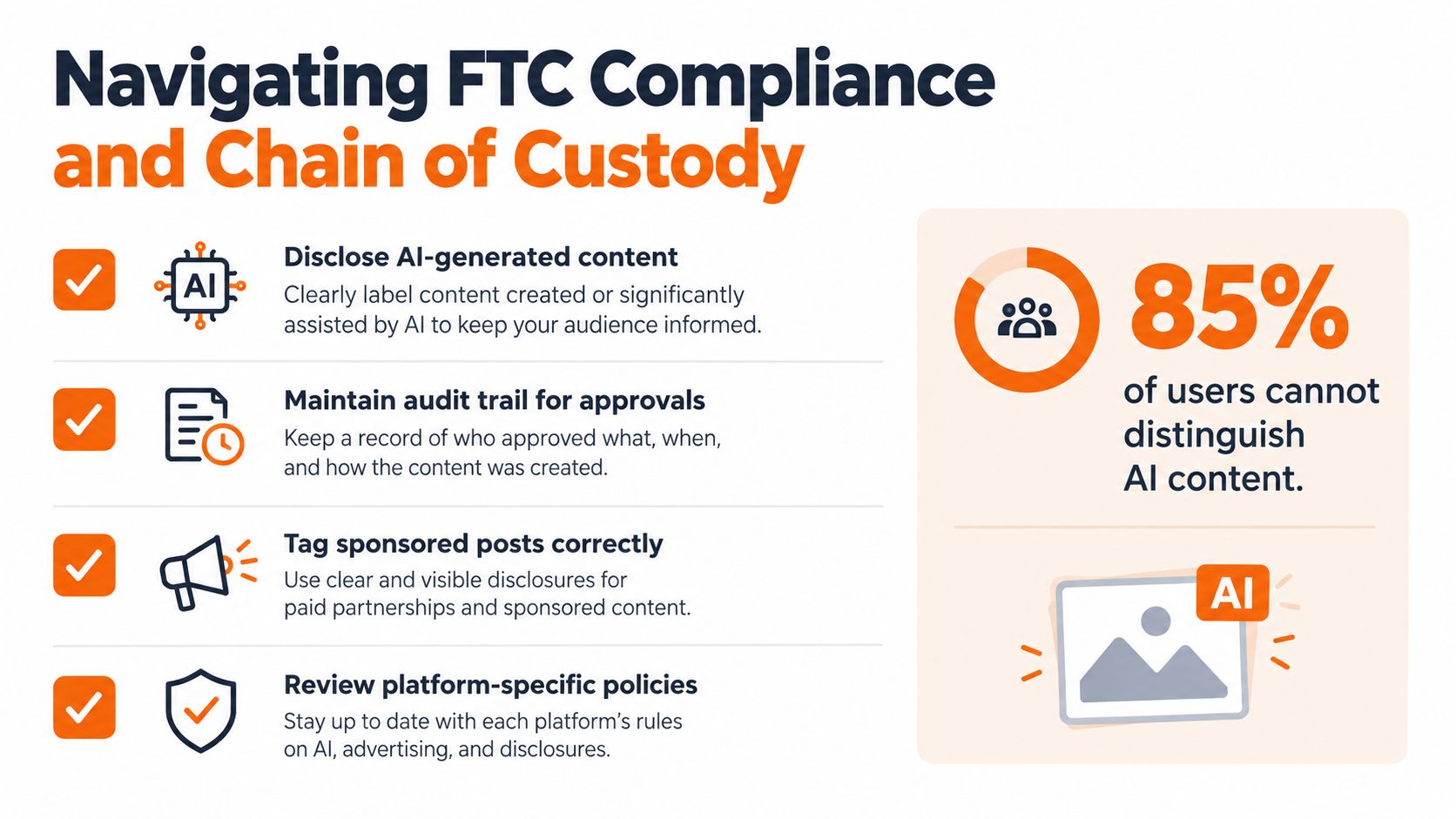
The Federal Trade Commission says material connections between an endorser and seller should be disclosed clearly and conspicuously. Its guidance also explains that advertising agencies and other intermediaries may face liability when they create or distribute deceptive endorsements, or when they omit required disclosures. Social disclosures should be unavoidable and shouldn't be contradicted by the surrounding message. The relevant FTC guidance on endorsements and testimonials should inform both product requirements and client contracts.
Invisible infrastructure still needs visible records
A customer doesn't need to see the underlying provider, but your system needs to preserve who supplied and approved the content. A chain of custody can be represented as structured metadata:
- Source record: Store the origin of the claim, testimonial, image, or endorsement.
- Editorial decision: Identify who drafted, edited, and approved the content.
- Disclosure state: Require the relevant commercial relationship or sponsorship disclosure before publishing.
- Policy result: Record automated checks, blocked phrases, and the reason for any override.
- Publication history: Preserve campaign version, locale, destination, timestamp, and delivery result.
Make disclosure a required field where the campaign type demands it. Don't bury it in optional notes. If the field is missing, the destination job should remain blocked rather than publishing a potentially misleading post without a warning.
Client-level prohibited-claims libraries are equally important. A regulated client may prohibit specific promises, before-and-after language, unsupported outcomes, or unverified testimonials. Store those rules per tenant and apply them to generated captions, localized variants, comments, and replies.
Human review belongs at the risk boundary
Automation is appropriate for repetitive checks and low-risk responses. It shouldn't decide whether a testimonial is authentic, whether a material connection needs disclosure, or whether a regulated claim is adequately supported. Route those decisions to a named reviewer and retain the review event.
The product can stay fully branded while the governance layer remains precise. In fact, the less visible the infrastructure is, the more important it becomes to expose approval history, policy status, and rollback controls to authorized operators. “White label” should describe the customer experience, not erase the evidence needed to investigate a complaint.
Designing Controlled Testing and Performance Baselines
Publishing the same creative, caption, CTA, and timing across every network produces a report, but not a useful experiment. If performance changes, you won't know whether the audience, delivery system, asset, or message caused the difference.
Start by freezing the variables that shouldn't change. Define the audience, objective, posting window, landing page, budget status, and primary metric. Then change one element, such as the opening hook, first frame, CTA, or caption, across randomized or matched audience splits.
Build experiments around campaign versions
A campaign object should expose the variables that matter instead of hiding them inside a final rendered post. Record creative version, locale, platform, timestamp, paid-versus-organic status, audience definition, and approval state. Keep a baseline or holdout cohort where the channel and audience make that practical.
The test record should answer five questions:
- What changed?
- Which audience received each version?
- What was the primary metric?
- What minimum sample threshold was defined before launch?
- What delivery differences could distort the comparison?
Don't promote a winner from impressions alone. Distribution can rise while meaningful actions decline. Use reach-normalized engagement, saves, shares, clicks, qualified replies, or downstream conversions according to the campaign objective. Keep rolling 30-day or 90-day baselines rather than treating historical averages as permanent targets. Sprout Social's 2024 report found average daily inbound engagements declined 12.5%, from 80 to 70, between 2022 and 2023 in its cited report, which illustrates why a fixed historical benchmark can mislead.
Account for delivery noise
Social platforms don't deliver matched variants with perfect symmetry. Timing, inventory, audience composition, moderation, and account-level limits can introduce differences that have nothing to do with the creative. Flag low-sample tests, report confidence intervals where your measurement design supports them, and avoid making strong claims from unstable results.
Tenant controls should make disciplined testing easy:
- Variable controls: Let operators select one test dimension and lock the rest.
- Baseline controls: Preserve an unchanged comparison version when feasible.
- Metadata controls: Attach locale, platform, audience, and delivery status to every result.
- Approval controls: Require review for regulated claims, licensed assets, and AI-generated replies.
- Promotion controls: Prevent a draft winner from becoming the default until the operator records a decision.
A supplied industry case reported CTR moving from 0.8% to 1.9% and ROAS from 1.1x to 2.3x, but those are case-specific figures, not general benchmarks. Treat them as an example of why controlled localization can matter, not as a promise for your customers.
The engineering payoff is traceability. When every delivery maps to a versioned campaign object and every metric retains its original platform dimensions, your client reports can remain branded without becoming vague. That is the standard worth building toward, whether you use a managed API, an internal integration layer, or a hybrid architecture.
Mallary.ai provides a white-labelable API and dashboard for embedding social publishing, engagement, and analytics across a SaaS workflow, with platform-specific validation, OAuth handling, durable jobs, and AI-assisted replies. Visit Mallary.ai to evaluate how its infrastructure could fit your tenant model and approval requirements.
Try it with Mallary
STOP!
Want ChatGPT or Claude to post on social media for you?
Connect your social accounts one time. Then tell your AI what to write. It can make your posts, share them, and reply on social sites that allow replies. You do not need to write code.
Pick your AI





Connect once. Ask in plain English. Mallary does the work.


