
September 18, 2026
Social Media Marketing API: The Developer Guide
STOP!
Want ChatGPT or Claude to post on social media for you?
Connect your social accounts one time. Then tell your AI what to write. It can make your posts, share them, and reply on social sites that allow replies. You do not need to write code.
Pick your AI





Connect once. Ask in plain English. Mallary does the work.
Your team inherits six social integrations on a Friday afternoon. Each one uses a different API version, token refresh behaves differently, retries are inconsistent, and webhook signatures aren't verified in the same way. A campaign that looks like one “publish” action in the product becomes six payload formats, six media validation paths, six sets of rate limits, and six ways for a successful request to turn into an ambiguous failure.
That's social media marketing API problem in 2026. Endpoint knowledge still matters, but reliable infrastructure also needs payload adaptation, centralized throttling, durable queues, idempotent event handling, preflight policy checks, and a plan for metrics that platforms can rename or remove. Meta's release history makes the maintenance burden concrete. On May 21, 2024, Meta introduced Graph API v20.0 and Marketing API v20.0, added six Instagram carousel-container metrics, and announced retirement timelines for older versions and demographic metrics during a 90-day transition window ending August 19, 2024. Marketing API v18.0 was scheduled for deprecation on August 13, 2024, and v19.0 on February 4, 2025, as documented in Meta's Graph and Marketing API v20 announcement.
The practical question isn't “What endpoint publishes a post?” It's “How does the system keep working when the platform, provider, payload, token, or metric definition changes?”
Table of Contents
- The Friday Afternoon Social API Problem
- Core Concepts Behind Every Social Media Marketing API
- Publishing Endpoints and Payloads Across Major Networks
- Rate Limits, Retries, and Two-Layer Throttling
- Engagement and Analytics Endpoints You Can Still Trust
- Webhooks, Signatures, and Idempotent Event Handling
- Platform Rules for Media, Captions, and Comment Behavior
- SDK, CLI, and Code Examples for Common Calls
- Build Direct vs Adopt a Unified Social Media Marketing API
- Integration Patterns for SaaS, Agencies, and AI Agents
- Quick Reference and Glossary
The Friday Afternoon Social API Problem
The incident usually starts innocently. A product team adds a social publishing feature, supports one network, then another, and eventually inherits a collection of integrations that grew around urgent customer requests. One connector stores long-lived credentials, another refreshes tokens inside request handlers, and a third assumes that a webhook delivery can be processed synchronously before acknowledging it.
The application may appear healthy in normal traffic. Then a platform changes a required scope, rejects a media container that used to pass validation, or returns a throttling response while the provider is also enforcing its own quota. A retry loop amplifies the problem. Analytics backfills compete with live publishing. The operator sees a queue full of jobs that have no consistent state model.
What a modern integration must absorb
A production social media marketing API layer needs to account for:
- Fragmented authorization: OAuth scopes, account roles, page access, refresh behavior, and reauthorization requirements differ by network.
- Version churn: Platform versions have defined lifecycles, and old fields can disappear before a team notices.
- Media-specific validation: A photo, short video, carousel, article, or pin can require a different upload sequence and different metadata.
- Two throttling layers: The platform can enforce one ceiling while an aggregation provider enforces another. Recent coverage of social API rate limits describes this as a separate platform limit and provider limit, with 429 handling,
Retry-After, exponential backoff, jitter, and write queues needed for reliable publishing. - Analytics deprecations: A metric name isn't a permanent contract. Availability, retention, and meaning can change independently.
- Automated traffic: AI agents can generate bursts of publish, comment, and analytics requests unless a policy layer controls tool calls.
Practical rule: Treat every platform adapter as a replaceable boundary, not as business logic embedded throughout the product.
The architecture that survives this environment is deliberately boring. A canonical post enters a validation layer, an adapter converts it into a network-specific payload, a scheduler assigns it to a platform-aware queue, and a durable job record tracks every transition. Webhooks update state when the platform sends an event, while polling remains a bounded fallback for asynchronous operations.
That operational lens matters more than memorizing endpoint names. The endpoint is only one part of a chain that must make retries safe, make failures explainable, and keep one network's outage from blocking the others.
Core Concepts Behind Every Social Media Marketing API
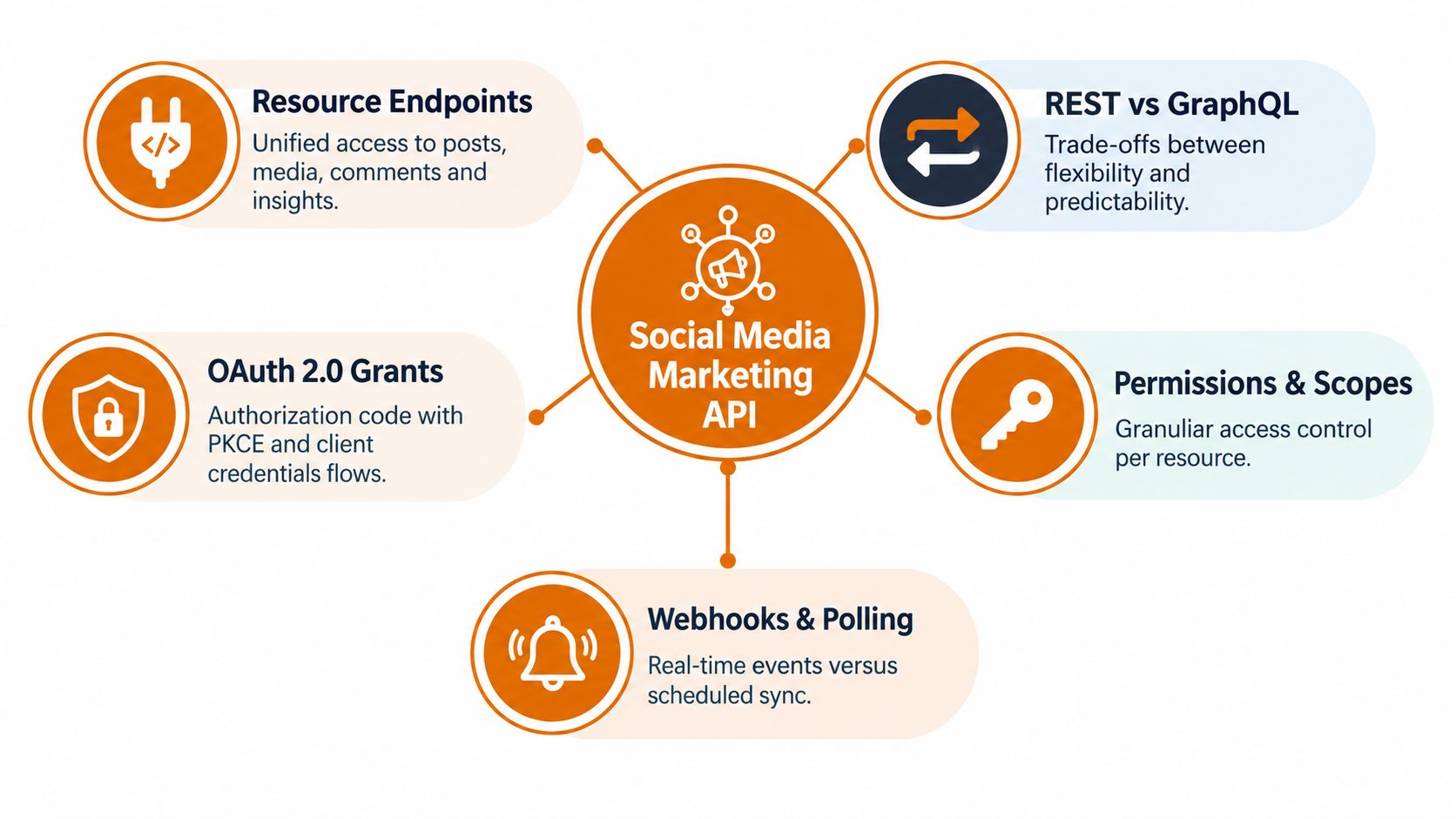
Every social platform exposes the same broad primitives, even though the names and payloads vary. A useful mental model is simple: endpoints act on resources, scopes grant capabilities, webhooks invert the request, and idempotency makes retries safe.
Resource endpoints
A REST API usually models resources such as accounts, media objects, posts, comments, and insights. GET reads a resource, POST creates an action or object, DELETE removes one, and platform-specific update operations change state. REST is predictable and easy to observe with ordinary HTTP tooling.
GraphQL can reduce round trips when a dashboard needs related account, post, and metric data in one query. The trade-off is operational complexity. Query cost, field availability, authorization failures, and schema evolution need more careful controls than a small set of REST calls. For a cross-network system, a stable internal model is usually more valuable than forcing every provider into one query language.
OAuth and scopes
OAuth 2.0 separates user consent from application access. Authorization code with PKCE is the usual choice for an interactive connection flow because the application exchanges a short-lived code for tokens without placing a client secret in a public client. Client credentials suits server-to-server access where no user resource is involved. A refresh token lets the server obtain a new access token, subject to the platform's rules.
Scopes are capability boundaries. Store them with the connection record, not in assumptions scattered across code. A publishing feature may need media and account permissions, while analytics or comment actions can require additional approval. When an API returns an error envelope, preserve the provider code, HTTP status, request identifier, and raw response metadata. Those details turn a vague “publish failed” message into a supportable diagnosis.
Webhooks and idempotency
A webhook is an HTTP callback sent when a subscribed resource changes. Your handler should verify the signature, persist the delivery, and enqueue work before acknowledging it. A polling loop asks whether anything changed. A webhook lets the platform tell you that something changed, which is why Meta's webhook guidance recommends event-driven detection to reduce unnecessary Graph API calls and the risk of hitting limits.
An idempotency key identifies the logical operation, such as “publish this canonical post to this account.” If the client times out after the platform accepted the request, retrying with the same key should not create a duplicate. Keep the key and resulting provider object ID in durable storage. That one design choice prevents many duplicate-post incidents.
Publishing Endpoints and Payloads Across Major Networks
A canonical request might contain a caption, media references, destination accounts, and a desired publish time. The platform adapters still need to make very different decisions about uploads, containers, URLs, status checks, and required fields.
| Platform | Publish Endpoint | Required Payload Fields | Media Upload Flow | Publish Status |
|---|---|---|---|---|
| Meta | /me/photos or /{page-id}/feed |
Access token, media or message fields, destination context | Image or video handling varies by object and account type | Read the returned object and reconcile later events |
| X API v2 | POST /2/tweets |
Bearer authorization, text, optional media IDs or reply context | Upload media separately, then reference returned media IDs | Tweet object returned synchronously when accepted |
/rest/posts |
Author URN, commentary, visibility, lifecycle state, content | Register or upload media before creating the post | Post response plus later reconciliation | |
| TikTok | /v2/post/publish/video/init |
Access token, source or upload information, publish settings | Initialize a video post, upload or reference media, then complete publishing | Often asynchronous, so track provider status |
| YouTube | videos.insert |
OAuth authorization, video metadata, upload body | Resumable upload is the safer choice for larger video files | Video resource returned after upload processing begins |
/v5/pins |
Board, title or description, media source, link where applicable | Supply an image or video source in the pin payload | Pin object returned, with later media processing possible |
Same intent, different validation
The differences aren't cosmetic. TikTok and Instagram-style publishing can use a container-then-publish sequence, while YouTube's video path is built around media upload and metadata insertion. X expects media identifiers created by a separate upload flow. LinkedIn requires an author identity and content structure that doesn't map cleanly to a simple page feed. Pinterest ties publishing to board permissions and pin-specific media fields.
A adapter receives an internal object such as:
textmedia[]account_idpublish_atreply_tolinkidempotency_key
It then produces a provider request, records the mapping, and returns a normalized job state. The adapter shouldn't leak platform-specific fields into the rest of the application unless the product intentionally exposes them.
Synchronous acceptance isn't final success
A 200 or 201 response often means the platform accepted the request. It may not mean the media is processed, the post is visible, or the final URL is available. Store states such as queued, accepted, processing, published, failed, and unknown, along with the raw provider response.
Many direct integrations fail. They mark a job complete at the first successful HTTP response, then have no way to reconcile an asynchronous media rejection. A durable state machine, provider status polling where permitted, and webhook reconciliation provide a much more accurate result.
Rate Limits, Retries, and Two-Layer Throttling
Most publishing outages aren't caused by malformed business logic. They come from a request cascade. A worker retries a throttled call, the retry competes with analytics traffic, the provider applies its own quota, and every tenant experiences a slower queue.
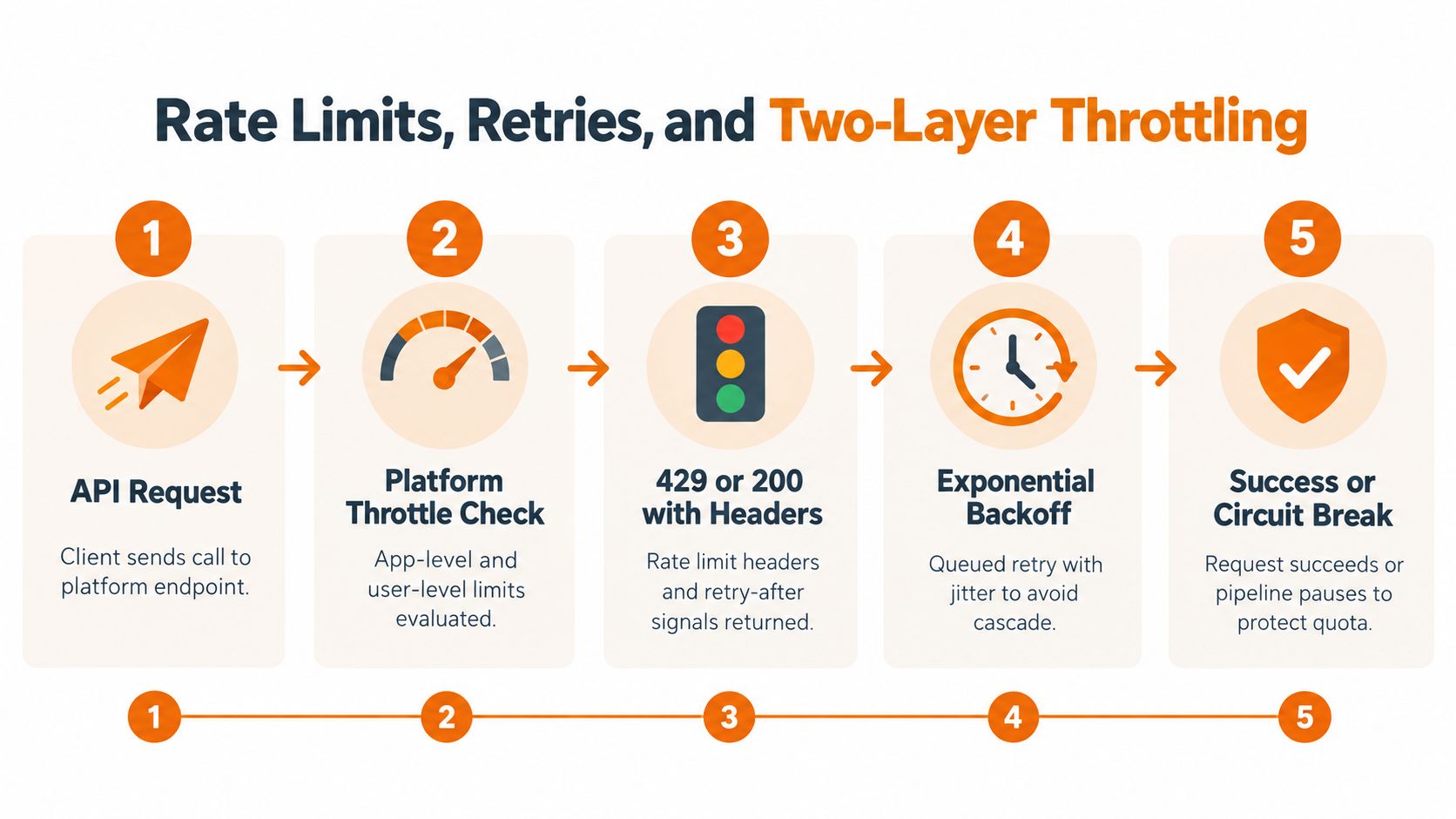
The important architectural fact is that there are two independent limit layers. The social platform can throttle the app or user, while the unified provider can throttle the account, workspace, or plan. A request can pass one layer and fail at the next.
Build one admission controller
Don't let every worker decide independently whether it can call a platform. Put admission control in front of provider requests and key the budget by the dimensions that matter, such as tenant, connected account, app, endpoint family, and platform.
Meta states that limits can apply at both app and user level. Marketing API and Instagram Platform requests use Business Use Case limits rather than the standard Graph API platform limit, and exceeding request, CPU, or total-time thresholds can trigger throttling, as described in Meta's rate-limiting documentation. Your controller should therefore observe response headers and provider usage, not rely on one universal counter.
When a request receives 429, inspect Retry-After if present. For platforms that expose remaining and reset headers, such as X, use those values to schedule the next attempt. Apply exponential backoff with decorrelated jitter, cap the delay, and stop retrying after a bounded policy. A poison message belongs in a dead-letter queue with the full request context, not in an endless retry loop.
The retry policy belongs beside the queue, not inside a platform-specific HTTP helper.
Keep publishing and analytics backfills in separate queues. Publishing is user-visible and latency-sensitive. Historical analytics can wait, and allowing it to consume the same concurrency budget creates avoidable incidents.
A useful alert set includes rising 429 responses, shrinking remaining quota, repeated token refresh failures, queue age, dead-letter growth, and a growing count of jobs in unknown state. Operators should see those signals before customers report missing posts.
For a deeper implementation discussion focused on provider and platform quotas, use this guide to API rate limits and resilient publishing.
The following video provides a visual overview of throttling and retry behavior:
Engagement and Analytics Endpoints You Can Still Trust
A dashboard can look precise while its underlying metrics keep changing. A post-level comment count is usually easier to interpret than platform-defined measures such as impression source, virality rate, or follower demographics. Those fields depend on permissions, retention windows, account type, and definitions that providers may revise.
Meta's 2024 API changes show the operational risk. The v20 release added six Instagram carousel-container metrics, including Likes, Comments, Shares, Follows, Profile Activity, and Profile Visits. Older versions were scheduled to lose certain demographic audience metrics after the stated transition period, as described in Meta's release documentation. Other Meta surfaces removed Page Insights metrics and replaced “impressions” with “views” in some cases. An analytics warehouse should therefore retain the provider field, collection time, and definition version. Do not rename every input into a timeless internal schema.
Separate engagement from interpretation
Use read endpoints for post-level likes, comments, shares, and available profile activity. Calculate derived metrics in your own system, and store the input fields and formula version beside each result. Sentiment analysis over short comments remains fragile because sarcasm, ambiguity, and language differences can change the outcome. If sentiment is part of the product, retain permitted raw comment text, model version, confidence, and review path together.
Historical coverage is not uniform across networks. Facebook insights may retain data for up to two years, LinkedIn may provide a rolling 12-month window, Instagram user metrics may cover up to 90 days, and X organic metrics may apply only to posts created within the previous 30 days. A unified analytics API can normalize coverage across seven networks, but platform retention limits still produce non-comparable time spans. Review this comparison of social media analytics API retention and metric coverage before promising a cross-network historical dashboard.
| Platform | Engagement Read | Comments/Replies Write | Insights Endpoint | Retention Window | Notes |
|---|---|---|---|---|---|
| Meta | Post and account engagement where permissioned | Platform-specific comment and reply objects | Graph and Marketing surfaces | Varies by metric and object | Metric names and availability can change |
| X | Post engagement fields subject to access | Reply and conversation operations | API analytics fields where available | Shorter windows can apply | Preserve raw response and access context |
| Social actions on supported content | Author and permission rules apply | Organization and member analytics | Rolling history can apply | Normalize only with a documented definition | |
| TikTok | Available video and account metrics | Product and permission dependent | Business and content insights | Window varies by endpoint | Do not assume demographic coverage |
| YouTube | Video engagement resources | Comment thread resources | YouTube Analytics surfaces | Query and account dependent | Upload processing and analytics timing differ |
| Pin engagement where exposed | Pin and comment capabilities vary | Account and pin analytics | Endpoint dependent | Board permissions affect access |
A production schema should keep raw responses, access context, provider timestamps, and the metric definition used at collection time. Store normalized values separately, with a source field and formula version, so a provider change does not rewrite historical reporting. For implementation patterns covering normalized metrics, pagination, and provider differences, see this social media analytics API guide.
Webhooks, Signatures, and Idempotent Event Handling
Polling is easy to write and expensive to operate. A worker repeatedly asks whether a comment, publish status, or account change exists, even when nothing has happened. Webhooks reverse that flow, but they introduce their own responsibilities: subscription management, signature verification, replay protection, persistence, ordering, and retry handling.
Verify before you process
Each platform names its signature header differently. Meta commonly uses X-Hub-Signature-256, while X uses X-Twitter-Webhooks-Signature. The underlying pattern is often HMAC-SHA256 over the exact raw request body, but the header format, secret, and verification details are provider-specific. Never parse and reserialize JSON before calculating the signature.
A safe handler follows this sequence:
- Read the raw body and signature headers.
- Verify the HMAC using the configured application secret.
- Check the timestamp window where the provider supplies a timestamp.
- Derive an idempotency key from the delivery identifier.
- Persist the delivery and event payload.
- Return success only after persistence.
- Enqueue expensive work for a worker.
- Dead-letter deliveries that repeatedly fail validation or processing.
The persistence record should include the platform, account, delivery ID, received time, signature result, event type, and processing state. A unique constraint on platform plus delivery ID makes duplicate deliveries harmless. If the provider emits sequence numbers, store them and detect gaps or out-of-order events rather than assuming arrival order.

Acknowledge durable receipt, not completed work
Webhook providers can retry for a long period, sometimes beyond a day. A handler that performs database writes, sentiment analysis, notification delivery, and an external CRM call before responding is difficult to reason about. Persist first, acknowledge, and let workers handle downstream effects with their own idempotency keys.
You can find a practical explanation of this request inversion in what a webhook is and how it works. The key design decision is to treat the webhook stream as durable input, not as a best-effort notification.
Platform Rules for Media, Captions, and Comment Behavior
A valid HTTP request can still produce a rejected post because the media or behavior violates a network rule. These rules belong in a preflight validator, not in a support ticket after a campaign misses its scheduled window.
Validate what you can before upload. File type, dimensions, duration, aspect ratio, caption encoding, account permissions, and required destination IDs are cheap to check locally. Validate what depends on the platform after upload, such as media processing state, link preview generation, board eligibility, or final publishing approval.
Keep platform constraints explicit
Don't hide rules inside scattered conditionals. Store them as versioned capabilities attached to each adapter, and return a structured error that identifies the field, rule, and remediation.
| Platform | Media Ratio | Caption Limit | Comment Depth | Link Handling |
|---|---|---|---|---|
| Meta | Format and placement dependent | Surface and media dependent | Reply hierarchy differs by object | Preview and permission behavior varies |
| X | Media and account rules apply | Tier and product dependent | Threads and replies use conversation context | Card rendering depends on URL and metadata |
| Post type and media dependent | Content-type dependent | Nested reply behavior is limited | Article previews can transform supplied URLs | |
| TikTok | Video format and posting permissions apply | Caption and feature rules vary | Comment features depend on account and API access | Link behavior is product-specific |
| YouTube | Video and thumbnail requirements apply | Metadata fields have separate constraints | Comment threads use their own resources | Description links follow YouTube behavior |
| Pin type and board rules apply | Title and description fields differ | Engagement model differs from feed networks | Destination URL is part of the pin model |
Some failures can be caught before the network call. A media validator can reject an unsupported ratio, missing audio requirement, oversized thumbnail, invalid character encoding, or unavailable account permission. Other failures only appear at publish time, so the job must remain recoverable rather than being marked permanently failed after one response.
Comment behavior needs the same treatment. A “reply” might mean a direct child comment on one network, a conversation reply on another, or an operation with limited nesting. Store both the canonical parent reference and the provider parent ID. Avoid assuming that a first-comment tactic, hashtag behavior, or link placement is portable across networks. Platform rules change, and the adapter should fail clearly when a requested behavior isn't supported.
SDK, CLI, and Code Examples for Common Calls
A unified client should make the common path short without hiding the operational state. The example below uses illustrative request shapes, so production code must follow the selected provider's current schema and authentication requirements.

const post = await client.posts.create({
  text: "Release notes are live.",
  media: [{ url: mediaUrl, type: "image" }],
  destinations: [
    { platform: "meta", accountId: metaAccount },
    { platform: "x", accountId: xAccount },
    { platform: "linkedin", accountId: linkedinAccount }
  ],
  publishAt: null,
  idempotencyKey: "post-release-notes-001"
});

console.log(post.jobId);
The value of this abstraction isn't only fewer lines. It centralizes token refresh, queue admission, normalized job states, and retry policy. The trade-off is that advanced platform features may require an escape hatch for native fields.
Direct calls expose the integration tax
A direct Meta call may require a page or user token and a platform-specific object path:
await fetch(` {
  method: "POST",
  headers: { Authorization: `Bearer ${metaToken}` },
  body: new URLSearchParams({ message: text })
});
X uses a different resource shape and may need a media upload before the tweet request:
await fetch("https://api.x.com/2/tweets", {
  method: "POST",
  headers: {
    Authorization: `Bearer ${xToken}`,
    "Content-Type": "application/json"
  },
  body: JSON.stringify({ text })
});
LinkedIn requires an author identity and a structured post body:
await fetch("https://api.linkedin.com/rest/posts", {
  method: "POST",
  headers: {
    Authorization: `Bearer ${linkedinToken}`,
    "Content-Type": "application/json",
    "LinkedIn-Version": "202501"
  },
  body: JSON.stringify({
    author: `urn:li:person:${personId}`,
    commentary: text,
    visibility: "PUBLIC",
    lifecycleState: "PUBLISHED"
  })
});
Those calls omit refresh-token exchange, upload handling, rate budgets, idempotency, and reconciliation. Put retry decorators around the queue worker, not around every low-level request without regard for operation safety. Mock signatures using the raw body and a test secret, then verify duplicate deliveries, stale timestamps, invalid signatures, and worker redelivery.
A small incident CLI is useful:
curl -X POST  \
  -H "Authorization: Bearer $API_TOKEN" \
  -H "Content-Type: application/json" \
  -H "Idempotency-Key: incident-post-001" \
  -d '{"text":"Service update","destinations":[{"accountId":"acct_123"}]}'
The minimum integration suite should test token expiry, revoked scopes, unsupported media, duplicate submission, 429, Retry-After, provider timeout, asynchronous failure, webhook replay, out-of-order delivery, and partial success across destinations.
Build Direct vs Adopt a Unified Social Media Marketing API
The build-versus-buy decision is a reliability and ownership decision, not a matter of engineering pride. Direct integration gives you maximum access to native features, direct visibility into provider behavior, and no abstraction fee. It also leaves your team responsible for token stores, version upgrades, schema migrations, platform approvals, support tooling, and every breaking change.
A unified layer trades some native depth for operational efficiency. You may wait for a provider to expose a new endpoint, accept a normalized schema that omits an edge feature, and manage vendor lock-in through exportable IDs and raw-response retention. Those costs are real.
A practical decision rubric
Build direct when:
- You support fewer networks and the scope is narrow.
- Posting volume is stable and predictable.
- A network-specific feature is central to your product.
- Your team can monitor deprecations and maintain approval workflows.
- You need complete control over request timing and raw payloads.
Adopt a unified API when:
- Customers connect many networks.
- Your product embeds publishing, engagement, and analytics for multiple tenants.
- You need common webhooks, queues, token refresh, and idempotency.
- AI agents can choose destinations dynamically.
- Your team would rather invest in the product than repeat connector maintenance.
Mallary.ai is one unified option that provides publishing, engagement, analytics, webhooks, token handling, retries, and platform-specific adaptation through a common developer surface. Evaluate it alongside direct APIs by checking native feature coverage, raw payload access, data retention, audit controls, failure transparency, and exit support.
The correct boundary is usually hybrid. Keep your canonical content model, policy engine, audit log, and tenant permissions in-house. Delegate repetitive platform plumbing only when the provider exposes enough status detail and operational control for your support team.
Integration Patterns for SaaS, Agencies, and AI Agents
A SaaS embed usually starts with one OAuth connection per tenant and a connection record that stores encrypted tokens, scopes, platform account IDs, and refresh state. The product submits a canonical post to a unified publish endpoint, receives a durable job ID, and consumes webhook events to update its own database. Rate budgets should be keyed per connected account and tenant so one customer's burst doesn't consume another customer's capacity.
An agency needs another layer of isolation. Group accounts by client, schedule jobs through platform-aware workers, and maintain split-fail queues. If LinkedIn rejects a media format or becomes unavailable, Meta deliveries should continue. The agency dashboard should show partial completion at destination level, not one red campaign-level error.
AI agents need event perception
An AI agent can use an MCP tool bridge to publish, inspect job status, fetch analytics, and draft replies. The agent shouldn't call platform endpoints directly from an unconstrained loop. Put the same preflight validator, authorization checks, idempotency policy, and rate admission controller in front of agent tools that protect human-triggered requests.
Webhook events become the agent's perception stream. A new comment can enter the system as a typed event containing account, post, author, comment, parent, and permissions. The agent can decide whether to answer, request approval, or ignore it, while the worker enforces policy and records the action.
This model keeps the AI layer replaceable. The platform adapters remain responsible for payloads and signatures, the queue remains responsible for retries, and the product remains responsible for user consent and auditability. That separation matters when an agent makes many decisions quickly.
Quick Reference and Glossary
| Endpoint Family | Auth | Common Failure | Recovery |
|---|---|---|---|
| Publish | OAuth user or page authorization | Invalid media or throttling | Preflight, queue, backoff |
| Engagement | Scoped account authorization | Missing parent or permission | Validate thread, reauthorize |
| Analytics | Read scopes | Retired or unavailable metric | Preserve raw fields, version definitions |
| Webhooks | App secret and subscription | Invalid signature or duplicate delivery | Verify, persist, deduplicate |
| Unified abstraction | Provider token plus connected accounts | Provider quota or unsupported feature | Inspect job state, use native escape hatch |
BUC means Business Use Case rate limiting. 429 indicates throttling. Retry-After tells a client when to try again. An idempotency key makes a repeated operation safe. An HMAC signature authenticates webhook content. MCP is a tool interface for connecting models to actions. A windowed rate limit applies a quota over a defined rolling or fixed period.
Mallary.ai gives product teams a unified API for publishing, engagement, analytics, webhooks, token refresh, retries, and durable social jobs across connected networks. If you're reducing multi-platform integration debt or building an AI-enabled publishing workflow, visit Mallary.ai to review the developer surface and start designing the operational layer around your product.


