Written by Outrank. Published by Mallary Labs LLC.
Published .
Instagram Facebook and Snapchat
A campaign can look perfectly organized in the content calendar and still fail at publication. The Reel crops badly on Facebook, the Snapchat version loses its native feel, the caption needs rewriting, and your analytics dashboard counts the same person twice across Meta surfaces. By the time the team fixes everything, “cross-platform distribution” has become three separate production jobs.
The right way to compare Instagram, Facebook, and Snapchat isn't to ask which platform is largest. Ask where a specific audience is most likely to act, which format the team can produce consistently, and how much platform-specific automation the workflow can support. That turns channel selection into a routing problem, not a popularity contest.
Table of Contents
- Why Instagram, Facebook, and Snapchat Are Not Interchangeable
- Scale, Reach, and Audience Intent in 2026
- Feature, Media, and Publishing Differences Compared
- APIs, Automation, and Cross-Posting Considerations
- Real Workflows for Creators, SaaS Teams, and Agencies
- The Hidden Cost of Cross-Posting Without a Strategy
- Which Platform Mix Fits Your Team and How to Run It
Why Instagram, Facebook, and Snapchat Are Not Interchangeable
Instagram, Facebook, and Snapchat can all distribute photos, video, stories, and advertising, but their operating conditions are different. A team that treats them as interchangeable usually creates one master asset, publishes it everywhere, and mistakes availability for suitability.
Use three filters before committing budget or production time.
Start with audience intent
People may open Instagram to discover a product, creator, or visual idea. Facebook often supports ongoing community activity, group participation, events, and familiar social connections. Snapchat is built around fast, personal, mobile-first communication, with public discovery layered onto an otherwise intimate product.
These aren't rigid user categories. They are useful defaults for routing. A product launch that needs visual consideration belongs naturally on Instagram. A local organization that depends on discussion and recurring community interaction may get more value from Facebook. A creator trying to capture spontaneous attention should consider Snapchat's informal, immediate environment.
Match the content lifespan
A Reel can continue finding viewers after publication. A Facebook post can support discussion, sharing, or reference over time. A Snapchat Story is more disposable, which changes both the creative brief and the audience expectation.
That difference affects production. Evergreen footage deserves captions, clean framing, and a deliberate call to action. Ephemeral content can be rougher and more conversational because the audience expects immediacy rather than polished permanence.
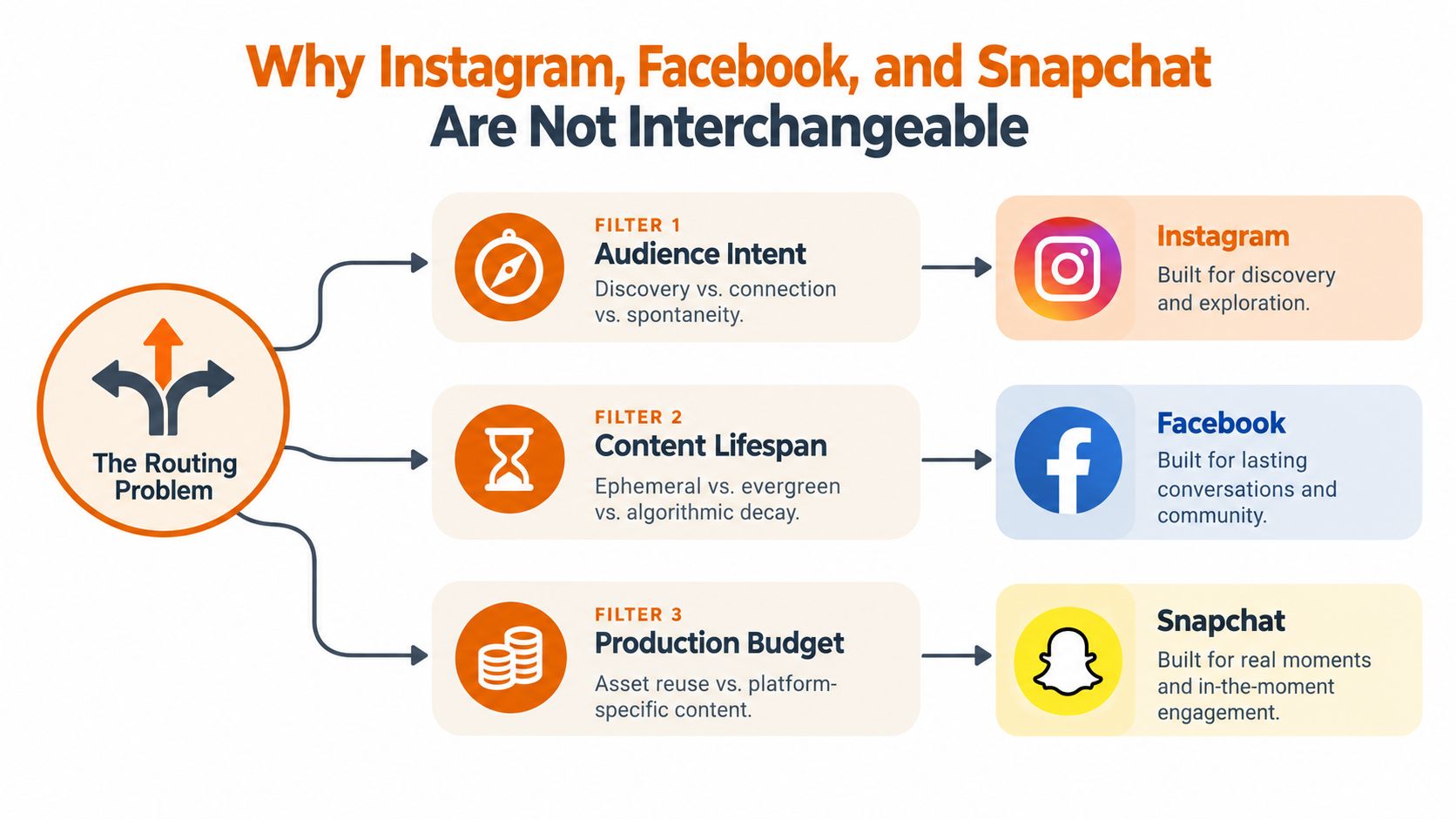
Measure automation friction before scaling
The final filter is operational. Can your publishing system create the right asset variant, obtain the required permissions, schedule the post, collect the relevant metrics, and retry a failed request without duplicating the post?
Instagram and Facebook can often share a connected Meta workflow, but that doesn't mean they share identical media behavior or reporting semantics. Snapchat should be treated as a separate delivery path unless your tooling explicitly supports the required publishing and measurement workflow.
Practical rule: Choose the platform where your audience intent, content lifespan, and automation capacity overlap. If only one of those three fits, don't scale the channel yet.
A strong 2026 mix therefore looks less like “post everywhere” and more like a routing table. One idea may become an Instagram Reel, a Facebook discussion prompt, and a Snapchat Story, but those are three executions with different jobs.
Scale, Reach, and Audience Intent in 2026
Raw audience size gives you context, not a media plan. Instagram reached 3 billion monthly active users in September 2025, after reaching 1 billion active users in 2018. Facebook had already crossed 1 billion users in 2012, and Meta reported 3.56 billion daily active people across its family of apps in Q1 2026. Those milestones explain why Meta remains central to global distribution, but they don't tell you which surface will produce useful action. Meta's reach and platform history provide the scale context.
Snapchat is large enough to deserve its own strategy. Separate 2026 reporting cited 483 million daily active users and 956 million monthly active users for Snapchat in Q1 2026, while Meta's family of apps reached the daily active figure noted above. AppTopia's Q1 2026 engagement analysis shows why those totals shouldn't be read as interchangeable attention pools.
| Platform | Reported Reach | Core Age Cohort | Dominant Intent |
|---|---|---|---|
| 3 billion monthly active users in September 2025 | Broad, with strong creator and discovery use | Visual discovery, consideration, identity, and creator interaction | |
| Largest platform by monthly active users in recent global reporting, within Meta's broader 3.56 billion daily active people in Q1 2026 | Broad, with stronger relevance among older adults and established communities | Community, discussion, events, retargeting, and familiar connections | |
| Snapchat | 483 million daily active users and 956 million monthly active users in Q1 2026 | More concentrated among teens and younger users | Private communication, spontaneity, lenses, Stories, and short-lived discovery |
Age fit can overturn a reach decision. Pew reported that half of U.S. adults use Instagram, while its 2025 teen survey reported that 55% of teens use Snapchat. The same Pew social media use report makes the important point indirectly through its audience breakdown: a platform's total scale doesn't tell you whether it reaches the life stage that matters to your offer.
Route by intent density
Instagram is usually the strongest first choice for products that need visual explanation, creator proof, or repeated brand exposure. Facebook earns priority when the conversion path includes Groups, local trust, events, discussion, or an audience that already uses the platform for ongoing relationships.
Snapchat deserves priority when the audience is younger and the creative concept benefits from immediacy, camera participation, or augmented reality. It shouldn't be added merely because the brand wants to claim presence across every major network.
Engagement direction matters as well. AppTopia reported that average time spent per daily active user grew 9.8% on Instagram and 10.3% on Facebook, while Snapchat declined 2.5% in its Q1 2026 analysis. That doesn't make Snapchat irrelevant. It means teams should demand a sharper reason for choosing Snapchat, such as a specific cohort, creator partnership, lens concept, or cultural moment.
Feature, Media, and Publishing Differences Compared
The first production mistake is treating a master video as a finished deliverable. It isn't. Each network has its own expectations around framing, captions, links, audience interaction, and measurement.
Instagram is the most natural home for vertical video, Reels, Stories, carousels, and visual profile discovery. Facebook supports a broader mix of feed posts, Reels, Groups, events, and paid placements. Snapchat is mobile-only and combines private communication with Stories, Spotlight, camera effects, and other fast-moving vertical surfaces. Research comparing the platforms found stronger bonding capital among Snapchat users and more daily time spent on Snapchat than Instagram, which reinforces the need to distinguish private connection from broad discovery. The platform comparison research is useful when designing audience segmentation.
| Criteria | Snapchat | ||
|---|---|---|---|
| Primary creative orientation | Vertical video, Stories, Reels, carousels, visual identity | Feed, Reels, Groups, events, community posts, and ads | Vertical camera content, Stories, Spotlight, and AR experiences |
| Content lifespan | Mix of persistent posts and temporary Stories | Persistent feed and community content, with format-dependent distribution | Strong emphasis on ephemeral communication, with public discovery through selected surfaces |
| Link behavior | More constrained on ordinary feed creative, with selected link surfaces | More flexible across pages, posts, ads, and destinations | Built around in-app viewing and mobile-first actions |
| Publishing workflow | Strong fit for structured visual publishing, but each format needs validation | Broad publishing and advertising surface with separate community considerations | More specialized workflow, especially for organic and camera-led content |
| Analytics baseline | Views, with format-level breakdowns still important | Views and surface-specific performance data | Surface and campaign metrics require separate interpretation |
| Pipeline risk | Wrong crop, missing format fields, and misleading cross-format comparisons | Caption, placement, community, and ad variation differences | Orientation, asset eligibility, ephemeral behavior, and limited reuse |
Meta's reporting language has also changed. Instagram and Facebook increasingly standardize around Views as the baseline metric, with Instagram dashboards shifting Reels, Stories, and posts away from Impressions or Plays. The social media analytics overview explains why a reporting layer should normalize Meta surfaces around Views while retaining the format breakdown.
That normalization is essential, but it shouldn't erase context. A Story View and a Reel View may both enter a top-line report, yet they represent different creative environments and different audience behavior. Store the network, format, organic or paid status, publication time, and campaign identifier alongside the normalized metric.
Design the asset pipeline around failure points
Build separate exports for vertical video, feed placements, Stories, and Snapchat delivery. Validate dimensions, duration, audio, captions, safe areas, thumbnail behavior, and link fields before a job reaches the publishing queue. A preflight check is cheaper than discovering a rejected asset after the campaign has started.
For teams building a direct integration, the Instagram API implementation guide is a useful technical reference for mapping publishing requirements to the product workflow. For audience-facing measurement, resources such as the Unfollowers Track like counter guide can help explain why visible interaction counts are only one part of Instagram performance analysis.
Don't use hashtags, link stickers, captions, or native scheduling as if they behave identically. They are platform features, not portable fields. Your content model should represent the shared idea separately from the network-specific execution.
APIs, Automation, and Cross-Posting Considerations
Cross-posting breaks when the system assumes that one OAuth token, one media object, and one response payload can serve every network. They can't. The practical architecture needs a shared campaign record and a platform-specific delivery layer.
Instagram's Graph API and Facebook's Marketing API generally provide the most mature foundation for Meta publishing, moderation, insights, and advertising workflows. Snapchat's Marketing API is more focused on advertising, conversion events, and approved creator or partner workflows. Organic publishing support should be verified against the account type and the current official product surface before you promise it to customers.
| Capability | Instagram Graph API | Facebook Marketing API | Snapchat Marketing API |
|---|---|---|---|
| Organic publishing | Suitable for supported professional publishing formats, with media validation required | Suitable for supported Page and content workflows | More limited and workflow-dependent, especially for organic Story publishing |
| Paid campaign management | Connected to Meta advertising workflows | Strong advertising and placement coverage | Advertising and conversion measurement are central use cases |
| Insights | Format and account metrics require normalization | Campaign, placement, and Page metrics need separate dimensions | Campaign and event metrics require Snapchat-specific mapping |
| Community automation | Comments and supported engagement actions can be routed through official permissions | Page and ad interactions can be handled through supported endpoints | Permissions and organic interaction workflows are narrower |
| Media handling | Queueing, transcoding, and format checks are essential | Placement variants and creative specifications require validation | Vertical media and platform-specific eligibility require dedicated checks |
| Reliability controls | Token refresh, retries, idempotency, and webhook processing | The same controls, plus ad-state tracking | The same controls, with extra care around asynchronous asset and campaign states |
Use queues, not chained requests
A reliable publisher accepts the campaign once, creates a delivery job for each destination, and records the result independently. If Instagram rejects a Reel because of a media problem, Facebook and Snapchat jobs shouldn't disappear. If Facebook succeeds and the worker times out before recording the response, an idempotency key prevents a duplicate post during retry.
The useful pattern is straightforward:
- Store the original asset and its intended use.
- Generate platform-specific variants in a media queue.
- Run preflight validation before API submission.
- Submit each destination as an independent job.
- Record external IDs, status, error codes, and timestamps.
- Ingest webhooks or poll only where the official workflow requires it.
- Normalize reporting after the network has returned its native metrics.
Snapchat should have its own adapter rather than a thin alias for the Meta adapter. Its mobile-only, ephemeral product model affects media handling, publishing assumptions, and retention of content references. Teams planning that integration can use the Snapchat API technical guide to map the platform's requirements before committing to a universal post schema.
Engineering rule: Share campaign intent, not blindly shared payloads. A universal payload is convenient until one platform silently ignores the fields your business depends on.
The same principle applies to analytics. Preserve native names and dimensions, then add normalized fields such as views, engagements, spend, and unique_reach where the data supports them. Never replace the original values with an aggregate that hides whether the audience came from a Reel, a Group, a Story, or a paid placement.
Real Workflows for Creators, SaaS Teams, and Agencies
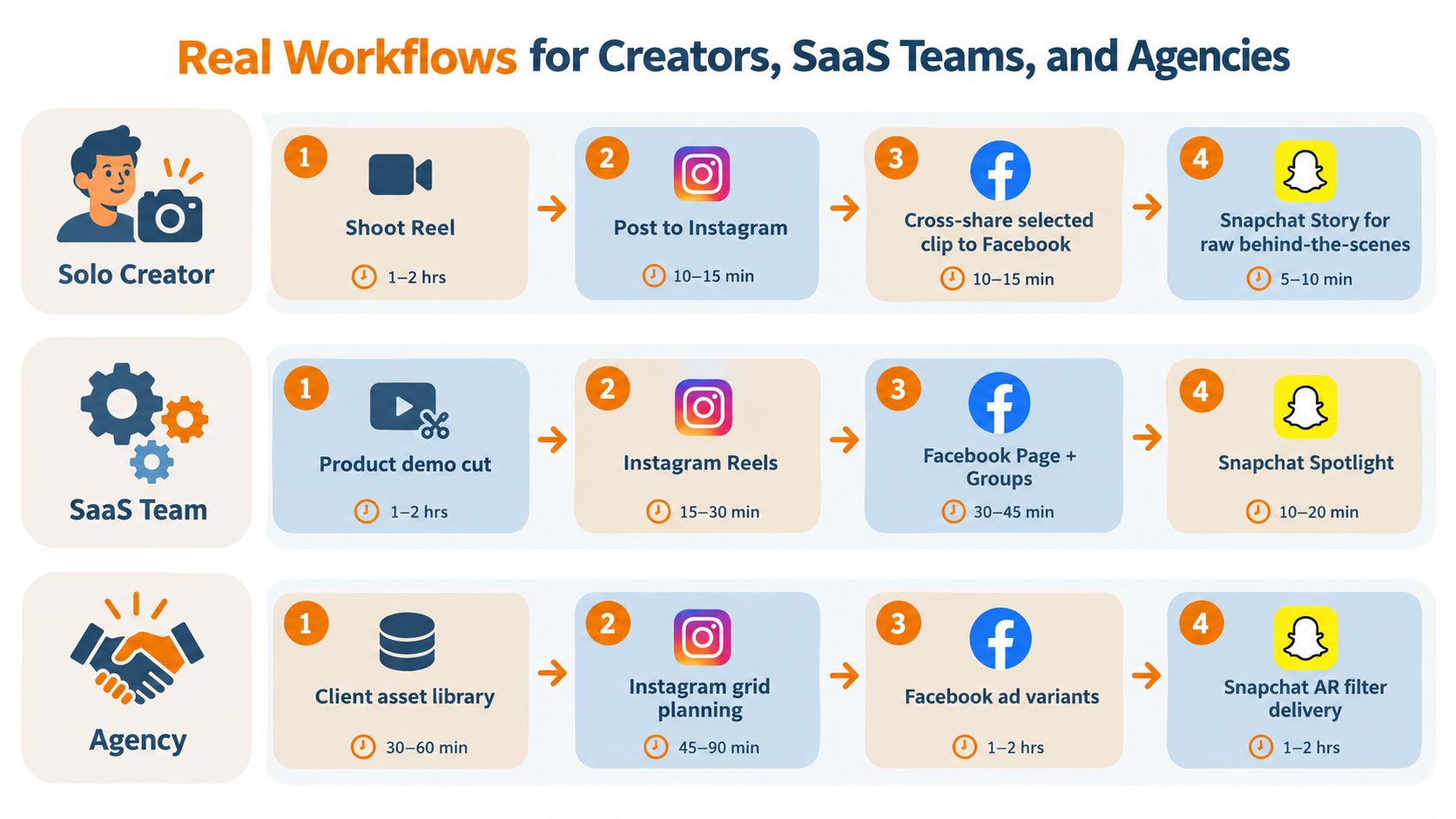
The strongest multi-platform systems split the work at the point where audience behavior changes. They don't force every network to carry the same asset in the same form.
A solo creator
A creator can record one central idea, publish the polished Reel on Instagram, cross-share only the clips that make sense for Facebook, and use Snapchat for raw behind-the-scenes moments or quick reactions. The calendar should stagger those releases instead of publishing the same cut everywhere at the same time.
Instagram carries the durable discovery asset. Facebook supports the part of the audience that wants a familiar update or discussion. Snapchat gets the informal material that would feel overproduced on the other networks.
A SaaS growth team
A SaaS team should separate demand capture from brand experimentation. Instagram can carry product education, founder clips, and visual proof. Facebook can support retargeting, Page content, Groups, and campaign variants tied to the broader Meta measurement setup.
Snapchat should run as a distinct awareness test with its own creative concept and landing-page tracking. Don't judge it by the same assumptions used for a Meta retargeting audience. A camera-native demonstration, creator collaboration, or short product reveal gives Snapchat a real job. A recycled screenshot ad does not.
The team should name campaigns by network and objective, maintain separate creative IDs, and connect downstream events to the originating platform. That makes it possible to compare qualified actions without pretending that every view has the same value.
A digital agency
An agency needs tenant isolation as much as it needs publishing speed. Each client should have separate credentials, approval states, media libraries, brand rules, and reporting dimensions. A shared inbox can centralize work, but response priority must remain platform-aware. A private Snapchat reply, a Facebook Group question, and an Instagram comment don't carry the same context or escalation path.
The agency's warehouse should preserve raw platform responses before calculating normalized metrics. That protects client reporting when a network changes its dashboard terminology or attribution behavior.
The video below adds a practical visual reference for organizing the production flow.
The Hidden Cost of Cross-Posting Without a Strategy
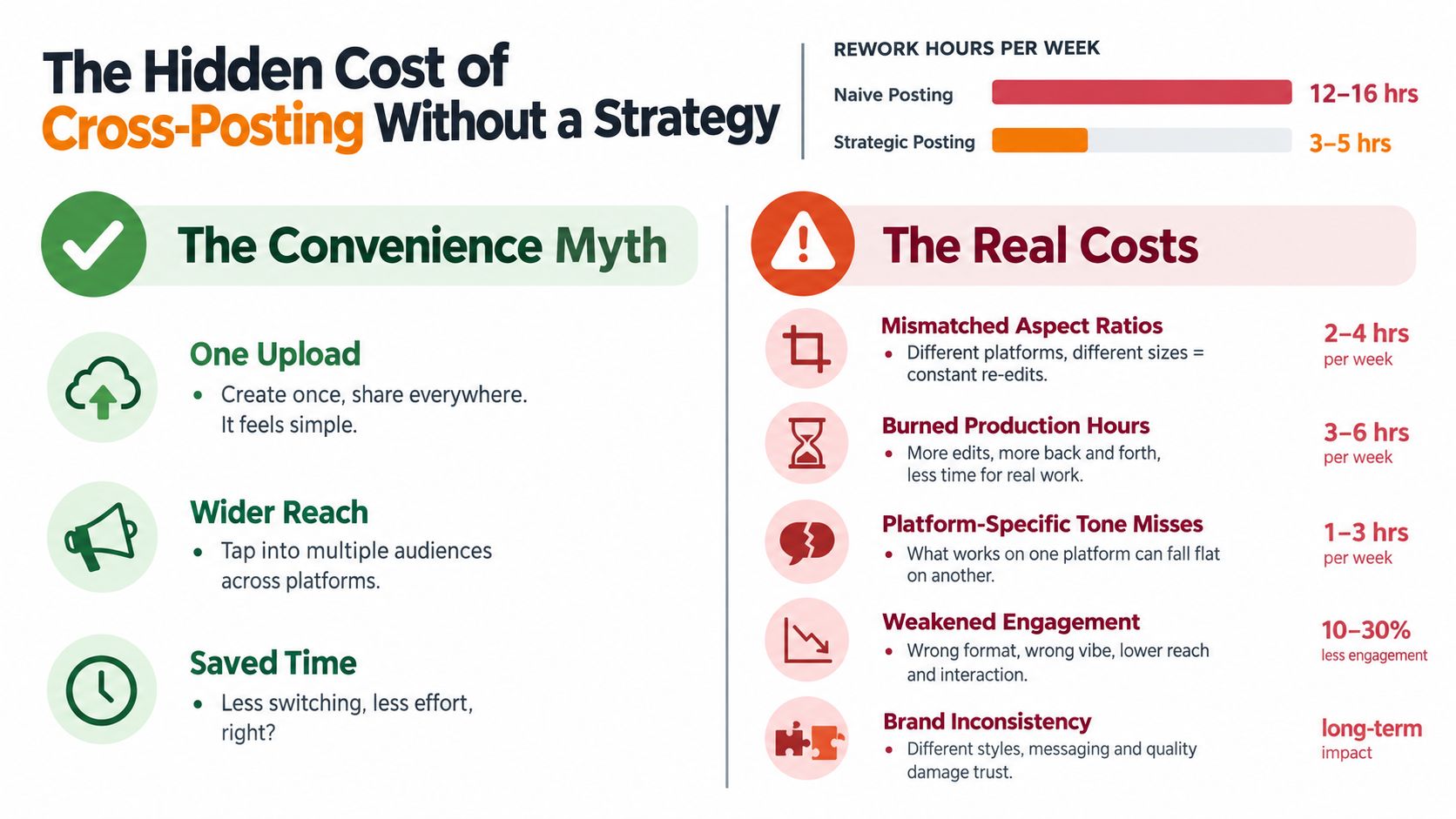
Cross-posting looks efficient because the first upload is fast. The expensive work appears afterward, when the team repairs the asset for each network, rewrites the caption, adjusts the call to action, answers comments in the wrong context, and explains inconsistent reporting to stakeholders.
A vertical video may need a new opening frame for Facebook. A casual Snapchat clip may need additional context before it works as an Instagram Reel. A link-led post may lose its purpose when the destination or link surface changes. These are not cosmetic edits. They alter the audience journey.
Track the leaks that a reach report hides
A top-line reach number can look healthy while the workflow wastes production capacity and reaches the wrong people. Track operational measures that expose those losses:
- Publish-to-engagement ratio: Compare the response to each network's native execution, not just the shared campaign total.
- Cost per unique reach: Separate duplicated Meta exposure from genuinely incremental audience delivery.
- Rework hours per campaign: Record time spent cropping, captioning, exporting, resubmitting, and manually repairing failed posts.
- Approval delay by platform: Identify which network holds the campaign back.
- Native-to-reused asset ratio: Show whether a platform receives purposeful creative or mostly leftover material.
Audience overlap also distorts decisions. Instagram and Facebook can reach many of the same people, while Snapchat may be valuable precisely because it reaches a different age cohort and communication context. Treating all impressions as incremental makes the campaign appear broader than it really is.
Teams planning paid distribution can also review FindClout's attention marketplace as a broader reference for thinking about multi-platform attention rather than treating every upload as equivalent inventory. The operational lesson is simple: cross-post only after deciding what must remain native.
The cross-posting social media workflow guide is useful for documenting those rules in a repeatable process. Your content calendar should specify the source asset, the adapted asset, the platform objective, the owner, and the success metric. If those fields are missing, the team is probably reposting rather than distributing strategically.
Which Platform Mix Fits Your Team and How to Run It
There isn't one correct answer for every team. The right mix depends on the audience you can reach, the creative you can sustain, and the engineering capacity available to maintain separate delivery paths.
| Team Type | Primary | Secondary | Skip | Why |
|---|---|---|---|---|
| Small DTC brand | Snapchat until a younger audience or camera-native concept is proven | Instagram supports visual product discovery, while Facebook adds retargeting and community reach without requiring a separate creative culture | ||
| Mid-market SaaS | Snapchat for generic lead-generation creative | Meta offers a practical environment for retargeting, product education, and conversion measurement; Snapchat needs a distinct awareness hypothesis | ||
| Multi-brand agency | Instagram and Facebook through separate workflows | Snapchat for qualified client use cases | No platform by default, but avoid universal templates | Agencies need broad operational coverage, yet every client should earn Snapchat through audience and creative fit |
| Solo creator | Snapchat or Facebook, depending on audience response | The platform that cannot be maintained consistently | A reliable publishing habit beats thin activity across every network |
For SaaS teams that need a broader messaging and distribution framework, this guide to improving SaaS brand visibility offers useful context for connecting social activity to brand discovery rather than treating each post as an isolated conversion asset.
Build a unified stack with deliberate boundaries
Use one publishing layer for authentication, scheduling, retries, media validation, and job state. Add a separate engagement layer for comments, replies, and moderation. Store native and normalized analytics in a warehouse that your reporting system controls.
Don't force one dashboard to become your source of truth for everything. Publishing systems are optimized for delivery, engagement tools for response management, and warehouses for historical analysis. Clear boundaries make failures easier to diagnose.
A practical rollout starts with a small surface area:
- Days one through seven: Audit audience cohorts, existing assets, permissions, and platform-specific objectives.
- Days eight through fourteen: Define the shared campaign model, media variants, preflight rules, and naming conventions.
- Days fifteen through twenty-one: Launch one repeatable workflow on the primary platform and add independent jobs for the secondary channel.
- Days twenty-two through thirty: Test Snapchat only if its audience and creative hypothesis are clear, then compare native outcomes without collapsing the reporting dimensions.
Mallary.ai provides a developer-first layer for publishing, engagement, and analytics across social platforms, with official API connections, media-rule validation, scheduling, webhooks, retries, and durable job handling. For teams routing Instagram, Facebook, and Snapchat through one operational system, that approach can reduce integration work while preserving platform-specific delivery rules.
Mallary.ai can help your team publish adapted content, manage platform-aware engagement, and normalize analytics without treating Instagram, Facebook, and Snapchat as one identical feed. Visit Mallary.ai to evaluate the API and dashboard for your next multi-platform workflow.
Try it with Mallary
STOP!
Want ChatGPT or Claude to post on social media for you?
Connect your social accounts one time. Then tell your AI what to write. It can make your posts, share them, and reply on social sites that allow replies. You do not need to write code.
Pick your AI





Connect once. Ask in plain English. Mallary does the work.


