
Written by Outrank. Published by Mallary Labs LLC.
Published .
Instagram API Alternative: A Developer's Comparison Guide
Your Instagram integration worked last month. Then Meta announced an endpoint change, a permission migration, or an account-access restriction, and your team had to turn a product roadmap into an emergency maintenance sprint. The difficult part wasn't adding another request. It was discovering which customers would lose access, which tokens needed reauthorization, which queued jobs would fail, and whether your historical metrics could still be trusted.
That's the problem behind an Instagram API alternative. The question isn't which provider exposes publishing, comments, or analytics. It's which approach reduces the amount of Meta-specific maintenance your team must absorb without creating a compliance problem, an opaque failure mode, or a second platform you can't replace.
| Alternative bucket | What it gives you | Meta-maintenance burden | Best fit |
|---|---|---|---|
| Official wrappers | Direct Graph API access with helper libraries | High | Teams needing maximum control |
| Third-party platforms | Publishing, analytics, and account management | Medium | Agencies and marketing operations |
| Unified multi-network APIs | One interface across social networks | Lower, if the provider actively maintains the abstraction | SaaS teams, agents, and multi-channel products |
The comparison below treats maintenance as a first-class engineering cost. It also separates official access from permissive access, because those aren't the same thing.
Table of Contents
- Why Developers Are Looking for an Instagram API Alternative
- Official Instagram Graph API Limits You Should Know First
- Three Buckets of Instagram API Alternatives Compared
- Scoring Criteria That Actually Matter to Engineering Teams
- Which Bucket Fits Your Real Situation
- How Mallary.ai Handles Instagram Against This Standard
- A Decision Checklist and Next Steps for Your Team
Why Developers Are Looking for an Instagram API Alternative
A product lead opens Meta's developer blog before stand-up. The announcement looks manageable. An object is being replaced, a permission is being renamed, or a legacy endpoint is being retired. The team has a transition window, so nobody panics.
Then someone checks the integration. The affected object sits inside account discovery, scheduled publishing, analytics synchronization, and customer onboarding. The migration isn't one code change. It touches OAuth scopes, database fields, retry logic, documentation, support scripts, and every test account that was configured under the old rules.
Meta's announcement about the Basic Display API shutdown shows how concrete that deadline can be. On September 4, 2024, Meta announced that Basic Display API would be discontinued after a 90-day transition period, becoming unavailable on December 4, 2024. Developers maintaining personal-account integrations had a fixed migration deadline, not an indefinite grace period.
Practical rule: Treat every platform announcement as a product-risk event, not merely an API ticket.
The recurring sequence is familiar:
- A quiet announcement lands. The affected endpoint may sit behind an SDK method your team never inspected directly.
- The clock starts. Customers continue connecting accounts while your migration is still being designed.
- The edge cases appear. Some accounts qualify for the replacement path, others need a new permission, and older tokens behave differently from new authorizations.
- The weekend disappears. Engineers patch production behavior before they can build a safe migration, rollback, or customer communication flow.
The human impact matters as much as the technical work. Support teams answer “why did my account disconnect?” while product managers explain delayed analytics and developers trace failures across several versions. A practical framework for cataloguing these issues is the guide to examples of customer and employee pain points, which helps separate user-visible friction from internal operational cost.
The vocabulary for a sound decision
Evaluate an alternative on four dimensions:
- Compliance posture: Does it use official permissioned access, provider-managed data collection, or scraping that your team must defend?
- Change absorption: Does the provider migrate endpoint versions and schemas, or does it forward Meta's changes straight to your code?
- SDK ergonomics: Can your developers handle OAuth, media validation, asynchronous jobs, and webhooks without rebuilding the same plumbing?
- Total cost of ownership: What will you maintain when a token expires, a permission changes, or a publish job succeeds at Meta but times out locally?
The right choice depends on whose accounts you need and how much platform maintenance your team can sustain. If you manage only your own professional accounts, direct Graph API access may be entirely reasonable. If you're embedding social features for many customers or across several networks, a thin wrapper often leaves the hardest work untouched.
Official Instagram Graph API Limits You Should Know First
The official Graph API is a controlled integration surface for professional use. It isn't a general-purpose window into Instagram, and an alternative that claims to remove every restriction deserves careful scrutiny.
Access is built around Business and Creator accounts, with permissions and app configuration determining what your application can do. That immediately rules out treating the official interface as a universal personal-account feed. Teams building account-management products must validate account eligibility during onboarding instead of discovering the restriction after a customer has invested time in connecting an account.
Permissions are part of the product
Advanced capabilities require more than adding a scope to an authorization URL. Meta expects an application to request appropriate permissions and, where required, complete review with a defensible use case. In January 2025, Meta introduced the instagram_business_manage_insights permission for insights access and stated that Advanced Access is required when requesting it for app users. The same announcement described replacements for legacy Instagram objects, including User, Media, Carousel, and Comment, in Graph API v22. Graph API endpoint updates were required by April 21, 2025, while Marketing API migration was due by January 21, 2026, as documented in Meta's API migration announcement.
That history changes the baseline for comparison. A provider that gives you an SDK but leaves permission review, reauthorization, and object replacement inside your application hasn't removed much operational risk. It has only made the first implementation more comfortable.
Media and throughput create operational work
Publishing is also conditional. Your system needs to validate media type, dimensions, processing state, caption rules, account permissions, and the difference between a request being accepted and a post becoming available. A request can fail before publication, remain asynchronous during processing, or succeed remotely while your client loses the response.
Rate limits add another layer. A production integration needs backoff, jitter, queue control, endpoint-aware throttling, and observability that distinguishes a platform quota response from a malformed request. Teams also need a token lifecycle strategy for every connected customer, including secure storage, refresh behavior, revocation detection, and reauthorization prompts.
For a detailed implementation baseline, use the Instagram API integration guide to inventory the work before comparing vendors. The essential question is simple: which responsibilities remain yours after the first successful publish?
Official access is valuable because it offers a supported compliance path. It isn't valuable because it is permissive. The best alternative is the one that preserves the official route while reducing the amount of platform-specific code your team must own.
Three Buckets of Instagram API Alternatives Compared
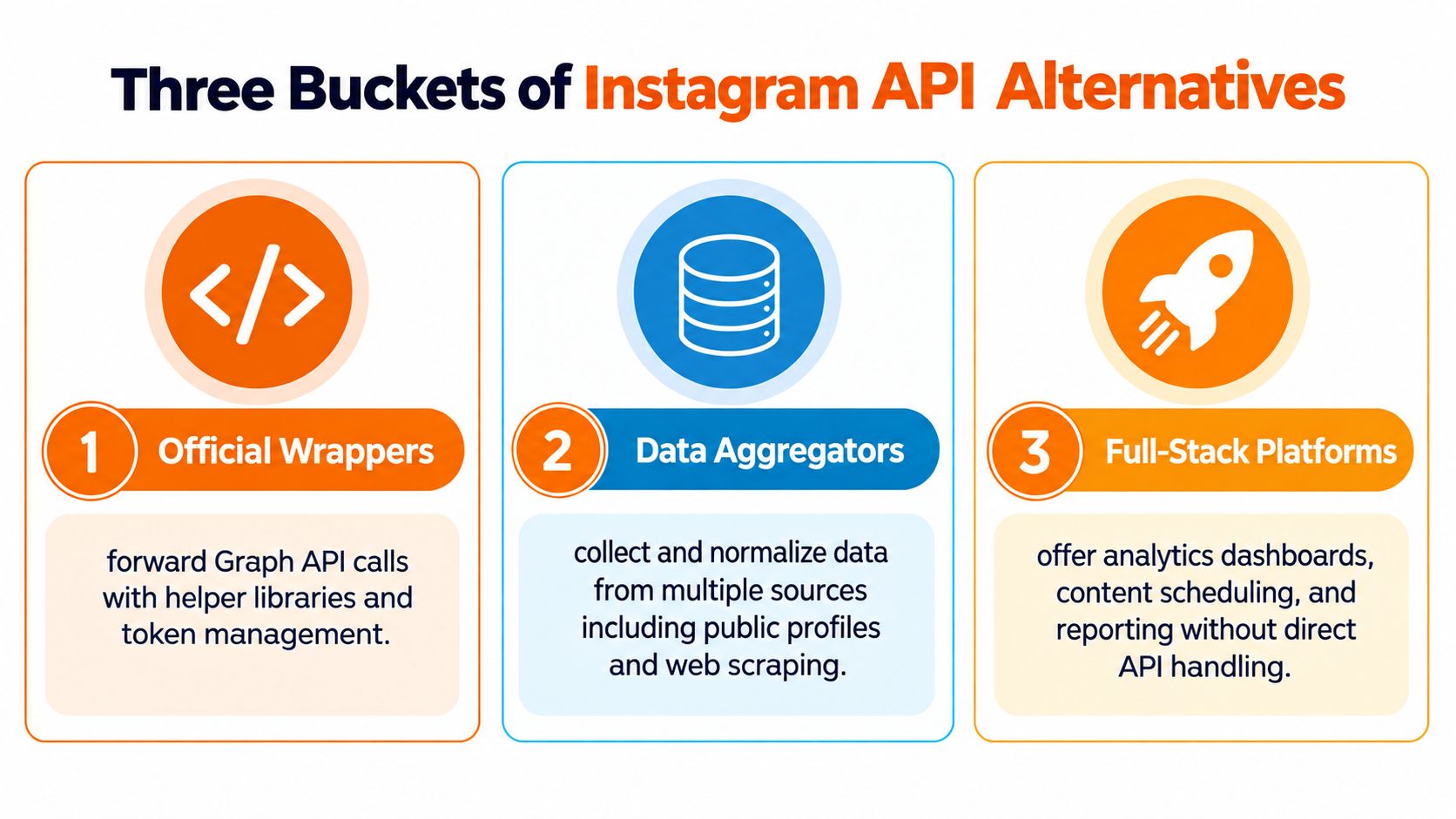
Most products marketed as an Instagram API alternative fall into one of three buckets. Classifying a provider takes less time than comparing every endpoint, and it reveals where the maintenance burden will land after launch.
Official wrappers and SDKs
These libraries sit close to Meta. They normalize request construction, provide typed models, simplify OAuth, or add convenience methods around the Graph API. Your team still owns the application credentials, permission review, account eligibility, version migration, storage, retries, and most incident response.
Their advantage is control. You can inspect every request, preserve raw platform identifiers, design your own data model, and avoid vendor-specific abstractions. Their predictable failure mode is also their weakness: when Meta changes the contract, your application receives the problem directly.
Choose this bucket when Instagram is a core capability, your team has strong platform-integration skills, and you need behavior that a general abstraction may hide.
Third-party publishing and analytics platforms
These products package official access into scheduling, reporting, inbox, or campaign workflows. Later, Buffer, and Hootsuite-style systems are designed for operators rather than teams that want to own every API detail.
They usually absorb some account connection complexity and present a usable interface for content teams. They may also provide exports, dashboards, approval flows, and organization-level permissions. The trade-off is that you inherit the platform's data model, release schedule, and product limits. If your SaaS needs a novel workflow, you may end up fitting your product around the vendor's UI or API.
This bucket works well when social management is an operating function, not the differentiating feature inside your product.
Unified multi-network APIs and agent interfaces
These APIs put Instagram beside networks such as YouTube, TikTok, LinkedIn, Facebook, X, Pinterest, Threads, Reddit, or Snapchat. The promise is less about Instagram completeness and more about giving a product one authorization model, one job system, and one publishing contract.
The strongest implementations absorb token refresh, rate-limit handling, media rules, retries, and schema differences. The weakest rename each network's endpoint behind a common prefix, leaving you to handle the same failures in unfamiliar clothing.
For a broader developer-oriented comparison of social media APIs for developers, inspect how each provider handles raw identifiers, errors, webhooks, and version changes. Security posture matters too. Official wrappers and unified platforms can use permissioned APIs, while data aggregators may rely on indexed or collected public data. A scraping-based provider adds a separate reliability and compliance risk that a publishing abstraction doesn't solve.
Scoring Criteria That Actually Matter to Engineering Teams
Feature lists reward visible capabilities. Production systems fail in the invisible layers: token recovery, duplicate prevention, queue durability, schema compatibility, and useful error messages.
| Criterion | Official wrappers | Third-party platforms | Unified multi-network APIs |
|---|---|---|---|
| Change-management burden | High, your team tracks Meta changes | Medium, vendor absorbs product-level changes | Potentially low, if migration is part of the service |
| Compliance posture | Strong control over official access | Usually provider-defined and account-focused | Strong when based on official APIs, verify the implementation |
| Rate-limit and quota handling | You build it | Usually included in workflows | Should be centralized and endpoint-aware |
| SDK and tooling quality | Varies, often close to raw APIs | Usually polished for operators | Varies, evaluate API, CLI, MCP, and webhook support |
| Multi-network coverage | Low unless you build it | Depends on the platform | Core value proposition |
| Pricing transparency | Infrastructure cost is visible, engineering cost is not | Product pricing is visible, usage limits may be restrictive | Compare usage, seats, jobs, storage, and support terms |
Change management deserves the highest weight
Meta's object replacements and permission changes show why migration work can't be reduced to “does it support publishing?” A wrapper may expose a new method quickly, but your team still needs to map old records, preserve identifiers, update permission requests, test existing tokens, and decide what happens to failed jobs during rollout.
Ask vendors these questions before signing:
- Who updates the integration when Meta changes a version?
- How much notice do customers receive?
- Are old and new schemas available during a transition?
- Can you replay failed jobs safely?
- What happens to historical analytics when a metric disappears?
- Can your team access raw platform responses for diagnosis?
A provider that absorbs migrations should document its compatibility policy. “We support the Instagram API” isn't enough. You need to know whether that means current endpoints only or a managed transition between contracts.
Compliance isn't a checkbox
Official access supports a clear permission model, but the application still needs to request and use scopes appropriately. A third-party platform may manage the app review and OAuth experience, yet your security team remains responsible for understanding where tokens live, who can access them, how revocation works, and what data the service retains.
Engineering test: Ask the vendor to describe one failed authorization, one expired token, and one deprecated permission from detection through customer recovery.
Rate limits and retry behavior also belong in the evaluation. A shared abstraction should prevent every tenant from competing for the same quota, apply idempotency to publishing, and expose job state without forcing your team to infer it from timeouts. If the vendor can't explain those mechanics, assume your engineers will eventually implement them.
Pricing transparency completes the picture. A cheap API can become expensive when every platform change consumes engineering days, support time, and emergency release capacity. Calculate the recurring maintenance cost, not just the request price or monthly subscription.
Which Bucket Fits Your Real Situation
The correct bucket changes with the product you're building. Use the account model, customer count, network scope, and compliance requirements to make the decision.
A solo developer building personal-account analytics
Pick an official wrapper if the tool analyzes accounts that users own and can connect through the supported professional-account path. You'll retain control and avoid paying for a platform layer you may not need.
The recommendation changes if the product requires personal accounts, broad public discovery, or competitor research. Those needs don't fit the official account-management model, so you should evaluate the provider's collection method and terms rather than assume a wrapper can provide access to them.
An agency white-labelling scheduling for many SMB clients
Pick a unified multi-network API when your agency must manage different customer accounts and publish the same campaign across several networks. Centralized OAuth, job status, media validation, and retries save more engineering effort than a thin Instagram-only SDK.
The recommendation changes if every client requires a highly customized approval workflow or strict tenant isolation that the provider can't demonstrate. In that case, a direct integration may justify its maintenance cost.
An AI agent builder using MCP or n8n
Pick a unified API with agent-facing interfaces, structured job results, explicit permissions, and safe retry semantics. An agent shouldn't need to understand every network's media upload sequence or guess whether a timeout created a duplicate post.
The recommendation changes if your agent's core value is Instagram-specific analytics that depends on data unavailable through the selected provider. Validate coverage with real workflows before designing the tool schema.
An enterprise SaaS product in a regulated vertical
Start with compliance and auditability, not feature count. An official wrapper may be the safer choice when you need complete control over storage, access logs, retention, and incident response, while a managed platform can work only if it satisfies your security review and exposes sufficient audit events.
The recommendation changes when multi-network support becomes a product requirement. Then compare the provider's tenant model, data residency commitments, deletion behavior, and contractual responsibility for platform changes.
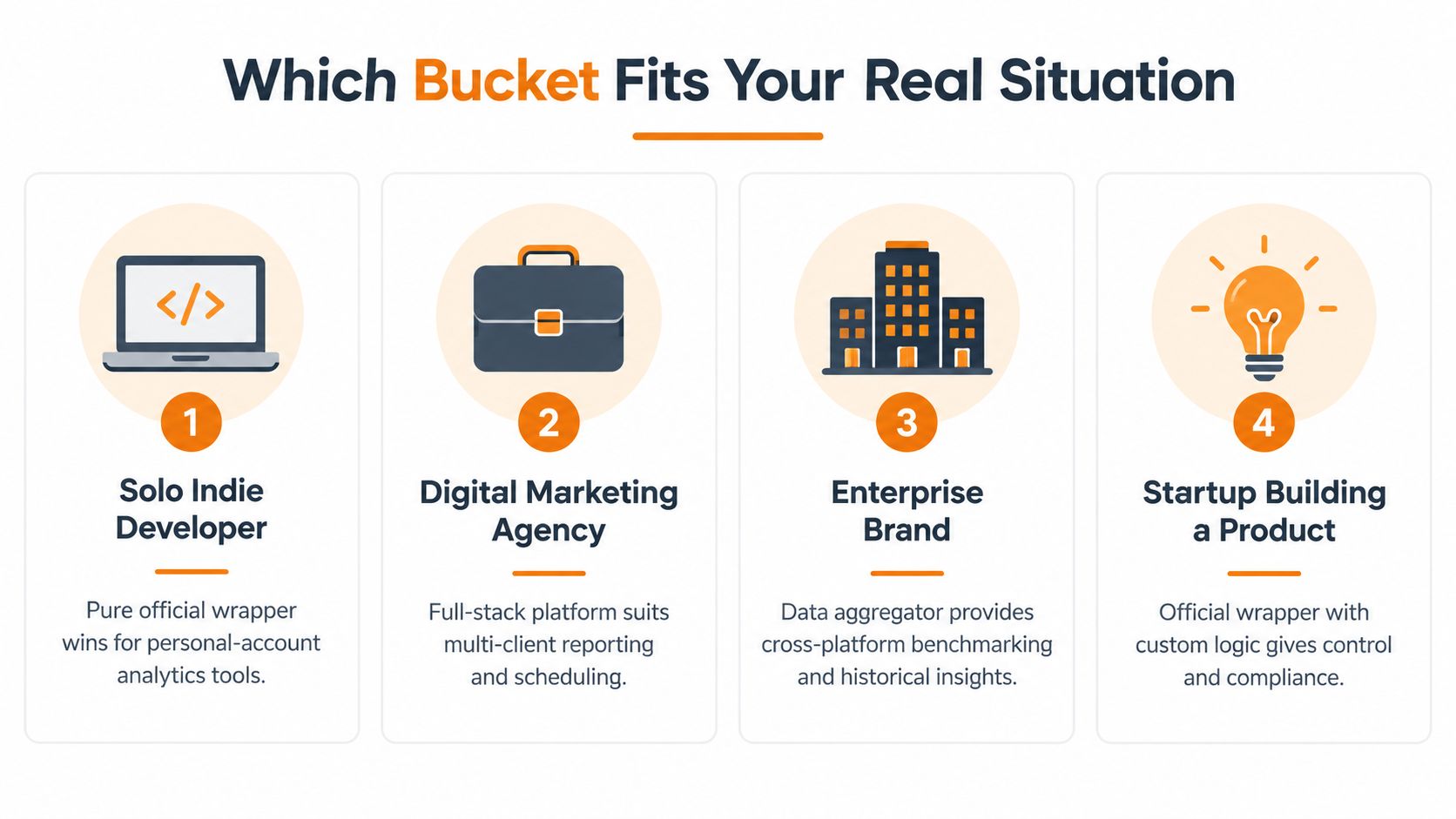
The decision is rarely “official versus unofficial.” It's usually direct control versus managed change, with compliance defining the boundary of acceptable choices.
How Mallary.ai Handles Instagram Against This Standard
“Official API access” isn't a differentiator by itself. Credible products can connect through official routes. The meaningful difference is what happens after Meta changes a permission, throttles a request, or replaces an object.
A durable abstraction should handle idempotent retries, durable job queues, schema-version tolerance, account reauthorization, and failure states that developers can act on. It should preserve enough raw platform context to diagnose incidents rather than returning a generic “publish failed” message.
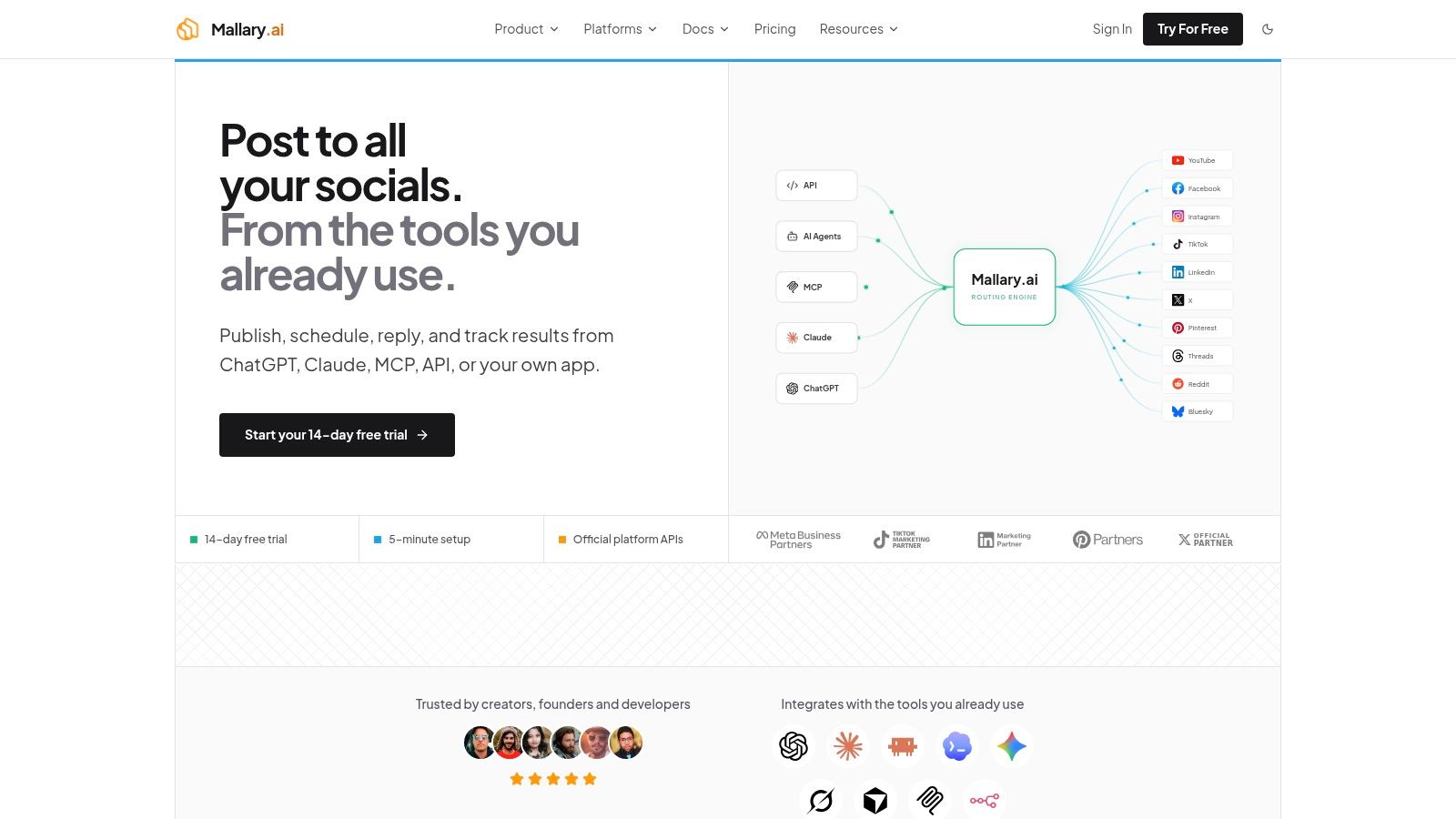
Mallary.ai is one option in the unified multi-network bucket. Its Instagram platform integration provides publishing for feed posts, Stories, Reels, and carousels through a common API. The service manages OAuth, token refresh, media hosting, rate-limit handling, retries, and platform-specific media validation, while also exposing API, MCP Server, and AI agent interfaces.
What the abstraction should absorb
For a SaaS team, the useful layer isn't only the publish call. It includes:
- Connection management: OAuth flows, token refresh, account state, and reauthorization handling.
- Delivery reliability: Durable queues, retries, idempotency, and observable job states.
- Platform differences: Media rules, payload normalization, webhooks, and preflight checks.
- Workflow reach: Bulk uploads, scheduling, CLI access, and integrations with automation tools.
- Engagement operations: Near-real-time AI auto-replies and multiple first comments at publish time for supported creator workflows.
That reduces the amount of Meta-specific code inside the product, but it doesn't eliminate due diligence. Ask how the service handles endpoint removal, permission changes, historical analytics, queued work, and customer notification. Confirm that raw platform IDs and useful failure details remain available when support needs to investigate an account.
There are trade-offs. Mallary.ai is younger than established social-management vendors, and a free tier may not suit a heavy SaaS workload. Teams should test throughput, isolation, support response, export behavior, and pricing at their expected customer scale instead of treating the abstraction as a substitute for validation.
The right standard is straightforward: the provider should absorb repetitive platform maintenance while giving your team enough transparency to operate the integration responsibly.
A Decision Checklist and Next Steps for Your Team
Run this checklist with engineering, product, security, and customer support in the same meeting:
- Permissions: Confirm the exact Instagram scopes and account types your workflow needs.
- Network scope: Decide whether Instagram is the product or one channel among many.
- Maintenance cost: Estimate the engineering time required to track versions, tokens, quotas, and media rules.
- Compliance: Send a security questionnaire covering token storage, retention, deletion, access logs, and subprocessors.
- Reliability: Verify retry, idempotency, queue, webhook, and outage semantics with failure tests.
- Migration readiness: Ask how the provider handles deprecated endpoints, renamed permissions, schema changes, and historical metrics.
- Pricing: Model usage, seats, jobs, storage, support, and the cost of maintaining a direct wrapper.
Then shortlist two alternatives, run a focused spike against your hardest workflow, and test account connection, publishing, retries, analytics, and reauthorization. Commit only after a load test includes a simulated Meta deprecation and proves that your customers receive a recoverable failure rather than a silent break.
Mallary.ai gives SaaS teams and developers one interface for Instagram publishing, engagement, and analytics across a broader multi-network workflow, with managed OAuth, retries, queues, and platform-specific validation. If reducing Meta-maintenance work is central to your decision, visit Mallary.ai and test the integration against your most failure-prone workflow.
Try it with Mallary
STOP!
Want ChatGPT or Claude to post on Instagram for you?
Connect your social accounts one time. Then tell your AI what to write. It can make your posts, share them, and reply on social sites that allow replies. You do not need to write code.
Pick your AI





Connect once. Ask in plain English. Mallary does the work.


