Written by Outrank. Published by Mallary Labs LLC.
Published .
Best Time to Schedule Social Media Posts: 8 Platforms
Most guides to the best time to schedule social media posts give you one confident window per platform. The most-quoted version of that advice comes from a benchmark of more than a million posts, which put the single best slot anywhere at Wednesday, 8 a.m. (Hootsuite's analysis). It's a reasonable prior. It isn't your answer.
Timing is a starting condition, not a lever. Two accounts in the same niche, publishing the same format at the same minute, can land in completely different places because their followers sit in different time zones, open the app at different points in the day, and reward different content types. The window that matters is the one where your audience is awake and your team is available to reply.
So this list does something different from a ranking. For eight platforms you get the window most roundups cite, the native analytics report that should override it, and a test design that settles the argument with your own numbers. You also get the operational piece most timing advice skips: scheduling in each audience's local time, and being present in the first hour when the platform is still deciding how far to push the post.
Table of Contents
- 1. Instagram Weekday Late-Morning to Early-Afternoon Window
- 2. Facebook Weekday Mid-Morning to Early-Afternoon Pages Window
- 3. LinkedIn Tuesday to Thursday Business-Hours Window
- 4. X (Twitter) Weekday Morning Window with High-Frequency Scheduling
- 5. TikTok Evenings and Weekends Window
- 6. YouTube Thursday to Sunday Afternoon and Evening Premiere Window
- 7. Pinterest Evening and Weekend Planning Window
- 8. Reddit Subreddit-Specific Morning Window with Community-First Timing
- Typical posting windows and scheduling fit across eight platforms
- Turn Benchmarks Into a Posting Schedule That Learns
1. Instagram Weekday Late-Morning to Early-Afternoon Window
Late morning to early afternoon on a weekday is the slot most roundups hand to Instagram, with Tuesday through Thursday named as the strongest days. The logic holds up better than most social advice, because Instagram engagement is front-loaded.
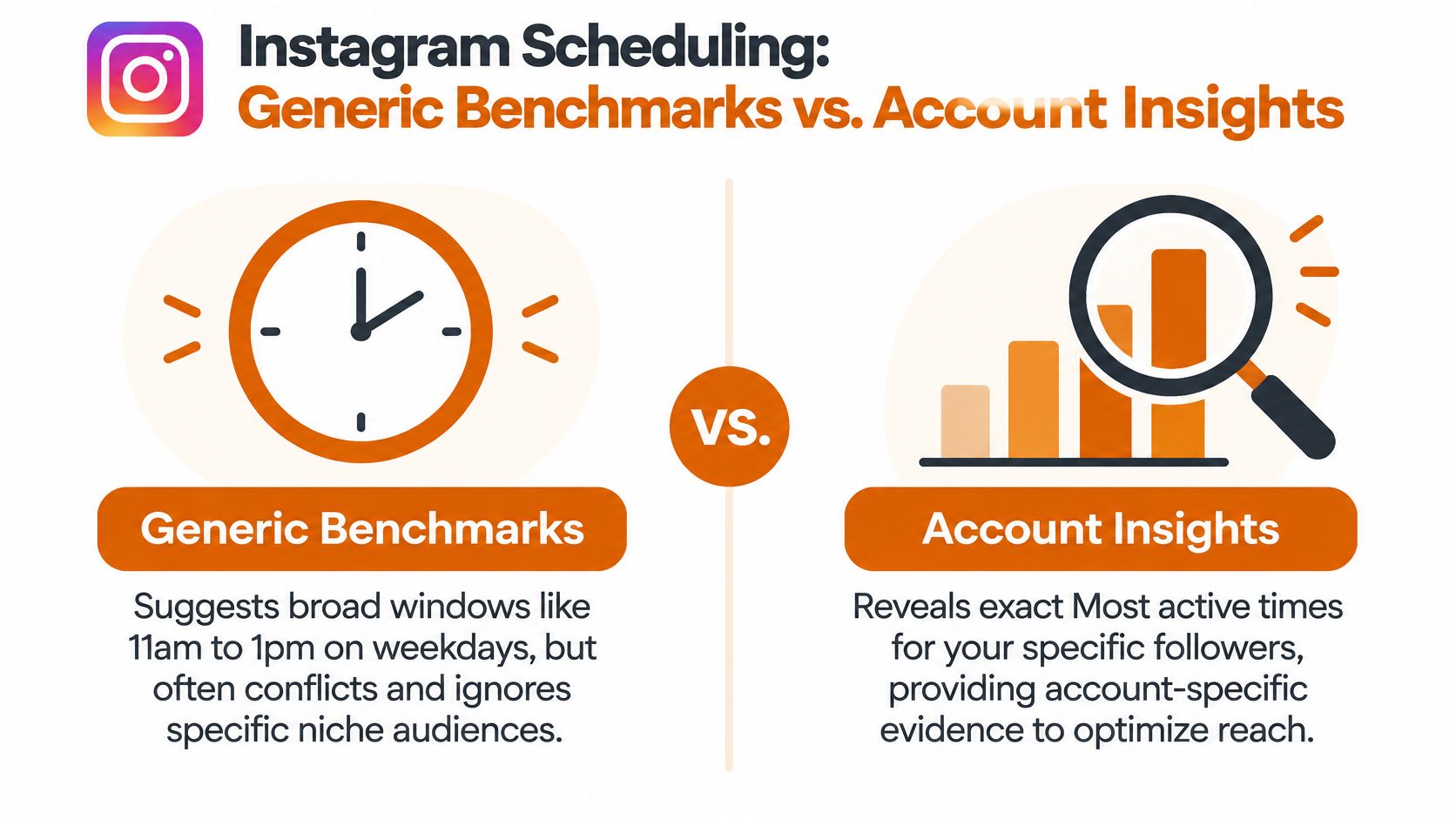
The gap between a generic benchmark and your own numbers is where the true answer sits.
A 2022 large-scale study of Facebook and Instagram engagement found that roughly 50% of all interactions occurred within the first four hours on Facebook and the first two hours on Instagram, and that the first hour alone generated about 31% of Facebook interactions and 40% of Instagram interactions (the 2022 engagement study). Publish shortly before your audience's peak rather than at it. An 11:45 a.m. post catches the noon crowd while the post is still warm.
Then the benchmarks disagree. Buffer's 2025 analysis found Instagram posts performing best between 3 p.m. and 6 p.m., with Fridays producing the most interactions (Buffer's Instagram posting data). Late morning or late afternoon, both cited by credible sources. That's your signal to test instead of copy.
Use Instagram Insights, Then Ignore the Roundups
Open Instagram Insights, tap the Audience tab, and read the "Most active times" chart. Take the top two cells and turn them into two test slots, keeping format, hook style, and call to action identical across both. Four to six weeks gives you enough posts for a readable comparison.
Judge slots on engagement rate per reach, not raw likes. A 5 p.m. post that reaches twice as many accounts will usually collect more likes even when it converts worse.
Say a DTC apparel brand schedules Reels at 12 p.m. on Tuesdays and Thursdays for six weeks, then compares them against weekend posts with matched creative. That comparison tells them more than any published chart. Cadence matters too, so settle how often to post on Instagram before you fine-tune hours.
Practical rule: publish 15 to 30 minutes before the window opens, and have someone ready to answer comments for the first hour.
Running several brands makes this a logistics problem, not a timing problem. Mallary.ai schedules each post to its own date, time, and time zone and runs pre-publish checks on media specs, which is the difference between a test that runs cleanly for six weeks and one you abandon in week two.
2. Facebook Weekday Mid-Morning to Early-Afternoon Pages Window
The Facebook Page window is 9 a.m. to 1 p.m. on weekdays, and the largest recent report supports the start of it. Sprout Social's 2024 data found Facebook posts performing best on weekdays from 9 a.m. to noon (Social Media Today's report summary). Page audiences skew older and more desktop-heavy than Instagram's, which keeps the morning check-in relevant here.
Afternoon publishing has stronger evidence behind it than most roundups admit. A 2024 peer-reviewed study of 5,825 posts from 155 university Facebook pages in Vietnam found afternoon posts generated 22% higher expected reactions, 52% higher expected comments, and 56% higher expected shares than morning posts, all significant at p < 0.001 (the 2024 Facebook timing study). The sample is institutional pages in one market, so treat it as a case for testing 12 p.m. to 5 p.m., not as a rule for your bakery.
Let Page Insights Break the Tie
Facebook Page Insights shows follower activity under Followers, in the "When your followers are online" panel. Pull the top three hours from the last 90 days rather than last week, then place your first test post an hour before the busiest block.
- Run one variable at a time. Same format, same offer, comparable audience size, different hour.
- Separate consumer from B2B. A Page with a workday audience behaves nothing like a local consumer Page.
- Watch shares, not only reactions. The study's largest effect landed on shares, which follow posts people find useful enough to forward.
Say a bakery posts daily specials at 8:30 a.m. to catch the commuter scroll, then tests the same photo format at 1 p.m. for a month. A nonprofit might run event announcements at 1 p.m. and pair them with Stories the same afternoon.
Posting Page content through a single endpoint alongside your other networks keeps a campaign synchronized, and attaching a context comment at publish time gives a post a second life in its own thread. Mallary.ai supports multiple first comments attached at publish time, so the follow-up lands with the post instead of an hour later.
3. LinkedIn Tuesday to Thursday Business-Hours Window
Say your best-performing LinkedIn post of the quarter went out at 4:52 p.m. on a Wednesday and nobody planned it. That timestamp is worth more than any published ranking, because LinkedIn's Page analytics don't hand you an audience-activity chart the way Instagram does. You have to build the picture yourself.
The window I'd start with is Tuesday through Thursday, 8 a.m. to 10 a.m. in your audience's time zone, with a midday slot as the second test. Professionals check the feed before the day gets loud, and distribution behaves best when a post collects attention early.
Reconstruct the Report LinkedIn Doesn't Give You
Open Analytics, go to Posts, and sort by impressions over the last 90 days. Write down the local publish time of each of your top 15 posts, convert those to your audience's dominant time zone using the Follower demographics panel, and look for clustering. When three of the top five land in the same two-hour band, that's your signal.
Then check content type against time. Written posts and documents tend to earn their attention early in the day, while video holds up later.
Practical rule: never publish a LinkedIn post into a slot where nobody on the team can sit in the comments for 45 minutes.
A B2B SaaS company schedules a thought-leadership article for Tuesday at 8:30 a.m. ET and has the author add a comment with a link to the underlying data within ten minutes. A recruiting agency publishes hiring updates at midday Wednesday to catch lunchtime browsing.
One strong post a day beats three inside an hour. Bursts split your own engagement across competing posts and make the timing test unreadable.
4. X (Twitter) Weekday Morning Window with High-Frequency Scheduling
X has the shortest post half-life of any platform on this list, which is the only reason timing gets so much attention there. A post that misses its first wave rarely recovers.
The "magic minute" theory deserves skepticism. A comparative academic review of feed recommendation systems found that all the systems studied prefer newer content, but that the preference can be slight in some of them (the ACM review of feed recommendation). If recency weighting is mild, a post at 9:20 a.m. isn't meaningfully punished against one at 9:00.
Published windows disagree with each other anyway. One roundup places X at 8 to 10 a.m., another at 9 to 11 a.m. on selected weekdays. When credible sources can't agree on a two-hour band, the band isn't the variable that decides your results.
Build a Three-Slot Baseline
Test 8 a.m., 12 p.m., and 5 p.m. local time, Tuesday through Thursday, and run each slot for at least six posts before drawing a conclusion. Track engagement rate per impression, not impressions.
- Export your data. X's native analytics let you export post-level metrics; group by hour of day in a spreadsheet.
- Exclude outliers. One viral post flattens a month of honest comparison.
- Reply fast. The first hour is where the conversation happens, and replies are what keep a thread visible.
A developer tools company publishes changelog posts at 9 a.m. PT on Tuesdays and answers questions in the following hour. A newsletter writer runs three short posts across morning, lunch, and evening to learn which slot earns clicks rather than impressions.
Automate the predictable questions and escalate the rest to a human. For a fuller cadence model, this guide to a Twitter posting schedule covers frequency alongside timing.
5. TikTok Evenings and Weekends Window
TikTok rewards evening attention more than any other network, and weekend mornings carry a second wave. Here's a walkthrough of the scheduling workflow before we get into the numbers.
HubSpot's 2024 survey of more than 1,500 social media marketers found 6 to 9 p.m. and 12 to 3 p.m. were the best overall windows for posting across social platforms (HubSpot's State of Social Media survey). That's stated practice from people running accounts, not observed reach. It points you at evenings as a first test, nothing more.
TikTok's feed is driven by recommendation rather than follower count, so timing seeds the first test audience instead of guaranteeing reach. Content quality still decides the outcome.
Use Follower Activity, Then Judge Retention
If your account has analytics access, the Followers tab shows follower activity by hour and day. Pick the two busiest evening hours and schedule your first month there.
- Judge hooks, not likes. Retention in the first three seconds tells you whether the slot delivered attentive viewers.
- Give posts 24 hours. TikTok's distribution is slower than X's or Instagram's, so don't reshuffle the calendar on two hours of data.
- Compare weekly, not daily. Daily samples are noise.
Say a fitness creator schedules workout clips for 7 p.m. on Saturdays to match when the audience is training or planning the week. A consumer brand posts product demos on Sunday evenings and reads hook retention in TikTok Analytics rather than view counts.
For platform-specific windows instead of cross-platform averages, this breakdown of the best time to post on TikTok goes deeper.
6. YouTube Thursday to Sunday Afternoon and Evening Premiere Window
YouTube doesn't have a daily peak the way X does. Its timing is a function of viewer habit and video length, which is why long-form and Shorts should never share a schedule.
Afternoon slots have real support. Adobe Express reported that 43% of surveyed users across six countries preferred posting in the afternoon, 32% preferred evening, 16% morning, and 9% late night (Adobe Express global social trends). That's stated preference from users, not measured watch time, so use it to choose a first test window and let YouTube's own data overrule it.
The pattern many creators land on is Thursday through Sunday, roughly 2 p.m. to 6 p.m. local time for long-form, with evenings stronger for entertainment formats. Educational and work-related content can do better inside the workweek.
The Report That Actually Matters Sits in Studio
Open YouTube Studio, go to Analytics, then Audience, and read "When your viewers are on YouTube". That chart is built from your own viewers, and it beats every published benchmark on this page.
- Upload early. Publish at least a few hours ahead of the slot so processing and checks finish before launch.
- Seed the launch. A Community tab post the day before gives the video a warm audience.
- Use Premieres for events. Live chat energy suits gaming and entertainment; it wastes the format on evergreen tutorials.
Say a tech education channel schedules a long tutorial for Thursday at 3 p.m. ET with a Community teaser the day before. A gaming channel runs a Friday evening Premiere and treats the live chat as part of the content.
Webhooks are the practical glue here. Triggering cross-posting the moment a video goes live, instead of hand-posting to four other networks afterward, keeps the launch window tight and the timing consistent.
7. Pinterest Evening and Weekend Planning Window
Pinterest is the one platform where the wall clock matters less than the calendar. People come here to plan, so a pin's job is to be indexed and waiting when the planning moment arrives.
Evenings and Saturday mornings are the windows most often named, and they fit how the platform gets used: after dinner, and on unhurried weekend mornings. Timing influences when a pin collects its first impressions. Keyword-matched titles and descriptions influence whether it gets found at all, and search keeps winning that argument.
Rule of thumb: for Pinterest, ship seasonal pins two to six weeks before demand peaks and stop worrying about the exact hour.
Read Pinterest Analytics for Day, Not Hour
Pinterest Analytics shows impressions and saves by pin, and the Audience insights panel tells you who is saving. Compare day-level patterns first, then narrow to hours once you have volume.
- Check outbound clicks. Saves flatter you; clicks tell you whether the pin reached someone planning to buy.
- Write the keyword into the title. Descriptions help, but the title carries more weight in search.
- Batch a season, not a day. Queue a full seasonal set in one sitting so the campaign lands ahead of the peak.
Say a home decor retailer schedules holiday pins six weeks before the season starts, then refreshes creative mid-season based on which boards drive clicks. A recipe blogger publishes weekend meal-prep pins on Saturday mornings and re-pins them to a seasonal board later.
Pinterest is unusually forgiving of early publication. A pin published weeks ahead has time to accumulate saves before your audience starts searching.
8. Reddit Subreddit-Specific Morning Window with Community-First Timing
Reddit is where a national benchmark is least useful. Each subreddit is its own audience, often concentrated in one region and time zone, and its peak has more to do with when that community's regulars browse than with anything platform-wide.
For broad, US-heavy communities, weekday mornings Eastern Time are the common starting point. Niche subreddits can peak at almost any hour, and a technical community's best window may sit mid-afternoon for the region where most members work.
Find the Window Without a Native Report
Reddit doesn't give most accounts an audience-activity chart. Build one from the community itself.
- Read the top posts of the week. Sort by top, note each post's age, and work backwards to the publish hour. Clustering shows you the live window.
- Check moderation tools. If you moderate the subreddit, the traffic stats page shows visits by hour and day for that community.
- Watch the new queue. A post that sits in new for an hour without an upvote is effectively dead, which makes the first 30 minutes the key test.
Rules come before timing. Read the self-promotion policy, check account age and karma requirements, and ask the moderators when you're unsure. A perfectly timed post that breaks a rule gets removed and can cost you the account.
Say a developer tools company publishes a technical write-up to three programming subreddits on a weekday morning ET, after reading each community's rules and adapting the title. A nonprofit posts a community update to a local subreddit timed to regional evening activity, then answers every comment.
Value-driven participation is the price of admission. Comment on other people's posts for weeks before you schedule anything promotional.
Typical posting windows and scheduling fit across eight platforms
| Platform | Typical Best Window | Best Days | Native Scheduling | Best For |
|---|---|---|---|---|
| 11 a.m.–1 p.m. local time | Tuesday–Thursday | Yes, through Meta Business Suite or approved APIs | Reels, Stories, and feed content | |
| 9 a.m.–1 p.m. local time | Tuesday–Thursday | Yes, through Meta Business Suite | Pages, local businesses, and community updates | |
| 8–10 a.m. local time; midday can also work | Tuesday–Thursday | Yes, scheduling available | B2B, hiring, and professional content | |
| X (Twitter) | 8–10 a.m. local time | Tuesday–Thursday | Scheduling available; tools may vary | News, product updates, and timely conversation |
| TikTok | 6–10 p.m. local time | Evenings and weekends | Scheduling available | Short-form video and creator content |
| YouTube | 2–6 p.m. local time | Thursday–Sunday | Yes, through YouTube Studio | Long-form videos, Shorts, and Premieres |
| Evenings or Saturday mornings | Weekends, especially Saturday | Scheduling available | Seasonal planning, recipes, home, and lifestyle | |
| Weekday mornings, often Eastern Time | Weekdays; varies by subreddit | Limited natively; API-based scheduling may be used | Community-specific discussion and niche audiences |
Turn Benchmarks Into a Posting Schedule That Learns
Start with the commonly cited window for your two most important platforms. Confirm it against each platform's own analytics. Then run a four- to six-week test with consistent formats and let the results set next month's calendar.
That sequence matters more than the specific hour you pick. A schedule built on someone else's million-post dataset describes an average audience that doesn't exist on any single account.
A Four-Step Loop You Can Run This Month
- Pick two slots per platform. One from the benchmark, one from your analytics. Keep everything else identical.
- Schedule in the audience's local time zone. A single global "best time" is meaningless across three continents. Per-post time zone control is what makes comparison valid, and every Mallary.ai plan includes it alongside analytics on how each post performed.
- Measure rate, not volume. Engagement per reach, comments per thousand impressions, clicks per post.
- Set a sample floor. Twelve posts per slot is a fair minimum before you crown a winner; six is enough to spot a disaster.
Keep the losing slot in rotation once a quarter as a control. Audiences shift, and a window that underperformed in January can win by June.
What to Do With a Window That Wins
Write it down as a policy, not a habit. "Instagram Reels, 11:45 a.m. local, Tuesday and Thursday" is testable; "post in the morning" isn't.
Then extend carefully. Move to a third platform only after the first two are settled, and re-run the test after any major change in format, audience mix, or paid spend. Timing interacts with everything else in your account, which is why a one-time answer never stays true for long.
If you'd rather not run the bookkeeping across networks yourself, Mallary.ai is one option worth comparing. It schedules posts to a date, time, and time zone you choose, keeps them in a queue, and reports views, likes, and comments per post so the next test starts from evidence rather than a hunch.
Mallary.ai gives you one endpoint for scheduling across ten social networks, with date, time, and time zone control on every post, multiple first comments attached at publish time, and hourly analytics checks on new posts through their first day. That's enough to run the two-platform comparisons in this guide without stitching together five separate dashboards. Start on the 14-day free trial and put your first timing test live this week at Mallary.ai.
Try it with Mallary
STOP!
Want ChatGPT or Claude to post on social media for you?
Connect your social accounts one time. Then tell your AI what to write. It can make your posts, share them, and reply on social sites that allow replies. You do not need to write code.
Pick your AI





Connect once. Ask in plain English. Mallary does the work.


