
September 22, 2026
Social Media API Aggregator Guide for Developer Teams
STOP!
Want ChatGPT or Claude to post on social media for you?
Connect your social accounts one time. Then tell your AI what to write. It can make your posts, share them, and reply on social sites that allow replies. You do not need to write code.
Pick your AI





Connect once. Ask in plain English. Mallary does the work.
You're on a video call, your demo starts in an hour, and the tenth social provider has just failed authorization. X needs one token path, Instagram needs another Meta configuration, TikTok is waiting on approval, YouTube reports a quota error, and every platform returns a different shape for media, metrics, and publishing status. The feature looked like one social integration when it entered the roadmap. It now behaves like a distributed systems project.
A social media API aggregator can remove much of that repeated plumbing, but only if you treat it as more than a convenience wrapper. The useful abstraction is a contract layer for OAuth lifecycle, quota math, retries, idempotency, and response normalization. It can give your product one interface while the underlying networks continue to enforce different rules. That distinction matters, because an aggregator doesn't make platform behavior uniform. It makes the differences operable.
Table of Contents
- When One Social Integration Becomes Ten
- What a Social Media API Aggregator Actually Does
- Aggregator vs Native Integrations
- The Four Operational Pillars Behind Every Aggregator
- Why Modern Rate Limits Made Aggregators Necessary
- How to Choose the Right Aggregator for Your Stack
- Implementation Patterns That Actually Scale
When One Social Integration Becomes Ten
The first integration is usually straightforward. A product team connects one social login, stores an access token, publishes a post, and moves on to the next roadmap item. Then customers ask for Instagram, X, TikTok, LinkedIn, YouTube, Facebook, Threads, and analytics. Each request sounds incremental until the backend owns separate authorization flows, media upload paths, webhook receivers, error taxonomies, and release schedules.
The night before a customer demo, an engineer adds the tenth provider. The OAuth callback works locally, but refresh behavior is unclear. The provider's media endpoint expects a different upload sequence from every other network. A retry creates a duplicate post in staging. The team now has a feature that passes the happy path and an operations problem that doesn't fit in the sprint.
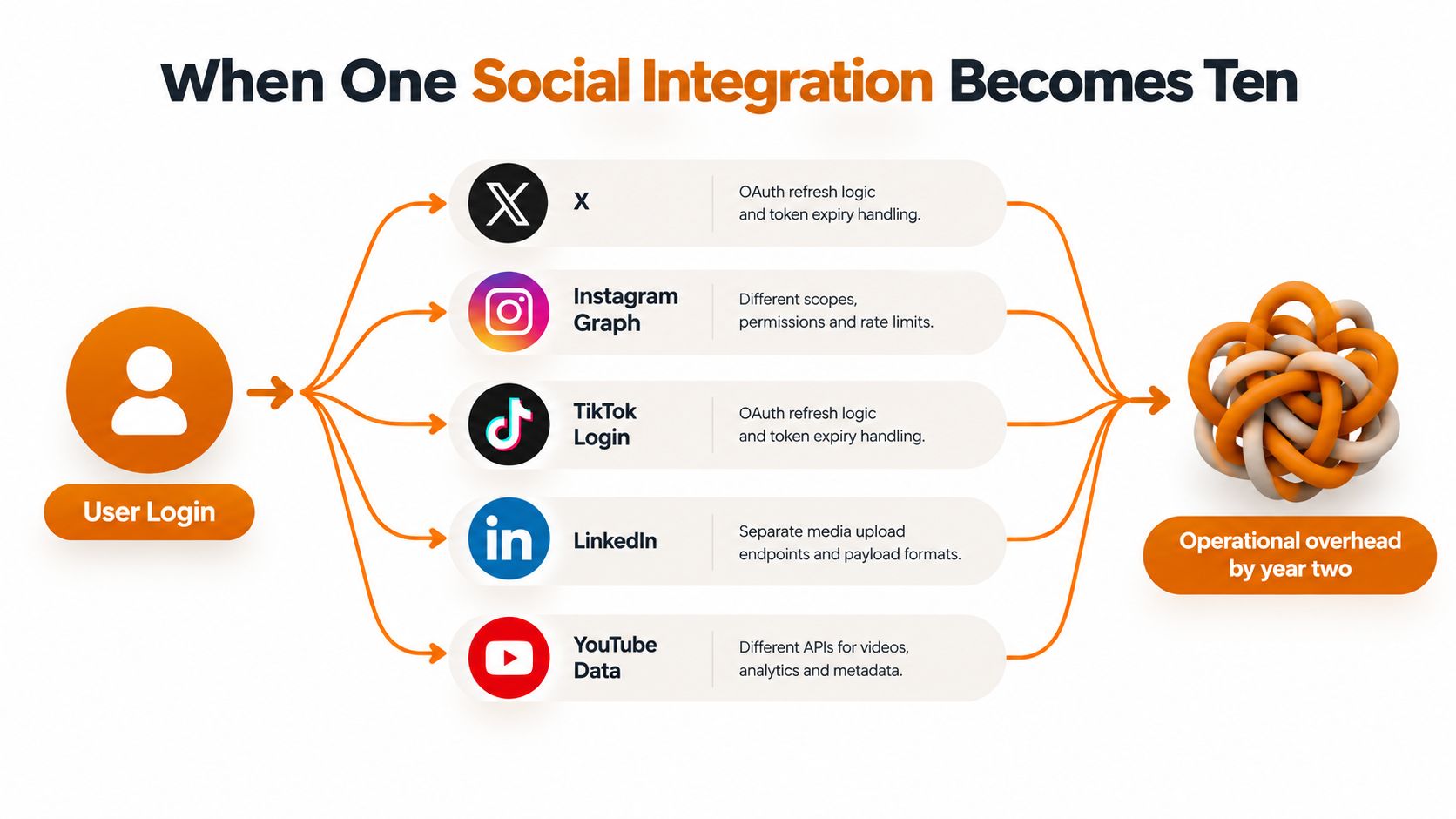
The repeated work is the real cost
Native integrations give engineers direct control, but every provider brings its own developer console, permissions, review process, token lifecycle, media semantics, and deprecation calendar. The work isn't limited to sending a post. Teams must also answer practical questions:
- Which credential applies: Is this request authorized with an app token, a user token, a page token, or a business-scoped credential?
- What does success mean: Did the platform accept the upload, publish the post, or only create an intermediate media object?
- What should be retried: Is a failure temporary, caused by an expired token, or a permanent validation error?
- How is the result stored: Can the product represent a post ID, a permalink, media status, and analytics object in one durable schema?
The aggregator emerges as a simplification layer for those recurring decisions. Your application sends a provider-neutral command, while the aggregator manages provider-specific authentication, request construction, response mapping, and delivery state. That doesn't eliminate platform change. It moves the first line of maintenance to a system designed to absorb it.
Practical rule: If the team only needs one network and a narrow endpoint, native integration may be sensible. If the product promises multi-network publishing or analytics, design the contract before adding the next provider.
What a Social Media API Aggregator Actually Does
A serious aggregator is a normalization contract, not merely a proxy. Your application supplies a platform-agnostic payload, and the service translates that payload into the target network's request model. It then returns a consistent response object while preserving enough provider detail for debugging and product decisions.
A typical request path looks like this:
- The client sends one command. The payload contains content, media references, target accounts, scheduling information, and an idempotency key.
- The gateway resolves the destination. It identifies the connected profile, provider, API version, required scopes, and applicable quota bucket.
- The service applies credentials. Stored OAuth material is selected, refreshed when necessary, and kept away from ordinary application code.
- The provider adapter builds the call. It handles upload sequencing, field names, media rules, pagination, and provider-specific headers.
- The response is normalized. The application receives a stable object with status, provider identifiers, timestamps, errors, and any available metrics.
- The operation is observed. Logs, webhook events, retry state, and raw responses make the result traceable.
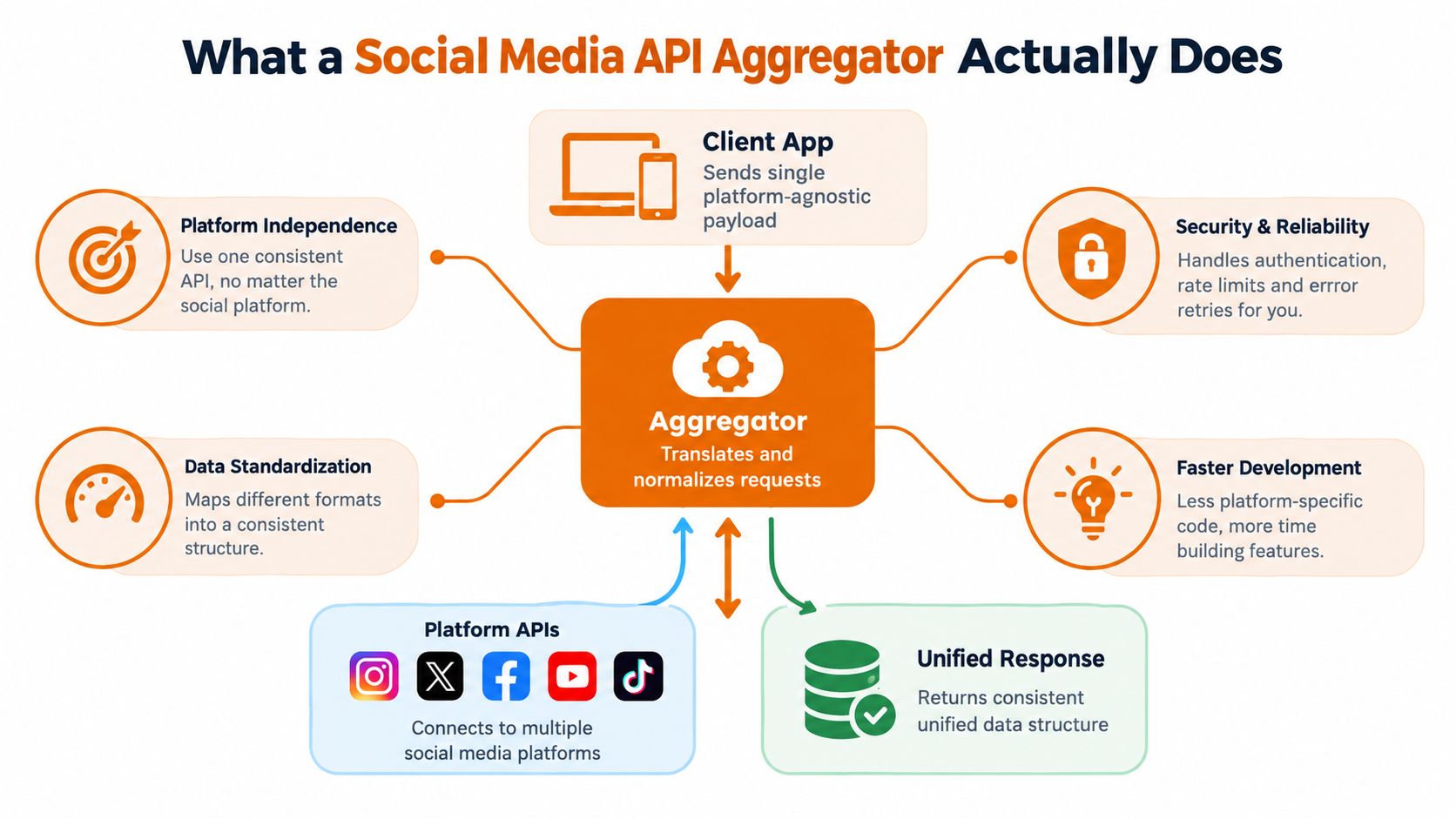
The contract must be opinionated
Publishing is the obvious use case, but the same layer can cover analytics retrieval, comment moderation, audience synchronization, and webhook delivery. The important design choice is deciding which fields are portable. A universal engagement_count can be useful, but it shouldn't pretend that every network measures engagement in the same way.
A durable response usually needs both normalized and provider-specific data:
- Stable fields: internal job ID, destination, state, created time, published time, and canonical permalink.
- Capability fields: media status, comment support, analytics availability, and supported content formats.
- Provider detail: raw response, provider error code, request identifier, and original object ID.
Teams evaluating the shape of this contract can review resources such as the NotFair integrations page alongside the practical architecture discussed in this multi-platform social API guide. The point isn't to copy a schema. It's to test whether an abstraction exposes meaningful differences instead of hiding them until production.
A loose wrapper doesn't solve much. If callers still need to know which network requires a separate upload, which response field is nullable, or which error code means “refresh the token,” the complexity has just moved sideways. Version the contract, document capability gaps, and make unsupported operations fail clearly.
Aggregator vs Native Integrations
The choice isn't between easy and hard. It's between owning platform complexity directly and paying another layer to own part of it. Native integrations offer the deepest control and the fastest access to newly released endpoints. They also leave your team responsible for every token transition, quota window, provider migration, and operational edge case.
An aggregator compresses that work into one integration surface. In exchange, you accept a recurring vendor relationship, possible latency from an additional hop, the vendor's release cadence, and the risk that its normalized model lags behind a platform's newest capability. The right decision depends on whether your product differentiates through social infrastructure or through the workflow built on top of it.
Trade-offs at a glance
| Dimension | Native Integration | Aggregator |
|---|---|---|
| Engineering hours | Higher initial and ongoing ownership per provider | Lower repeated plumbing, with integration work concentrated in one contract |
| Release cadence | Immediate access to supported native endpoints | Depends on vendor adapter and release process |
| Analytics fidelity | Full access to provider fields and nuances | Consistent fields, but some metrics may be simplified or unavailable |
| Compliance coverage | Your team must assess storage, scopes, audits, and deletion behavior | Vendor controls can reduce work, but your team still needs due diligence |
| Debugging | Direct provider requests and raw responses | Requires raw-response access, provider IDs, and transparent error mapping |
| Failure handling | You design queues, retries, backoff, and reconciliation | Vendor may provide these, but you must understand their guarantees |
| Vendor dependency | Lower platform abstraction dependency | Higher dependency on vendor uptime, pricing, and roadmap |
Where native wins
Build directly when you need a provider feature the aggregator doesn't expose, when analytics fidelity is central to the product, or when regulatory requirements demand complete control over token storage and data movement. Native code also makes sense for a narrow internal tool with a small number of destinations. The team can keep the surface area constrained rather than creating a broad abstraction that it can't maintain.
Where an aggregator wins
Buy the contract layer when your roadmap includes many networks, customer-managed connections, scheduled publishing, or cross-platform reporting. The value isn't just fewer SDKs. It's fewer places where an expired token, duplicate submission, quota collision, or provider-specific upload state can wake up the on-call engineer.
The strongest architecture is often hybrid. Keep a thin escape hatch for raw provider operations, but route common actions through the normalized contract. That preserves control without forcing every product feature to understand every network.
The Four Operational Pillars Behind Every Aggregator
The aggregator earns its place in a production stack through operational behavior. A unified endpoint without reliable token handling, quota accounting, duplicate protection, and failure recovery is only a cleaner way to reach unreliable systems.
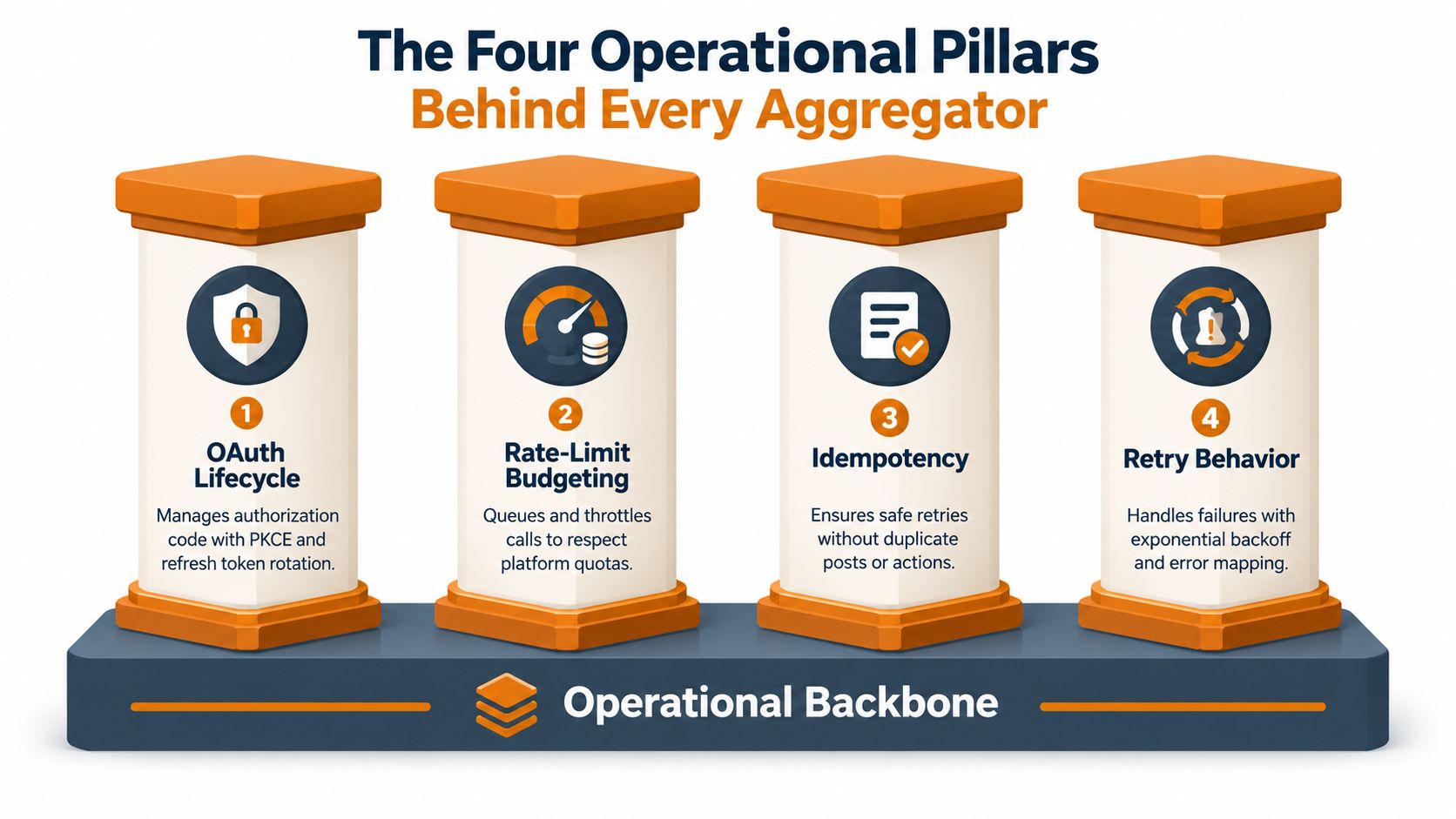
OAuth lifecycle
Authorization code with PKCE should end with a durable connection record, not a token copied into an application table and forgotten. The service needs to track access-token expiry, refresh-token rotation, granted scopes, provider account identity, and revocation state. Granular scopes matter because publishing, reading analytics, and moderating comments may require different permissions.
Centralized storage also gives the system one place to handle refresh races. If several workers discover an expiring token simultaneously, they shouldn't all rotate it independently. Use a lock or compare-and-swap strategy, persist the newest credential atomically, and record the provider response without exposing secrets in logs.
Rate-limit budgeting
A useful aggregator maintains a quota ledger per provider, account, token, endpoint, and application where those dimensions apply. Token buckets work well for smooth throughput. Sliding windows are useful when the provider enforces a fixed recent-history window. Either way, callers need a meaningful response when capacity is unavailable, such as a queued state, retry-after value, or explicit budget error.
Don't hide quota consumption behind an opaque “try again” response. Return enough metadata for the product to distinguish throttling from validation failure. A scheduler can then prioritize urgent publishing, defer analytics pulls, and prevent background work from consuming capacity needed for user actions.
Idempotency
A client-supplied idempotency key should represent the intended operation, not each network attempt. The aggregator stores the key, request fingerprint, and final or in-progress result. If a browser double-clicks or a worker retries after a timeout, the same key returns the existing operation rather than creating another post.
This is especially important when the provider accepted a request but your service lost the response. You can't safely assume that a timeout means failure. A durable job record, provider correlation data, and reconciliation process make the outcome recoverable.
Retry behavior
Naive tight loops turn temporary throttling into a larger outage. Exponential backoff with jitter spreads retries across workers and gives the provider time to recover. Retry transient server failures and explicit throttling responses when the operation is safe to repeat. Refresh credentials for authentication failures when the provider indicates that the token is stale. Fail fast on malformed media, missing permissions, unsupported content, and other permanent errors.
The aggregator should map provider errors into actionable categories while retaining the original code and message. A product can show “reconnect your account” for an authorization failure, “queued for later” for quota exhaustion, and “edit this media” for validation failure. That is more useful than returning a generic 500 and asking every client team to decode provider behavior independently.
Why Modern Rate Limits Made Aggregators Necessary
A publishing feature can be correct in isolation and still fail under shared quota pressure. Facebook documents rate limiting as a platform control, including a calls-within-one-hour formula of 200 multiplied by the number of users. Usage appears through response headers and the App Dashboard, as described in this social API rate-limit reference. Meta business-use-case limits can also create separate buckets for Pages, Instagram, or Threads, with formulas based on engaged users or impressions.
The 2026 examples show why an aggregator needs to act as a contract layer. X can enforce a user posting ceiling of 100 posts per 15 minutes and an app ceiling of 10,000 posts per 24 hours. Instagram publishing is commonly handled in developer practice as 25 media publishes per rolling 24 hours. TikTok's Content Posting API has been reported at 6 requests per minute per user token and roughly 15 to 25 videos per day per account. The platform figures and caveats are summarized in current social API quota examples.
| Platform | Endpoint | Quota | Window | Reset behavior |
|---|---|---|---|---|
| X | User posting | 100 posts | 15 minutes | Rolling platform window |
| X | App posting | 10,000 posts | 24 hours | Daily application window |
| Media publishing | 25 publishes | Rolling 24 hours | Rolling account or app behavior | |
| TikTok | Content Posting API | 6 requests per minute per user token | 1 minute | Short request window |
| TikTok | Video publishing | 15 to 25 videos per account | Daily | Daily account behavior |
| YouTube | Uploads | 100 uploads | Daily | Daily bucket |
| YouTube | Prior shared quota model | 1,600 units per upload from a 10,000-unit pool | Daily | Shared pool model |
YouTube's June 2026 update changes the implementation boundary. Uploads moved into a separate 100 uploads per day bucket, while the earlier model charged about 1,600 quota units per upload from a shared 10,000-unit daily pool, according to the quota reference above. The aggregator therefore needs a versioned policy engine. Product commands can remain stable while provider quota rules change.
Quota math becomes scheduling infrastructure
One worker pool may serve publishing, comment replies, and analytics. A burst of analytics requests can consume capacity reserved for a time-sensitive post. Per-user ceilings layered on per-app ceilings make one global counter inadequate. Separate ledgers, queues, priorities, and reset calculations are required.
A spreadsheet records limits, but it cannot coordinate concurrent workers or reserve capacity. The aggregator turns those rules into infrastructure through an explanation of how API rate limits shape scheduling architecture. It can throttle before rejection, expose remaining budget, and apply revised policies when a platform changes its rules. The operational headache does not disappear, but the quota contract becomes consistent across networks.
How to Choose the Right Aggregator for Your Stack
Start with the operations your product must support, then score vendors against those operations. “Supports Instagram” isn't enough. Ask whether the service supports the exact media types, account classes, publishing actions, insights, comments, and webhook events your users need.
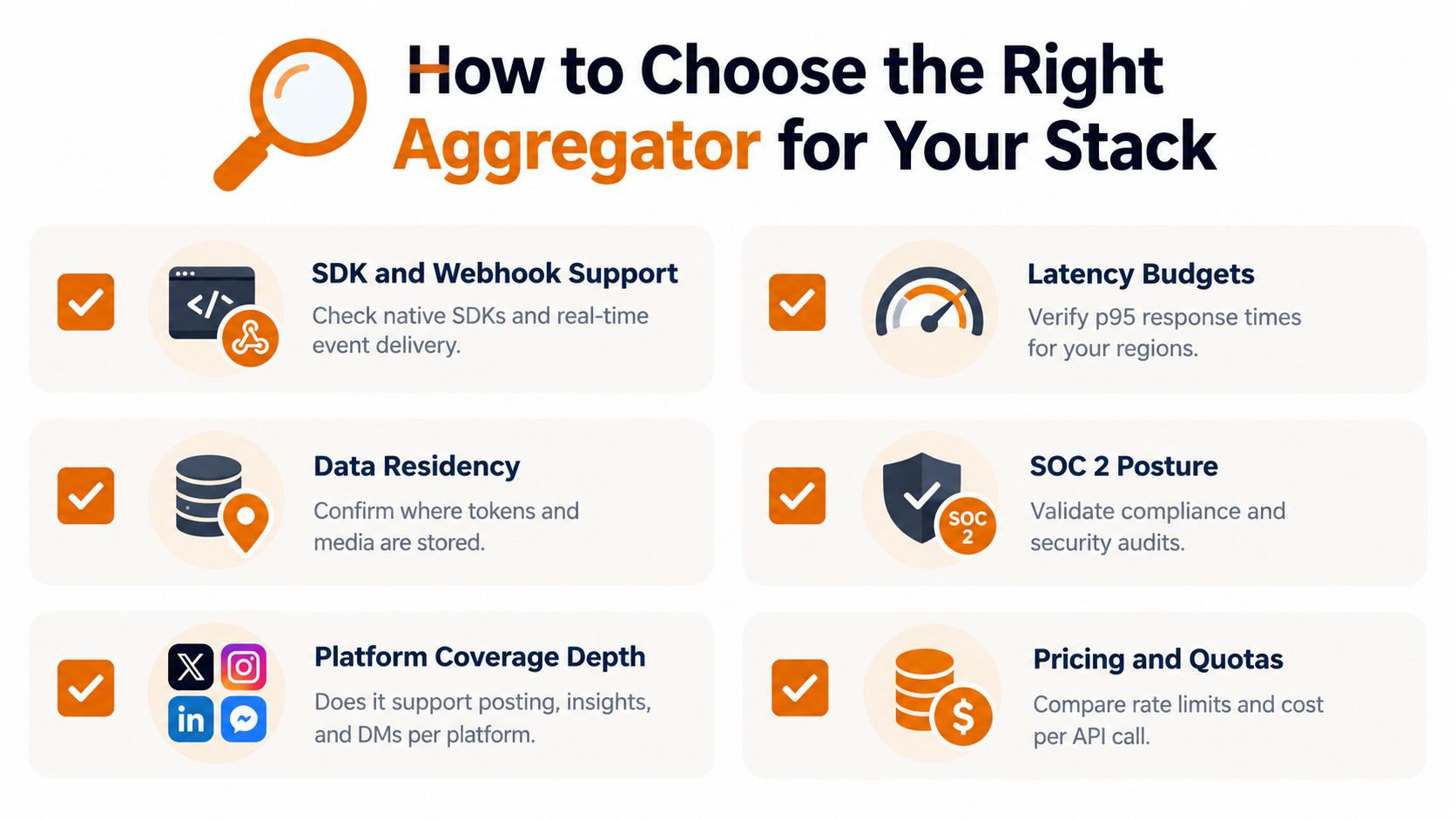
A practical evaluation rubric
- SDK and webhook support: Check whether the SDKs match your language stack and whether webhooks deliver publish completion, token changes, comments, and failures with durable event IDs.
- Latency budgets: Ask for regional behavior, queue semantics, and percentile latency definitions. A synchronous request may be fine for metadata but unsuitable for media processing.
- Data residency: Confirm where access tokens, media, logs, backups, and raw provider responses are stored. Token deletion and account disconnect flows should be documented.
- Security posture: Review independent audits, access controls, encryption practices, incident procedures, and subprocessor disclosures. A certification label alone doesn't explain the operational boundary.
- Platform coverage depth: Test real workflows, including Instagram Reels, LinkedIn organization posts, YouTube uploads, TikTok video publishing, comment replies, and analytics. Many products support reading but not writing, or basic posts but not media workflows.
- Error normalization: Look for stable error categories, provider codes, retry guidance, and raw-response access. A vendor that only returns “provider error” will slow incident diagnosis.
- Pricing model: Compare cost per active connected account, API call, published operation, stored media object, and webhook event. A low entry price can become expensive when background polling and analytics increase.
- Deprecation handling: Request the policy for provider API changes, migration windows, version pinning, and customer notifications.
A vendor aggregator usually minimizes maintenance but creates dependency on its uptime and roadmap. An open-source wrapper gives you source control, yet your team still owns credentials, tests, quota changes, and provider reviews. In-house development offers maximum control and maximum responsibility.
Three red flags should stop a procurement process. The first is vague SLA language that excludes the operations you depend on. The second is no documented deprecation policy. The third is an inability to expose raw provider responses, request identifiers, or delivery history when a normalized result looks wrong.
Implementation Patterns That Actually Scale
Put credentials behind one secrets vault and expose them to workers through narrowly scoped service interfaces. Store connection metadata separately from encrypted token material, and make revocation an explicit state transition that downstream jobs can observe.
Queue writes instead of sending them directly from request handlers. Use per-platform workers so one provider's throttle doesn't stall every destination. Add circuit breakers around outbound calls, and keep webhook receivers isolated by network so a malformed event or provider outage doesn't block unrelated delivery paths.
The aggregator should be the source of truth for feature flags and capability checks. Version normalized schemas, preserve raw responses for diagnosis, and run reconciliation jobs that compare expected publish and analytics state with provider state. When a platform throttles below an acceptable level, define degradation behavior in advance. Delay low-priority analytics, keep user-initiated publishing visible, and communicate partial success rather than pretending a multi-destination operation is atomic.
For bulk workflows, the same principles apply to bulk social media posting architecture. Treat each destination as an independently observable job, not as one request that either “worked” or “failed.”
Mallary.ai provides a unified API and dashboard for publishing, engagement, analytics, OAuth handling, rate limits, token refresh, idempotency, retries, and queued jobs across supported social networks. If you're evaluating a contract layer for embedded social features, visit Mallary.ai to review the API and integration options.


