September 23, 2026
Attribution Modeling Explained for Smarter Marketing
STOP!
Want ChatGPT or Claude to post on social media for you?
Connect your social accounts one time. Then tell your AI what to write. It can make your posts, share them, and reply on social sites that allow replies. You do not need to write code.
Pick your AI





Connect once. Ask in plain English. Mallary does the work.
You can feel a conversion chain getting messy long before the dashboard tells you so. Someone sees a LinkedIn post, searches the brand later, reads a comparison page, gets a nurture email, then comes back directly two days later and converts. If last click gets all the credit, the final visit looks heroic and everything upstream looks optional, even when those earlier touches did the demand creation.
That's why attribution modeling matters. It helps teams assign credit in a way that's more useful than “whatever happened last,” so budget, content, and product decisions don't get pulled toward the loudest channel in the room. A practical way to think about it is to pair attribution with outcome reporting, like the kind of content-performance thinking described in Mallary's metric guide, then ask what moved people forward.
Table of Contents
- Why Attribution Modeling Matters More Than Ever
- How Attribution Modeling Actually Works
- Comparing Common Attribution Models and When to Use Each
- Measurement Pitfalls That Distort Your Attribution Results
- Implementing Attribution With the Right Data and Instrumentation
- How to Choose and Adopt the Right Attribution Approach
- Putting Attribution Modeling Into Practice
Why Attribution Modeling Matters More Than Ever
A common pattern looks like this. Marketing runs a paid social campaign, SEO brings in a comparison article, email keeps the prospect warm, and the final click comes from branded search. If the team only rewards the last visit, paid social and SEO look like background noise, even though they helped shape the conversion path.
That distortion changes behavior. Media buyers keep funding channels that close instead of channels that create demand, content teams get judged on the wrong pages, and product teams lose sight of which messages helped people understand the offer. Attribution modeling exists to spread credit in a way that better reflects how buyers move.
What attribution can answer
It can help teams compare channels, campaigns, landing pages, and touch sequences. It can also show whether a path is mostly top-of-funnel discovery, middle-of-funnel evaluation, or final-stage conversion.
What it cannot do, by itself, is prove causality. A conversion path is evidence, but it isn't automatically proof that a touchpoint caused the result. That's why mature teams use attribution as a decision aid, not as a courtroom verdict.
Practical rule: If a model changes your budget, it should also face a reality check from experiments or backend conversion data.
The pressure to do this well is increasing because customer journeys are less linear and less visible than they used to be. People jump across devices, save links for later, ask peers in private channels, and come back through direct traffic that hides the original influence. Once that happens, the old habit of crediting the final click starts to break down.
How Attribution Modeling Actually Works
Think of a conversion like a goal in soccer. One player scores, but several teammates may have carried the ball, opened space, or created the final pass. Attribution modeling tries to decide how much credit each touchpoint should receive for the result, not by guessing who looks most impressive, but by applying a rule or algorithm to the path.
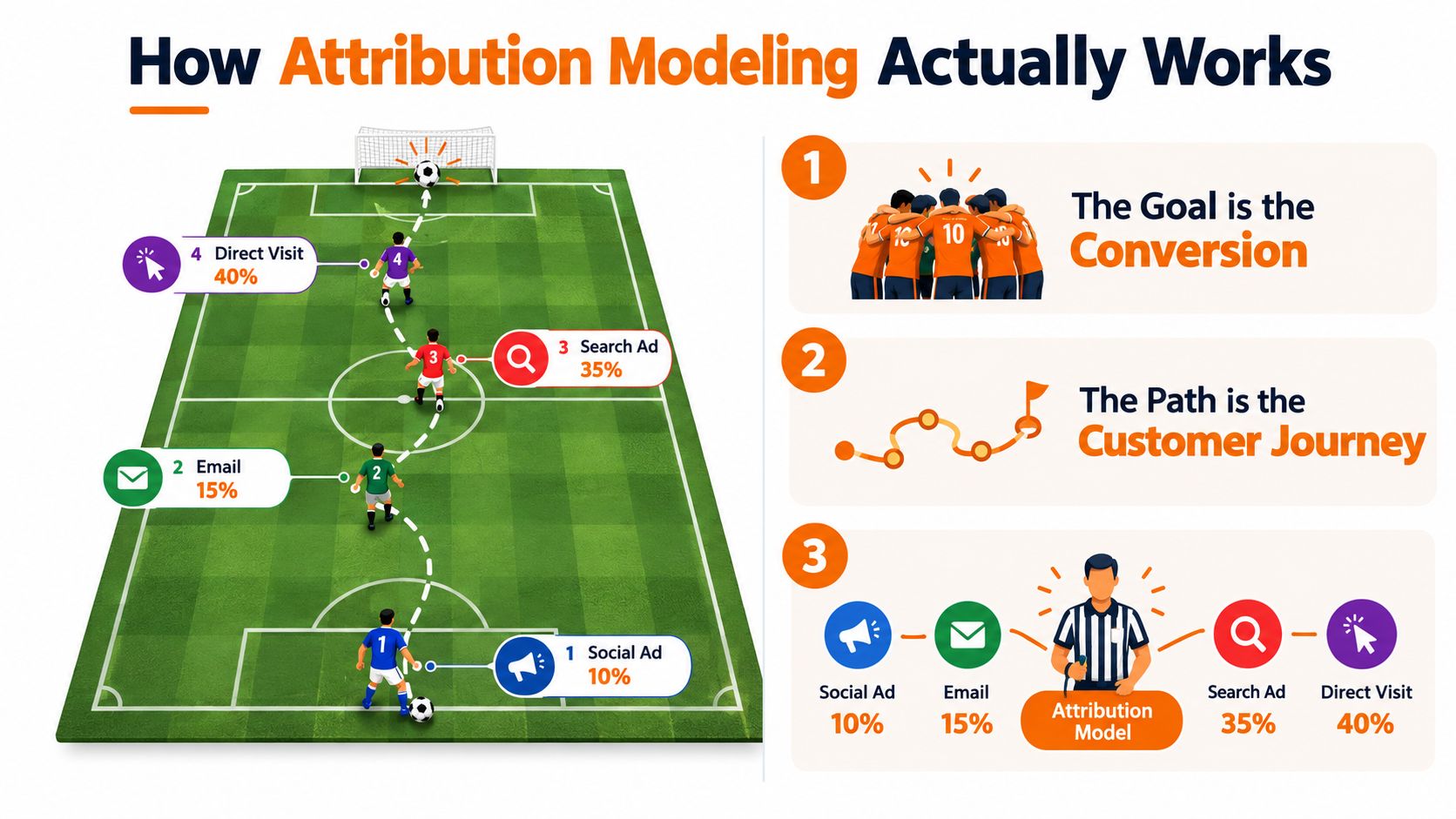
A path starts with touchpoints, which are the interactions a person has with your brand before converting. Those can be ads, emails, search visits, product pages, or direct visits. A model reads that path and decides how to divide the credit.
The basic mechanics
Single-touch models give all the credit to one moment. First-touch says the opener deserves the full score. Last-touch says the closing move gets everything. Multi-touch models split credit across several interactions, either evenly, by position, or through data-driven rules that look at real conversion paths.
That history matters because the field has moved from broad statistical estimation to more granular credit assignment. Marketing mix modeling traces back to the 1950s and became widely adopted in the 1980s as a top-down way to estimate each channel's contribution to sales. As digital marketing expanded, last-click became common in the early 2000s because it was simple and often the default in tools like Google Analytics by that period. Around 2010 to 2012, data-driven attribution began to appear, using methods such as Markov chains, logistic regression, and Shapley values to assign credit from actual conversion-path data rather than fixed rules. The historical overview from Statsig captures that evolution clearly.
If you want a second explanation of the same mechanics from a product perspective, Refport's guide on how attribution works in Refport is a useful companion.
The key idea is simple. The same journey can produce different answers depending on the model, because each model is asking a slightly different question about influence.
The part teams miss
Attribution isn't just bookkeeping. It sits inside a causal question, which means the core issue is not “what touched the buyer?” but “what would have happened if that touchpoint hadn't been there?” That counterfactual mindset is what separates useful measurement from pretty path counting.
Comparing Common Attribution Models and When to Use Each
No single model is right for every team. A startup with one main acquisition channel doesn't need the same structure as a company running paid social, search, email, creator partnerships, and offline events at once. The best model is the one that matches the question you're asking.
Model choice should follow the decision, not the dashboard.
The most dangerous mistake is using one attribution lens for every job. A model that's good at showing the first point of contact may be terrible at showing what closes revenue. A model that smooths credit across the path may be useful for planning but misleading for payout decisions.
Attribution Model Comparison at a Glance
| Model | Credit Logic | Strengths | Weaknesses | Best For |
|---|---|---|---|---|
| First-touch | Gives all credit to the first interaction | Good for discovery and awareness analysis | Ignores everything after the first visit | Top-of-funnel content, early-stage acquisition |
| Last-touch | Gives all credit to the final interaction | Simple and easy to explain | Over-credits closing channels and hides assist effects | Short sales cycles, direct response decisions |
| Linear | Splits credit evenly across all touches | Fairer than single-touch in multi-step journeys | Treats weak and strong touches the same | Basic multi-channel reporting |
| Time-decay | Gives more credit to touches closer to conversion | Useful when recency matters | Can under-credit early demand creation | Nurture-heavy journeys |
| Position-based | Gives extra credit to first and last touches | Highlights entry and conversion moments | Assumes those positions matter most in every journey | Funnels with clear start and finish points |
| Data-driven or algorithmic | Uses path data and statistical rules to assign credit | More responsive to real behavior | Harder to explain and validate | Complex journeys, larger data sets, multi-device behavior |
Singular reported that, across trillions of ad impressions and clicks, Meta showed up to 50% higher ROAS under multi-touch attribution than under last-touch attribution, which shows how much rankings can move when the credit rule changes. That analysis is a good reminder that the model is not a neutral wrapper. It can flip winners and losers.
For teams deciding which model fits their use case, the affiliate-focused guide on which attribution model works best is a practical cross-check, especially when revenue paths are short and channel ownership matters.
How to think about the trade-off
- First-touch: Use it when you care about acquisition discovery.
- Last-touch: Use it when you need a fast, simple operational signal.
- Linear or position-based: Use them when you want a middle ground that feels easier to explain to stakeholders.
- Data-driven: Use it when you have enough clean path data to support more advanced credit assignment.
The right question is rarely “Which model is best?” It's “Which model is least likely to distort the decision I'm about to make?”
Measurement Pitfalls That Distort Your Attribution Results
A customer sees a community recommendation, asks an AI assistant for options, clicks a retargeting ad, and then searches your brand before converting. A tracking system may record only the final search and ad click. Attribution modeling can still produce a neat answer, but missing or biased path data makes that answer unreliable.
Why last-click bias keeps happening
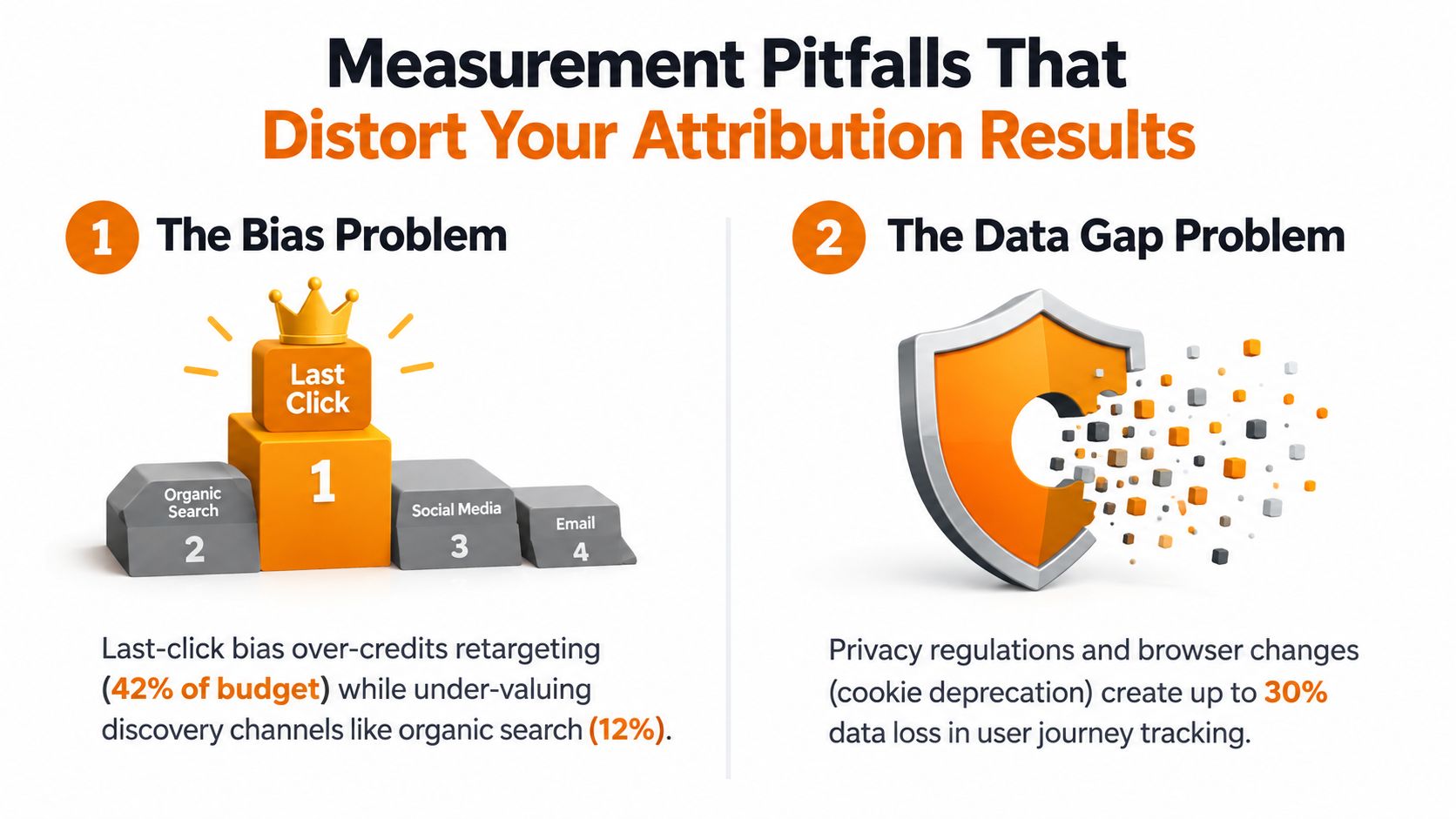
Last-click models reward the final visible interaction. Retargeting, branded search, and direct traffic can therefore appear stronger than the channels that created demand earlier. The causal framework behind attribution makes the distinction clear: analysts need to estimate the effect of an advertising intervention on conversion, not merely count observed engagement. The causal framework paper frames attribution as a counterfactual question: what would have happened without that intervention?
A recorded click proves that an interaction occurred. It does not prove that the interaction caused the sale. Treating every observed path as evidence of influence turns correlation into a budget decision.
Why the data itself is incomplete
Customer journeys cross devices, platforms, consent states, and offline conversations. Privacy changes can remove identifiers, platform silos can split one journey into several records, and sales teams may close opportunities after interactions that never enter the marketing dataset. These gaps limit what any path-based model can observe.
An internal view of cross-platform measurement helps teams compare reporting across social, search, email, and owned media. Mallary's cross-platform analytics guide provides relevant context for examining those reporting differences.
The newest blind spot
The dark funnel extends beyond cookies and device stitching. It includes influence from AI answers, community discussions, podcasts, and private recommendations that may shape demand without generating a trackable click. Agency Analytics reports that 48% of marketers identify tracking AI-driven discovery through ChatGPT or AI Overviews as their toughest attribution challenge. Its benchmark also places the dark-funnel gap at an average of 38% of B2B pipeline, reaching 51% in product-led motions. That 2026 benchmark shows why this is a structural measurement problem.
Classic multi-touch is therefore becoming incomplete, not merely noisier. If an influence never creates a measurable event, the model cannot assign it credit with confidence. Teams should treat model output as evidence for a causal investigation, then test whether changing exposure changes outcomes.
Implementing Attribution With the Right Data and Instrumentation
A campaign can generate clicks in an ad platform, sessions in analytics, and revenue in the CRM, yet still appear as three unrelated stories. Attribution works only when those systems share a reliable account of the same customer journey. Treat tracking as infrastructure, not a one-time analytics setup.
Build the input layer first
Start with the systems closest to each event. Ad platforms record exposure and clicks, web and app analytics capture behavior, CRM and OMS systems show backend outcomes, and server-side events can preserve signals that browser tracking misses. The aim is consistent coverage, not indiscriminate collection. A purchase should have a recognizable definition wherever it appears.
Set the foundations before choosing a model:
- Unified event names: Use one taxonomy for signups, demos, purchases, and qualified leads.
- Identity resolution: Connect a user, account, or order across sessions when the business context permits it.
- UTM discipline: Apply consistent campaign tags so source and medium do not split into near-duplicate variants.
- Timestamp alignment: Put events on comparable clocks so their sequence reflects the customer path.
- Webhook reliability: Queue late or out-of-order publishing and conversion events, then deduplicate them before modeling.
A simpler model fed by dependable events is more useful than a complex model built on inconsistent records.
Check for mismatch before you trust the dashboard
Before modeling, run a reconciliation audit. Export a recent period of platform conversions beside CRM or OMS outcomes, match records by order, account, or event ID, and classify every difference. Flag duplicates, view-through-only events, delayed webhooks, missing consent signals, and cases where cross-device stitching breaks the path. The purpose is to create a documented map of what each system can and cannot observe.
A 2026 benchmark reports a median 22% reconciliation gap between platform-reported and backend conversions. Braze's benchmark provides context for why source systems may disagree. Use the finding as a prompt to test your own definitions, not as a substitute for that audit.
For teams connecting social publishing with campaign automation, Mallary's custom report builder can help shape these signals into decision-ready reports. The reporting layer should preserve source definitions, reconciliation status, and known blind spots rather than hide them behind one total.
If the CRM, ad platform, and analytics tool tell different stories, reconcile definitions before debating attribution logic.
Attribution becomes useful when the measurement stack makes uncertainty visible. That record gives analysts a sounder basis for investigating causal impact, including influence that never becomes a trackable click.
How to Choose and Adopt the Right Attribution Approach
The right stack depends on the question. If you're trying to understand which channel opened the door, a simple model may be enough. If you're trying to allocate spend across a long, multi-channel system, you'll probably need more than one lens.
The current market is already moving in that direction. A 2021 benchmark found 81% of marketing organizations either used multi-touch attribution or planned to, while 31% of media budget among MTA users was being measured by MTA, and the ROI of MTA solutions was reported at 7%. More recent 2026 research found MTA adoption at 47% in 2026, up from 31% in 2023, while marketing mix modeling rose to 26% from 9% over the same period. The MMA benchmark shows the market is broadening its measurement mix, not replacing one tool with another.
A practical selection framework
Use single-touch when the business question is narrow and the sales path is short. Use multi-touch when you need to understand assist behavior inside digital journeys. Use marketing mix modeling when offline activity, broad media, or channel saturation make user-level paths incomplete. Use incrementality testing when you need to know whether a touchpoint caused lift, not just whether it appeared in the journey.
For many teams, the strongest setup is hybrid. MTA helps with channel and campaign reads, MMM helps with broader allocation, and tests help validate whether the claimed effect is real. That triad is especially useful when the channel mix includes commerce media, CTV, gaming, or creator-driven discovery that doesn't fit neatly into one path.
The embedded video below is a useful mental reset if your team needs to explain this to non-specialists.
Adoption checklist
- Define the decision first: Budget allocation, content planning, product messaging, or revenue forecasting all need different lenses.
- Map the error tolerance: Some decisions can survive approximation, others can't.
- Start with one reliable source of truth: Usually backend conversions, not platform claims.
- Add complexity only when the journey justifies it: More channels, longer cycles, and more offline influence increase the need for triangulation.
- Agree on governance: Marketing, product, finance, and analytics need the same definitions before the model goes live.
The most mature teams don't ask for a perfect model. They ask for the least misleading one they can trust, then compare it against other measurement methods when the stakes rise.
Putting Attribution Modeling Into Practice
Attribution becomes useful when teams treat it as a diagnostic system rather than a permanent channel ranking. Start with a recent decision, such as reallocating campaign budget or improving product messaging. Trace which evidence supports that decision, where the journey is incomplete, and which inputs deserve confidence.
Reconcile platform reports with backend conversions, then review the event taxonomy. Choose one decision to inform this month and document the assumptions behind it. Compare the result with another method, such as a holdout test or a broader media model, before changing spend. Agreement is reassuring, but disagreement can reveal tracking gaps or a causal assumption that needs testing.
The hardest missing touches may never create a click. As noted earlier, nearly half of marketers now rank AI-driven discovery as a top attribution challenge. Classic multi-touch models can therefore miss community discussions, AI-generated recommendations, and private conversations that influence demand before someone reaches a measurable page.
Audit one recently won deal for untracked AI or community touches. Add a qualitative “how did you hear about us?” field to complement click-path data, and review the answers alongside conversion records. This will not turn dark-funnel activity into precise channel credit, but it gives the team evidence that a last-click or multi-touch report cannot capture alone.
If your stack assumes every valuable interaction leaves a clean trail, revisit that assumption before adding model complexity. Mallary.ai helps teams publish, measure, and automate across channels from one system, supporting cleaner campaign and conversion data for attribution work. Visit Mallary.ai to explore a social automation layer for more disciplined measurement.


